Trae 2.0 SOLO Mode In-Depth Review: Full Workflow from Natural Language to Website Deployment

ByteDance launches Trae 2.0 with SOLO mode enabling end-to-end delivery from natural language to website deployment.
ByteDance released Trae 2.0 on July 21st, featuring SOLO Agent mode that lets users complete the entire workflow from requirements analysis and code generation to online deployment using only natural language. Technically, it introduces vector databases for RAG-based memory and self-repair capabilities. In testing, a complex information portal went from requirements input to Vercel deployment in under an hour. The product creates massive competitive pressure on AI Agents like Manus and Genspark, leaving vertical data specialization as the only survival path for smaller Agent companies.
ByteDance officially released Trae 2.0 on July 21st, with the most notable update being the launch of the SOLO Agent mode. This feature elevates Trae from an IDE coding tool to an intelligent collaboration partner with end-to-end delivery capabilities. Users with no coding experience can complete the entire workflow from website development to online deployment simply by describing their requirements in natural language. For previously hyped AI Agents like Manus and Genspark, this undoubtedly creates enormous competitive pressure.
Trae's Development History and the Strategic Significance of 2.0
The Trae project began around December 2024, with the overseas version launching on January 20, 2025, and the domestic (China) version releasing on March 30. Between March and May, Trae rapidly built a loyal user base thanks to its native Chinese language support and rich MCP tool integrations, often being compared to Cursor. MCP (Model Context Protocol) is an open standard protocol proposed by Anthropic in late 2024, designed to establish a unified communication interface between AI models and external tools and data sources. Before MCP, every AI application needed custom adapter code to connect to different tools (such as database queries, file operations, API calls, etc.), resulting in high development costs and ecosystem fragmentation. MCP defines standardized request-response formats, enabling AI Agents to invoke various external capabilities in a "plug-and-play" manner. Trae's early versions extensively integrated MCP tools, meaning users could conveniently connect third-party services like GitHub, databases, and design tools into their development environment, greatly expanding the Agent's capability boundaries. At the developer conference on July 21st, ByteDance announced that Trae's monthly active users had surpassed 1 million.
The 2.0 release marks a fundamental shift in Trae's positioning — upgrading from a "coding assistance tool" to an "intelligent delivery partner." The official slogan announced at the launch was "All you need is SOLO," with a very clear intent: one SOLO mode can replace the multiple Agent tools you previously needed.
Technical Architecture Upgrade: From Executor to Collaboration Partner
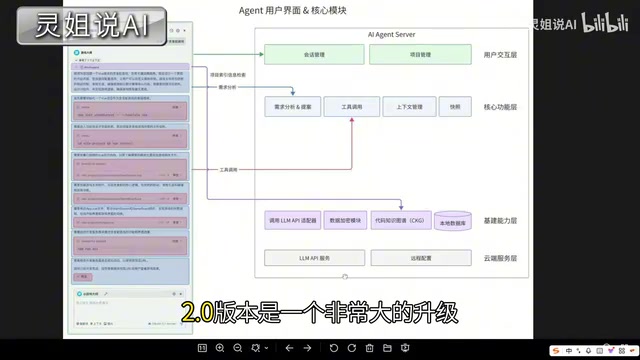
Historical Conversations and Context-Enhanced Retrieval
Trae 1.0's workflow was "receive instructions → analyze requirements → invoke tools → execute tasks," requiring users to provide very specific instructions. Version 2.0 adds historical conversation and context retrieval modules, introducing a vector database that converts users' code, conversation history, and documents into vectors for storage and retrieval.
A vector database is a database system specifically designed for storing and retrieving high-dimensional vectors, with representative products including Pinecone, Weaviate, and Milvus. Its core principle is converting unstructured data like text, code, and images into high-dimensional numerical vectors through Embedding models, then using Approximate Nearest Neighbor (ANN) algorithms to achieve semantic-level similarity search. Unlike traditional keyword search, vector retrieval can understand semantics — for example, searching for "travel products" can also match semantically related content like "scenic spot recommendation systems." Trae 2.0's introduction of vector databases into the Agent architecture essentially implements the RAG (Retrieval-Augmented Generation) paradigm: before generating responses or executing tasks, the Agent retrieves relevant context from vectorized conversation history and codebases, then injects this information into the large model's prompts, significantly improving output accuracy and contextual coherence.
This means the SOLO Agent possesses true "memory capabilities." It not only remembers what you've said before but can also analyze your deeper intentions based on conversation history. For instance, if you've mentioned "building a travel product" across multiple conversation turns, it will automatically incorporate this background information into subsequent task planning, making decision paths more intelligent and efficient.
Proactive Conversations and End-to-End Delivery
In version 1.0, users needed to constantly debug manually, accept protocols, handle environment configurations, and perform other tedious operations. The SOLO mode in 2.0 achieves true end-to-end integration — from requirements analysis, code generation, and error fixing to final website deployment, the entire process is proactively driven by the Agent with almost no user intervention needed.
At the user interaction level, SOLO mode combines the editor, terminal, browser, and documentation into a "four-in-one" complete closed-loop workflow. The Agent proactively writes requirements documents, plans functional modules, installs dependencies, fixes compilation errors, and even guides you through online deployment after development is complete.
Hands-On Test: Building an Information Portal with SOLO Mode
To truly test the upper limits of Trae 2.0's SOLO mode capabilities, I designed a high-difficulty test task: building a comprehensive information portal website about the Yarlung Tsangpo River hydropower stations. The challenge lies in the fact that it involves extensive specialized knowledge (hydrology, geography, engineering parameters, geopolitical analysis, etc.), complex content structures, and extremely high demands on the Agent's information organization and presentation abilities.
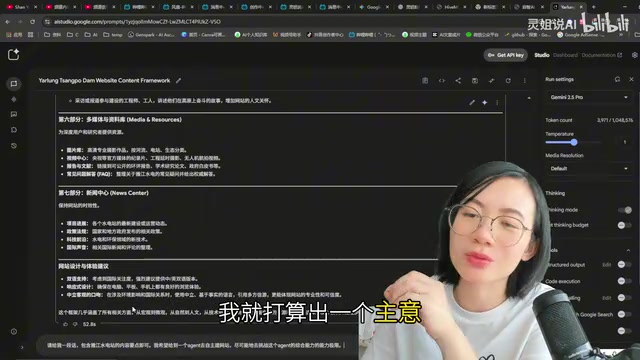
Requirements Input and Automatic Planning
I first used Google AI Studio to generate a richly detailed task description covering multiple sections including a hydropower station technical parameter database, multi-dimensional impact analysis, international geopolitical discussion, and engineering technology showcase. I then pasted this description directly into SOLO Builder's dialog box, adding: "Beyond the sections in the above instructions, you can add any sections you think should be included in this information portal."
SOLO Builder immediately began analyzing the requirements and automatically generated a detailed Markdown requirements document, including a product overview, user personas (general visitors and professional visitors), seven core modules (homepage, about the Yarlung Tsangpo River, hydropower station directory, impact and analysis, international geopolitics, technology and engineering, news center), and even used Mermaid diagrams to illustrate user browsing path flowcharts. Mermaid is a text-based diagramming tool that allows defining flowcharts, sequence diagrams, Gantt charts, and other visualizations using concise Markdown-like syntax. Unlike graphical tools like Visio, Mermaid diagram definitions are entirely plain text that can be embedded directly in Markdown documents and natively rendered by mainstream platforms like GitHub and Notion. This characteristic makes it an ideal choice for AI Agents generating visual documentation — the Agent only needs to output structured text descriptions to automatically generate professional flowcharts without invoking any graphics processing tools.
Fully Automated Development and Self-Repair Capabilities
After confirming the requirements document, SOLO Builder entered the fully automated development phase. The most impressive aspect throughout the entire process was its self-repair capability — when TypeScript compilation errors occurred (7 errors appeared during testing), the Agent automatically identified and fixed the problems without user intervention. Environment configuration, dependency installation, project scaffolding, and other steps that previously required manual handling were all completed autonomously by the Agent.
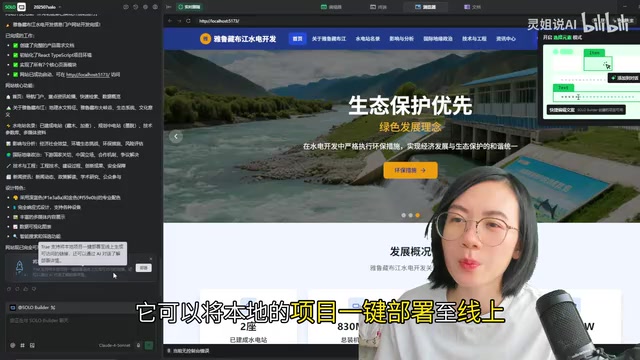
Deliverables and Vercel One-Click Deployment
The final generated website far exceeded expectations. The deep blue and gold color scheme conveyed the professional feel of an authoritative information portal; each section featured highly relevant images; the hydropower station directory included detailed technical parameters (installed capacity, dam type, etc.) for stations like Zangmu, Jiacha, and Medog; the impact analysis module presented a balanced view of social benefits and ecological challenges; and the international geopolitics section objectively described the impacts on India and Bangladesh.
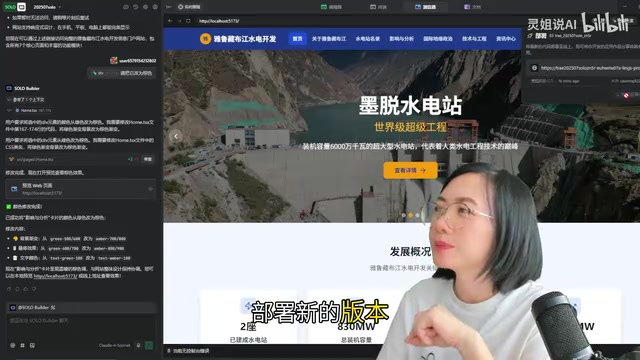
More critically, SOLO mode supports one-click deployment via Vercel. Vercel is a cloud deployment platform created by Next.js framework founder Guillermo Rauch, focused on hosting and automated deployment of frontend applications and full-stack JavaScript projects. Its core advantage lies in deep integration with Git repositories — developers simply push code to GitHub, and Vercel automatically triggers builds, deploys, and generates globally CDN-accelerated access links. Vercel also provides Serverless Functions capabilities, enabling frontend projects to handle backend logic without separately maintaining servers. For AI Agent-generated projects, Vercel's zero-configuration deployment feature is particularly important — the Agent doesn't need to understand complex server operations; it simply pushes code following standard procedures to complete deployment.
After clicking the deploy button, the Agent automatically completed the authorization and deployment process, generating a publicly accessible URL. The entire website supports responsive design, displaying properly on phones, tablets, and computers. From inputting requirements to deployment going live, the total time was under one hour, with actual communication time with the Agent being approximately ten minutes.
If you're unsatisfied with certain details, you can use the "select element" feature to click any element on the page and describe modification requirements in natural language. For example, I changed a green element to brown, and the Agent not only modified the specified element but also automatically adjusted related backgrounds and hover effects to maintain overall visual consistency.
Trae 2.0's Impact on the AI Agent Ecosystem and Industry Outlook
The release of Trae 2.0's SOLO mode has had a profound impact on the existing AI Agent ecosystem landscape.
The Competitive Dilemma Facing Genspark and Manus
Agents like Genspark essentially use frontend code to implement specific functions, while Trae 2.0 possesses more generalized capabilities and broader application scenarios. More importantly, SOLO mode currently uses the Claude 4 Sonnet model, with unlimited credits and usage during the beta phase. Claude 4 Sonnet is a large language model released by Anthropic in 2025, belonging to the mid-tier version of the Claude 4 series, with significant improvements over its predecessor in reasoning ability, code generation, and long-context handling. Anthropic's Claude series is known for its "Constitutional AI" training methodology, which improves safety and reliability by having the model self-evaluate and self-correct. The Sonnet version strikes a balance between performance and cost — it's not as powerful as the flagship Opus version, but offers faster inference speed and lower API calling costs, making it ideal for Agent scenarios requiring frequent interaction. Trae 2.0's choice of Claude 4 Sonnet as its underlying model reflects ByteDance's pragmatic strategy in model selection: Agent scenarios require models to maintain stable code generation quality across extended multi-turn conversations, rather than pursuing peak intelligence in single responses.
By comparison, Genspark's membership costs 70-80 yuan for only about 10,000 credits, which can be exhausted by creating just two complex PPTs — a stark difference in cost-effectiveness.
Manus finds itself in an even more awkward position — its core team is rumored to have relocated to Singapore, and the emergence of Trae 2.0 forces its investors to reassess the project's prospects.
Deep Vertical Specialization Is the Only Path for Small and Mid-Size Agent Companies
Analyzing from the AI competition "iron triangle" — computing power, algorithms, and data — small and mid-size Agent companies simply cannot compete with giants like ByteDance on computing power and algorithms (talent). This "iron triangle" framework is a widely recognized core competitiveness model in the industry. On the computing power front, the GPU cluster investment needed to train a frontier large model has skyrocketed from tens of millions of dollars in 2023 to hundreds of millions or even billions of dollars by 2025, with NVIDIA's H100/B200 GPUs in chronic short supply. ByteDance, leveraging the massive inference demand generated by its global businesses (TikTok, Douyin, etc.), has extremely strong bargaining power and scale advantages in GPU procurement — ranking first nationally and in the global top ten for computing power procurement volume. On the algorithm front, the competition for top AI research talent has entered an "arms race" phase, with Meta spending $200 million to recruit Apple's AI Chief Scientist Ruoming Pang being a typical example, and talent movement between OpenAI, Google DeepMind, and Meta FAIR often accompanied by astronomical compensation packages. This resource concentration effect means that competition in general-purpose AI Agents is essentially a game between tech giants, with small and mid-size companies having virtually no chance of direct confrontation.
The only breakthrough lies in data. Deep cultivation in vertical domains can accumulate unique user data and domain knowledge, forming competitive moats. For example, design-focused agents can accumulate extensive design philosophies and system prompts, delivering better results than general-purpose Agents in specific tracks. This is also why design-focused agents like LabArt have generated significant buzz.
2025 has been called the founding year of Agent entrepreneurship, but it's not an easy one. A single product release from a tech giant could spell the end for a particular agent. Choosing the right vertical track and rapidly accumulating domain data are the keys to survival for small and mid-size Agent companies.
Related articles
 Product Reviews
The Programmer's Desk Setup Guide: Building a Workspace That Feels Like Home
Discover how programmers build productive, comfortable workspaces. From multi-monitor setups to ergonomic design, explore the desk philosophy that drives focus and flow.
 Product Reviews
Qoder vs Cursor Real-World Comparison: Which $20/Month AI IDE Is Better?
Hands-on comparison of Qoder vs Cursor AI IDEs: Agent autonomy, human interaction count, and architecture decisions. Qoder needed only 2 interactions vs Cursor's 8.
 Product Reviews
Cursor Cloud Agent Demo: Eliminating Bottlenecks Across the Entire Software Development Lifecycle
Deep analysis of Cursor's Cloud Agent demo showing how cloud VMs, automated test artifacts, and a full-chain control plane systematically eliminate human bottlenecks across the software development lifecycle.