Trae Solo Mode in Action: Building a Complete Indie Product from Scratch in Two Hours

Trae Solo mode enables building and deploying a complete indie product via natural language in two hours.
This article showcases ByteDance's AI programming tool Trae and its Solo mode, demonstrating how a developer built a fully functional "Happy Calculator" product in just two hours through natural language conversation. The product features responsive layout, Chinese-English internationalization, and poster export capabilities. The article argues that AI programming tools are evolving from coding assistance to independent delivery, and that indie developers' core competitiveness will shift from coding ability to product insight.
The Efficiency Revolution of AI Programming Tools
While we're still debating whether AI can replace programmers, someone has already used an AI programming tool to develop and deploy a complete indie product in just two hours. The star of this story is Trae's Solo mode — an AI development tool that generates runnable projects directly through natural language conversation.
Trae is an AI-integrated development environment (IDE) launched by ByteDance, and its Solo mode represents a new paradigm known as "AI Agent programming." Unlike earlier code-completion tools such as GitHub Copilot, Agent-mode AI can autonomously plan tasks, invoke toolchains, and execute multi-step operations, forming a complete "perceive-plan-execute" loop. These tools typically leverage the code generation capabilities of large language models (LLMs), combined with file system operations, terminal command execution, browser preview, and other tool-calling abilities, upgrading AI from a "suggester" to an "executor." The evolution of AI programming tools has roughly gone through three stages: the first was "smart completion" represented by TabNine; the second was "context-aware code generation" represented by GitHub Copilot; and the third is "autonomous Agent development" represented by Cursor, Devin, and Trae Solo, where AI can understand high-level requirements, autonomously decompose tasks, and deliver end-to-end results.
One developer used Trae Solo to build a "Happy Calculator" — a product that's not only fully functional but also supports mobile responsiveness, Chinese-English internationalization, and even shareable poster exports. This case naturally raises the question: just how far can we push the productivity boundaries for indie developers?
The Finished Product: Small but Complete
This Happy Calculator is not a simple demo — it's an indie product with a complete user experience. Its core features include:
- A scientific multi-dimensional evaluation system: Quantitatively assesses users' happiness across multiple dimensions
- Clean interaction design: Users only need to make a series of simple choices to receive their happiness index
- Responsive layout: Adapts to both mobile and desktop screens
- Chinese-English internationalization: Reaching a broader user base
- Poster export: Users can generate an image of their results and share it directly on social platforms
It's worth noting that responsive design and internationalization (i18n) are both time-consuming systematic efforts in traditional development. Responsive design requires using CSS media queries, Flexbox, CSS Grid, and other techniques to make one codebase adapt to different screen sizes. Internationalization (abbreviated i18n because there are 18 letters between the first and last letters) involves text translation extraction, multilingual JSON file maintenance, dynamic interpolation handling, and many other steps — often the kind of thing indie developers "know they should do but find too tedious." The fact that AI tools can automatically handle both of these workflows is a significant demonstration of how they lower the technical barrier.
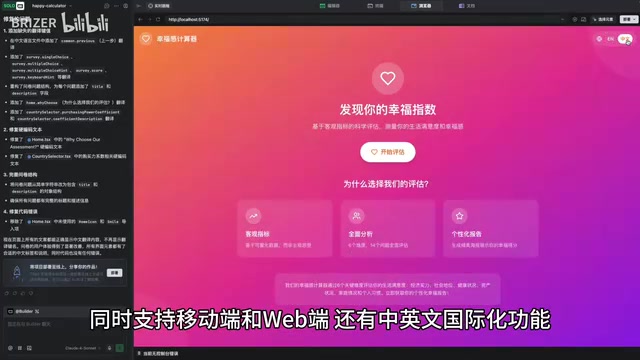
From a product completeness perspective, this has already reached a level where it could be launched and operated directly. For indie developers, the cost of validating a product idea has been dramatically reduced.

Development Workflow: From Requirements to Deployment
Step 1: Describe Requirements in Natural Language, AI Generates the Requirements Document
The entire development process starts with a brief requirements description. In Trae Solo mode, developers simply tell the AI what they want to build in natural language, and the system automatically generates a structured requirements document.

The key point here is that it took "several rounds of back-and-forth discussion" — AI doesn't perfectly understand requirements on the first try. Instead, it gradually refines and improves through multiple rounds of dialogue. This process is similar to communicating with a product manager, but far more efficient than the traditional approach.
Step 2: Requirements Finalized, Solo Mode Automatically Generates Complete Code
Once the requirements document was confirmed, Trae Solo mode moved directly into the development phase, automatically generating the complete project code — from the frontend interface to business logic, from internationalization configuration to responsive adaptation, all in one go.

Step 3: Fine-Tune Details, Deploy Quickly
AI-generated code isn't immediately perfect. The developer still needed a few rounds of fine-tuning — adjusting UI details, fixing edge cases, or optimizing the interaction experience. But the overall workload was minimal, and the entire process from start to deployment was completed within two hours.
What Trae Solo Mode Actually Changes
Dramatically Lowers the Technical Barrier for Indie Development
Traditional indie product development, even for a simple web application, requires developers to master frontend frameworks, state management, internationalization solutions, responsive design, and many other technical areas. Trae Solo mode encapsulates these technical details within AI capabilities, allowing developers to focus their energy on the product's core value.
Compresses Idea Validation Cycles to Hours
"One indie product a day" may be a slight exaggeration, but completing an MVP (Minimum Viable Product) in two hours has indeed become a reality. MVP is a core concept in the lean startup methodology, systematically articulated by Eric Ries in The Lean Startup — building a product version with minimal development cost that can validate core hypotheses, iterating quickly through real user feedback, and avoiding wasted resources on unvalidated directions. Traditional MVP development typically still requires days to weeks, while AI programming tools compress this cycle to hours, essentially turbocharging the "build" phase of the "build-measure-learn" loop. This means indie developers can fail fast, validate market demand at extremely low cost, and no longer need to invest weeks of development time on an uncertain idea.
Human-AI Collaboration Has Found a More Efficient Division of Labor
You may not have noticed, but in this case, the developer didn't completely hand everything off to AI. The multi-round discussions during the requirements phase and the fine-tuning after development both demonstrate the irreplaceable role of human product thinking and attention to detail. AI handles efficient execution while humans handle directional decisions — this is likely the most pragmatic collaboration model at the current stage. This division of labor also foreshadows a deeper transformation of the software engineer's role: evolving from "code writer" to "requirements definer and quality gatekeeper," where core competitiveness will increasingly depend on insight into user needs rather than proficiency with specific tech stacks.
Conclusion: AI Programming Is Moving from Coding Assistance to Independent Delivery
The project from this case study is open source (Happy Calculator), and interested developers can try it out and reference it.
From a broader perspective, what Trae Solo mode represents is the trend of AI programming tools evolving from "coding assistance" to "independent delivery." This evolutionary path closely aligns with AI's capability leap from "language understanding" to "task planning and execution" — when the time to develop a complete product shrinks from weeks to hours, an indie developer's core competitiveness will no longer be coding speed, but product insight and creativity.
For those who want to try indie development, now may be the best time to get started — the tools are ready, and all that's left is your idea.
Related articles
 Product Reviews
The Programmer's Desk Setup Guide: Building a Workspace That Feels Like Home
Discover how programmers build productive, comfortable workspaces. From multi-monitor setups to ergonomic design, explore the desk philosophy that drives focus and flow.
 Product Reviews
Qoder vs Cursor Real-World Comparison: Which $20/Month AI IDE Is Better?
Hands-on comparison of Qoder vs Cursor AI IDEs: Agent autonomy, human interaction count, and architecture decisions. Qoder needed only 2 interactions vs Cursor's 8.
 Product Reviews
Cursor Cloud Agent Demo: Eliminating Bottlenecks Across the Entire Software Development Lifecycle
Deep analysis of Cursor's Cloud Agent demo showing how cloud VMs, automated test artifacts, and a full-chain control plane systematically eliminate human bottlenecks across the software development lifecycle.