Trail: Precise Local Smart Home Control via Decision Models

Trail replaces open-ended command generation with hierarchical typed decisions, enabling reliable local small-model smart home control.
The article introduces Trail, a method that addresses the dilemma in natural language smart home control between cloud LLM privacy leakage and unreliable local SLM action generation. Trail converts open-ended command generation into constrained selection: the action space is split into room, device, and operation levels, with candidates drawn from a runtime device registry to eliminate invalid actions, while also supporting confidence-based abstention and structured memory. The team extended HomeBench into Trek-Base, Trek-Robust, and Trek-Memory. Trail achieves 85.3% robustness accuracy versus 69.8% for fine-tuned Qwen3.5-4B, and 75.6% on multi-turn memory versus 42.5% for the baseline. Limitations such as real-world deployment, registry maintenance, and multi-user conflicts remain to be validated.
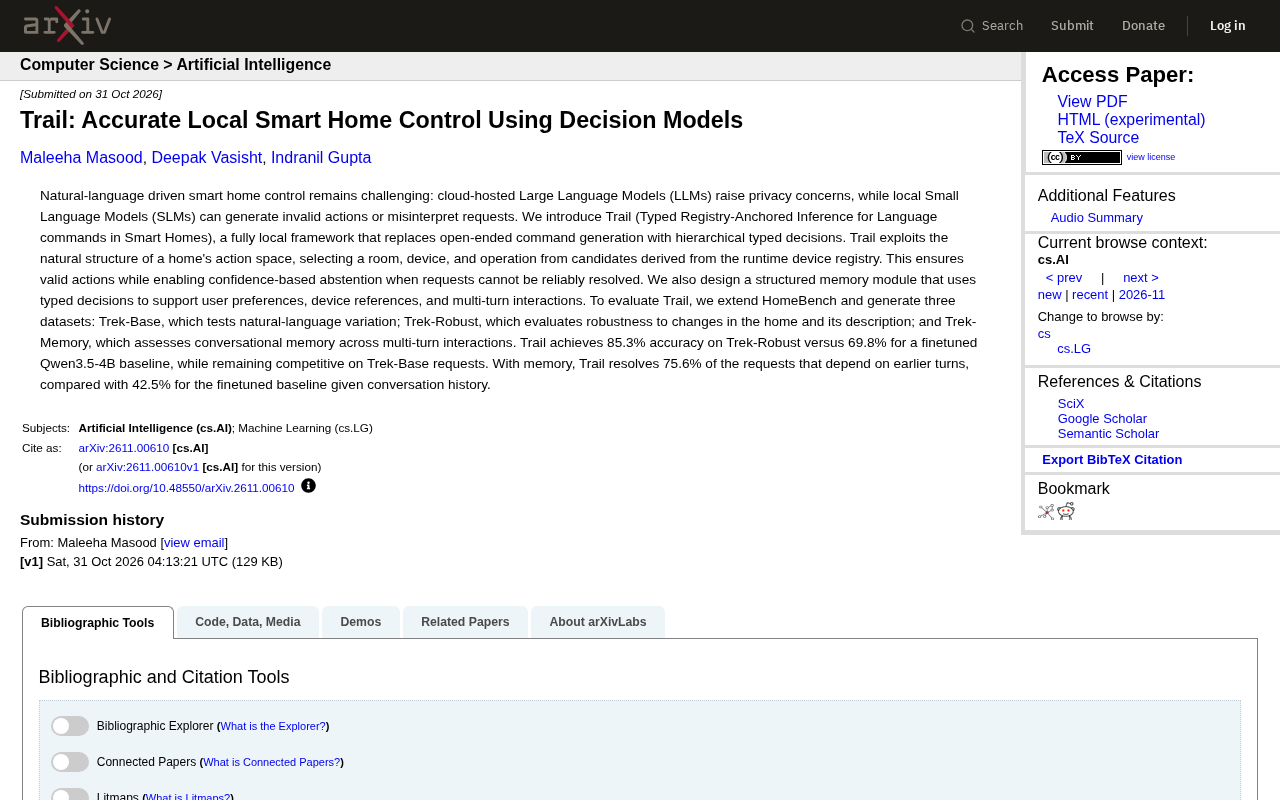
As smart home devices become ubiquitous, controlling homes with natural language has become a necessity. However, the privacy risks of cloud-based large language models (LLMs) and the unreliable action generation of local small language models (SLMs) make this vision difficult to realize. A recent paper proposes Trail (Typed Registry-Anchored Inference for Language commands in Smart Homes), which attempts to replace open-ended command generation with hierarchical typed decisions, improving control accuracy and robustness while running entirely locally.
Background: Cloud privacy and local reliability are hard to achieve together
Natural language-driven smart home control has long faced a dilemma: cloud-hosted LLMs can understand complex requests but expose household data to external parties; local SLMs protect privacy but tend to generate invalid actions or misread user intent. For example, when a user says "dim the living room lights a bit," a local small model might return a nonexistent device ID or perform an operation in the wrong room.
The paper points out that this failure stems from open-ended command generation—the model must freely output action strings, whereas the action space of home devices is actually highly structured. Trail's core idea is precisely to exploit this structure and turn "generation" into "selection."
Small language models (SLMs) typically refer to models with 1 to 7 billion parameters that can run on consumer-grade GPUs or edge devices, such as small versions of the Qwen series, the Phi series, or small Gemma models. Compared with cloud-based large models, SLMs have the advantage that inference is fully localized and household voice data never leaves the home; the cost is weaker semantic understanding and instruction-following ability, making them more prone to hallucinations or formatting errors on tasks that require precise output. Smart home control happens to be a task where "output must be strictly valid," so the shortcomings of SLMs are amplified. This is also the direct motivation behind the recent technical approach of "small models + external structural constraints": rather than expecting small models to become smarter, shrink the space in which they need to make decisions.
Trail's core mechanism: Hierarchical typed decisions
Trail no longer lets the model directly output complete commands. Instead, it decomposes the action space into levels: first select the room, then the device, and finally the operation. The candidates at each level come from a runtime device registry, so the model can only choose among valid options, fundamentally avoiding invalid actions.
This design also enables confidence-based abstention: when a request cannot be reliably parsed, Trail can choose not to execute rather than "guess." For smart home scenarios, this is safer than erroneous execution.
In addition, Trail designs a structured memory module that uses typed decisions to support user preferences, device references, and multi-turn interactions. For example, if the user first says "turn on the desk lamp in the study" and then says "make it brighter," the memory module can correctly associate "it" with the desk lamp.
Typed decisions draw on the idea of type systems in programming languages: each decision variable has a predeclared value type, and the model can only choose within the set of valid values for that type rather than freely generating arbitrary strings. In Trail, "room," "device," and "operation" each constitute a type, whose valid values are dynamically provided by the device registry at runtime. This is similar to traditional constrained decoding, but the constraints occur at the semantic level rather than the token level, making them closer to the actual structure of the home domain. It also means the system does not need to retrain the model when devices are added or removed—only the registry needs to be updated.
Experimental design and datasets
To evaluate Trail, the research team extended HomeBench and generated three datasets:
- Trek-Base: tests the diversity of natural language expressions;
- Trek-Robust: evaluates robustness to changes in the home environment and its descriptions;
- Trek-Memory: evaluates conversational memory ability in multi-turn interactions.
These datasets cover the full range of challenges, from basic understanding to environmental changes and then to contextual memory.
HomeBench is a benchmark for smart home instruction understanding; the original version mainly examines a model's ability to match home environment descriptions with user instructions. The Trail team extended it in three ways: adding synonymous rewrites and colloquial expressions to examine language diversity (Trek-Base); perturbing room names, device aliases, and environment descriptions to examine robustness (Trek-Robust); and introducing multi-turn dialogue history and requiring resolution of pronoun references and ellipsis (Trek-Memory). This "one benchmark, three stress dimensions" extension allows different capability weaknesses to be located individually rather than masked by average accuracy.
Results: Significant improvements in robustness and memory ability
On Trek-Robust, Trail achieves 85.3% accuracy, while the fine-tuned Qwen3.5-4B baseline reaches 69.8%, a clear gap. On Trek-Base, Trail also remains competitive, indicating that structured decisions do not sacrifice basic understanding ability.
The improvement in memory is even more notable: with the memory module, Trail can resolve 75.6% of requests that depend on previous dialogue turns, whereas the fine-tuned baseline achieves only 42.5% when given dialogue history. This means Trail can more reliably track user intent and device references in multi-turn interactions.
Significance and limitations
Trail's value lies in transforming "open-ended generation" into "constrained selection," preserving the privacy advantages of local deployment while compensating for the shortcomings of small models through typed decisions and a memory module. The confidence-based abstention mechanism also aligns with the high safety requirements of smart homes.
However, the paper has not yet disclosed long-term deployment performance in real home environments. The maintenance cost of the device registry, generalization to unseen device types, and performance in multi-user conflict scenarios remain directions that need further validation.
For developers focused on local AI and smart homes, Trail offers an approach worth learning from: rather than letting the model run free, use environmental structure to constrain model output.
One-line Summary
Trail replaces open-ended command generation with hierarchical typed decisions, enabling local small models to reliably control smart homes.
Paragraph Summary
The article introduces the Trail method proposed in a paper, which aims to resolve the dilemma in natural language smart home control between privacy leakage from cloud-based large models and unreliable action generation by local small models. Trail's core is to transform open-ended command generation into constrained selection: it splits the action space into three levels—room, device, and operation—with candidates drawn from a runtime device registry, thereby eliminating invalid actions and supporting confidence-based abstention and structured memory. The research team extended HomeBench to build three datasets: Trek-Base, Trek-Robust, and Trek-Memory. Results show that Trail achieves 85.3% accuracy on robustness, significantly higher than the fine-tuned Qwen3.5-4B's 69.8%; its multi-turn memory task resolution rate reaches 75.6%, versus only 42.5% for the baseline. The article also notes limitations that remain to be validated, such as real-world deployment, registry maintenance, and multi-user conflicts.
Related articles

64 Releases in 40 Days: How Strata Uses Release Velocity to Define Its AI Local Inference Roadmap
Strata shipped 64 releases in 40 days with 460k+ characters of notes. From 0.1.0 to 0.2.10, a three-step path: make it run, make it fast, make it trustworthy.
Ripple-65B Open-Source Model Tops Community Charts
Ripple-65B open-source LLM debuts atop community charts, using a self-recursive architecture to slash long-context KV cache for low-latency hundred-billion-scale inference on ordinary GPUs, with preview weights, quantized files, and one-click Olema & VLM deployment.

Deploy Open-Source Video Model MiniMax H3 Locally in 5 Minutes and Skip Cloud Generation Fees
Bilibili creator tests local deployment of open-source video model MiniMax H3: three-step ComfyUI install, 5-minute setup, no coding. Same prompt generates in 2 minutes locally vs 4 minutes online with queuing, saving about 30 RMB per 15-second 720P video. Includes VRAM requirements and RTX 5080 test results.