Trama: An AI Agent Tool That Creates Native Mac Automations Using Natural Language

Trama lets you create native Mac automations by simply describing tasks in natural language.
Trama is a macOS-native AI Agent tool that replaces traditional flowchart-style automation with natural language input. Triggered via Cmd+Option+X, it leverages AppleScript, Shell, OCR, and screen awareness to execute system-level tasks. It supports multiple LLMs (Claude, GPT, Gemini, Groq) via a BYOK model, proactively suggests automations based on observed behavior, and offers self-repair when errors occur.
Saying Goodbye to Flowchart-Style Automation
In the world of Mac automation tools, Zapier and Apple's Shortcuts have long dominated the landscape. But they share a common problem: they require users to think like programmers. You need to break down logic, drag and drop modules, set up conditional branches, and chain trigger flows — essentially, this is writing code through a visual interface.
Zapier was born in 2011, making it one of the earliest platforms to apply "if...then..." (IFTTT logic) to SaaS tool interconnection, and currently supports connections to over 6,000 apps. Apple Shortcuts evolved from the Workflow app acquired by Apple in 2014 and was officially built into the system starting with iOS 12. Both types of tools fundamentally employ a "Directed Acyclic Graph" (DAG) orchestration philosophy — users need to define explicit inputs, processing steps, and outputs, with data flow between each node requiring explicit configuration. This model is intuitive and efficient for programmers or users with strong logical thinking, but research shows that over 70% of ordinary users abandon automation workflows when they involve more than 3 steps.
For developers, this may not be a barrier; but for the vast majority of regular Mac users, this "programming mindset" threshold is enough to significantly diminish the value of automation.
The new tool Trama, which recently reached #10 on the Product Hunt leaderboard (with 84 upvotes), attempts to completely remove this layer of abstraction. Its core philosophy is simple: you just describe what you repeatedly do in your own words, and leave the rest to it.
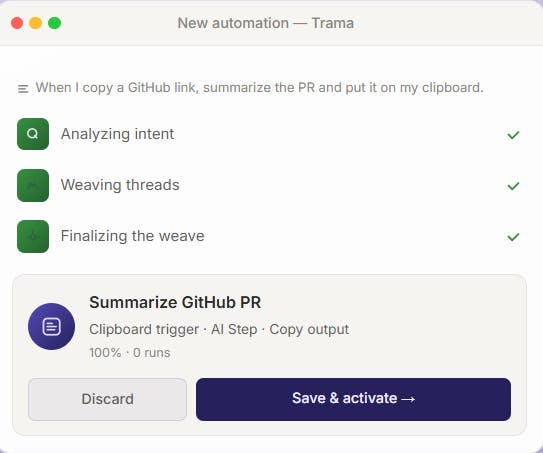
Core Interaction: One Shortcut, One Sentence
Trama's usage logic is extremely straightforward. Press Cmd+Option+X, describe the operation you want to automate in everyday language in the popup input box, and it runs in the background.
This "summon and use" design is reminiscent of the interaction paradigm of Spotlight or Raycast, but Trama is aimed at "executing actions" rather than "retrieving information." Spotlight has been macOS's built-in global search tool since Tiger (10.4), summoned via Cmd+Space, initially supporting only file and app searches. Raycast is a third-party alternative that appeared in 2020, expanding this paradigm from "search" to "execution" — users can run scripts, manage windows, query APIs, and more through a plugin system. Trama takes this a step further: Raycast still requires users to select predefined commands or plugins, while Trama accepts completely free-form natural language input, with AI parsing intent and dynamically generating execution plans. These three represent three generations of evolution in Mac global shortcut entry points: retrieval → command execution → intent understanding.
Users don't need to pre-build any workflows, nor do they need to understand the relationship between Triggers and Actions — describe your intent, get results directly.
Multi-Language Input Support
An easily overlooked but quite important detail: Trama emphasizes "in your language, not just English." This means Chinese, Japanese, French, and other non-English native speakers can describe their needs directly in their mother tongue. For natural language-driven automation tools, native language support significantly reduces the cognitive burden during expression and expands the tool's potential audience.
Truly "Native": Deep into macOS Internals
The biggest difference between Trama and many wrapper-style AI tools lies in its deep invocation of macOS system capabilities. According to official information, it can access the following system-level capabilities:
- AppleScript: Invoking scripting control capabilities between macOS applications
- Shell: Executing command-line operations
- OCR: Recognizing text content on screen
- Screen awareness: Understanding what's currently happening on the screen
AppleScript is a scripting language that Apple introduced back in 1993 (the System 7 era), and its unique strength lies in "inter-application communication" — through the Apple Events protocol, one script can control another application's behavior, such as having Finder move files, Mail send emails, or Safari open web pages. Shell scripts provide direct access to the Unix underpinnings, including file system operations, process management, network requests, and more. The addition of OCR and screen awareness completes the "visual understanding" dimension — traditional scripts can only operate objects with exposed APIs, but combined with screen recognition, AI can "see" and operate application interface elements that lack scripting interfaces. This is precisely the core approach of "Computer Use" capability in current AI Agent technology.
This combination means Trama is not just a "chatbot" but an AI Agent with system-level execution capabilities. It can read screen content, operate applications, run scripts, and translate natural language instructions into actual control over the operating system. This is the foundation for its claim of "native automations."
Proactively Discovering Repetitive Actions, Rather Than Passively Waiting for Commands
Another highlight of Trama is its proactiveness. Traditional automation tools are passive — you think of a repetitive task and then manually configure it. Trama will "notice what you're repeating and proactively suggest automation solutions."
This is a noteworthy design trend in the AI Agent era: tools shifting from "waiting for commands" to "observing behavior and anticipating needs." This transition from passive response to active observation is called "Context-Aware Agent" in the AI Agent field. Its technical foundations include: continuous monitoring of user operation sequences, pattern recognition algorithms to discover repetitive patterns, and intent reasoning based on large language models. Similar design philosophies have appeared in other products — for example, Google's Smart Compose proactively suggests completions while users compose emails, and Windows Power Automate added "process mining" features in 2024 to discover automatable repetitive operations. But Trama brings this capability to the operating system's global level, theoretically able to observe all of a user's behavioral patterns across applications — which far exceeds single-application suggestion systems in both potential and privacy risk.
If this feature delivers well in practice, it can capture repetitive labor that users themselves haven't even noticed, truly unlocking the potential of automation.
Self-Repair Mechanism When Errors Occur
One of the biggest pain points of automation scripts is that once an error occurs, ordinary users often can't understand the error messages and simply give up. Trama addresses this with a solution: if an automation fails, AI explains the reason for the error and supports one-click repair.
This design transforms "debugging" — work that originally belonged to programmers — into a process that ordinary users can understand and act on. This is a crucial piece for lowering the barrier to Mac automation.
Bring Your Own Key: Flexible Multi-Model Integration
For AI model integration, Trama adopts a "Bring Your Own Key" model, supporting access to Claude, GPT, Gemini, Groq, and other major large language models.
The "Bring Your Own Key" (BYOK) model is becoming an important branch in developer tools and productivity tools. Compared to SaaS subscription models, BYOK lets users pay directly to model providers (OpenAI, Anthropic, Google, etc.), while the tool itself only charges a software usage fee or is completely free. The economic logic of this model is: taking GPT-4o as an example, API call costs are approximately $2.5 per million input tokens, and for everyday automation tasks, the cost per call is typically less than $0.01, far below the $10-20/month fixed fee of subscription-based tools. Additionally, under the BYOK model, data is sent directly from the user's device to the model provider, reducing data leakage risk at intermediate points — which is particularly important for automation tools handling sensitive system operations.
This design brings several practical benefits:
- Cost transparency: Users directly use their own API quota, avoiding the "hidden markups" common in subscription-based tools
- Model freedom: Users can flexibly choose different models based on task complexity and cost considerations
- Privacy control: Data flow is determined by the user's own API key, rather than being routed through a third party
For power users and technical users, this flexibility is often more welcomed than an integrated, closed solution.
Trama's Strengths and Challenges
Trama represents an important direction in the evolution of Mac automation tools: from "visual programming" to "natural language Agent." The core problem it tries to solve genuinely exists — most people benefit little from automation precisely because the configuration threshold is too high.
However, tools of this nature also face inherent challenges. The ambiguity of natural language may cause execution results to deviate from expectations, and system-level execution permissions (AppleScript, Shell, screen awareness) demand higher security and controllability requirements alongside their powerful capabilities. When an AI Agent gains system-level execution permissions, security risks increase exponentially. Shell commands can delete files, modify system configurations, or even install malware; AppleScript can send emails or access the Keychain without confirmation. Mitigation strategies currently being explored in the industry include: sandbox execution (previewing operations in a restricted environment first), operation confirmation mechanisms (requiring explicit user approval for high-risk operations), and the "principle of least privilege" (AI only receives the minimum system access needed to complete the current task). Additionally, "Prompt Injection" attacks are a potential threat — if malicious text displayed on screen is read by OCR and influences the AI's decision-making, it could lead to unintended dangerous operations. These issues currently have no perfect solutions and remain ongoing challenges that all system-level AI Agents must address.
Users need to find a balance between "convenience" and "trusting AI to operate my computer."
Judging from its current Product Hunt performance of 84 upvotes and #10 ranking, Trama is still in its early stages. Its actual stability, execution accuracy, and the intelligence of its proactive suggestions still need long-term validation from more real users. However, as a macOS automation product with a clear philosophy and definite direction, it deserves continued attention from readers following the Mac productivity tool ecosystem and AI Agent application trends.
Related articles

Chain of Thought Isn't Just for AI: How Humans Can Use CoT to Improve Thinking Quality
Chain of Thought isn't just a prompt trick for large models. Starting from a Hacker News discussion, this article analyzes why CoT works for human thinking too, breaks down actionable ways to transfer it, and highlights the key differences between human CoT and machine CoT.
Cloudflare Teams Up with OpenAI: Closi…
Cloudflare Teams Up with OpenAI: Closing the Loop from Vulnerability Discovery to Defense with AI
Cloudflare uses OpenAI Daybreak to investigate security vulnerabilities and generate reviewable remediation plans, while developers use Codex to boost coding efficiency and quality.

Orca Multi-Agent Orchestration in Practice: A Guide to Parallel Collaboration with Claude and Codex
Orca is Stable AI's free open-source agent workbench supporting 34 agents like Claude Code and Codex in parallel. Learn its Git worktree isolation, multi-model orchestration, and mobile management.