Transferring into AI Application Development Without a Top-Tier Degree: The 3 Hard Skills You Need
3 hard skills to transition into AI application development from a non-elite university background.
For job seekers without top-tier academic credentials, AI Application Development Engineer is a more accessible entry point than competitive algorithm roles. The three core hard skills are: hands-on LLM fine-tuning with LoRA/SFT; framework-based engineering using LangChain, Milvus, and knowledge graphs rather than low-code tools; and production deployment using vLLM, TensorRT, and FastAPI. The article also cautions that the source video contains course promotion and that quick-results promises should be viewed critically.
Can someone from an ordinary or non-elite university background still break into the AI industry? The answer is yes — and there's a relatively clear path to do it: AI Application Development Engineer.
The highly competitive AI algorithm roles are genuinely difficult for most candidates without a top-tier academic background to crack. But AI application development is different. As long as your hands-on skills are solid, you can still land offers — even at major tech companies. What enterprises actually need right now are developers who can take technology and turn it into real, working products. This article draws from career-switching advice shared by an AI practitioner on Bilibili, and outlines the core competencies this track demands — for anyone feeling lost about where to start.
Hard Skill #1: Foundational LLM Knowledge and Fine-Tuning in Practice
You'll often hear people online say fine-tuning is unnecessary — that it's easy to break a model. But in actual interview situations, the opposite is true: without hands-on fine-tuning experience, your resume is likely to get filtered out immediately.
Here's an important distinction: companies don't expect you to train a large model from scratch — that's neither realistic nor necessary. What you actually need to master is LoRA and SFT (Supervised Fine-Tuning) — specifically, parameter configuration, and building and setting up training datasets. The key isn't how well you can recite theory, but whether you've personally run a complete fine-tuning project from end to end — from data preparation and parameter configuration to training and validation. That hands-on experience is what separates "watched a tutorial" from "actually done it" on your resume.
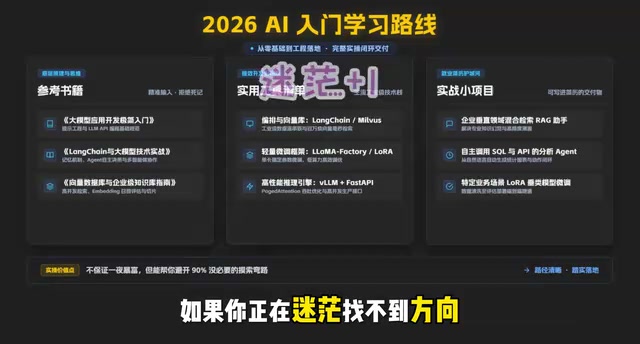
LoRA (Low-Rank Adaptation) is currently one of the most widely used fine-tuning methods for large models. The core idea: instead of modifying all the weights of a pre-trained model (which requires enormous compute and VRAM), you insert two low-rank matrices alongside the existing weight matrices and only train those. This reduces the number of trainable parameters by a factor of 1,000 or more, making fine-tuning feasible on consumer-grade GPUs like the RTX 3090 — dramatically lowering the hardware barrier. SFT (Supervised Fine-Tuning) refers to training a model on human-labeled input-output dialogue pairs in a supervised manner, teaching it to respond in a specific style or with domain-specific knowledge. It's the standard pathway for turning a general-purpose foundation model into a vertical business assistant. The two are often used together: fine-tune using SFT data with the LoRA method, then iterate with minimal compute — this is the most common engineering approach companies use to deploy large models internally.
Hard Skill #2: AI Application Development Is Not Low-Code Drag-and-Drop
The second common trap is equating AI application development with low-code, drag-and-drop tools. The practitioner in the video puts it plainly: low-code tools are only good for building demo prototypes. Real enterprise business systems are built on frameworks.
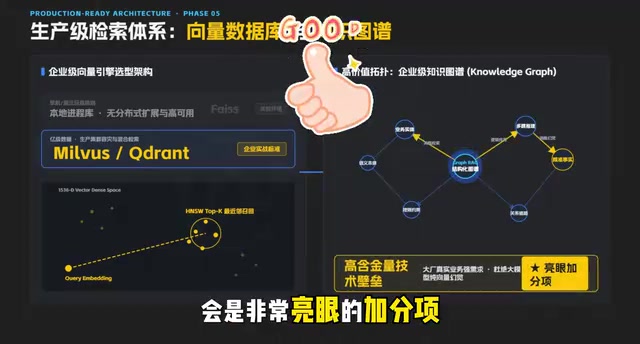
In industry, the LangChain ecosystem is currently the dominant choice. A mature AI business system rarely relies on a single large model to solve everything — it's fundamentally an engineering system. Within that system, vector databases are an essential component, and you need to understand database architecture. The video specifically emphasizes not stopping at using FAISS for experiments — production environments more commonly use vector databases like Milvus.
Knowledge graphs are another differentiating skill. Not every small-to-mid-sized company will implement them, but having this capability makes you stand out in interviews, because major tech companies have real business demand for it. In short, understanding AI applications as "an engineering system" rather than "calling a model" is the foundational mindset for this career track.
LangChain is the most widely used framework for building large model applications. It provides standardized interfaces for connecting large models with external tools, databases, and memory modules, enabling developers to quickly build complex applications like Retrieval-Augmented Generation (RAG), Agents, and multi-step reasoning pipelines. Vector databases are the core component of RAG architectures: text is converted into high-dimensional numerical vectors by an embedding model and stored in the vector database; when a user asks a question, the system converts the query into a vector as well, performs a similarity search in the database to find the most relevant passages, and passes those to the large model to generate an answer. FAISS is Meta's open-source local vector search library — good for experiments and small-scale validation. Milvus is a distributed vector database designed for production environments, supporting high-concurrency retrieval across tens of billions of vectors, data persistence, and cluster deployment — the mainstream choice when companies actually go live. The gap between the two reflects the engineering divide between "can build a demo" and "can ship to production."
Hard Skill #3: Model Inference and Production Deployment
The third skill is what the video's author considers the dividing line between "someone who tweaks parameters" and "a real AI application development engineer" — model inference and production deployment capabilities.
This includes: understanding inference acceleration frameworks like vLLM and TensorRT, knowing how to optimize and speed up models, and being able to wrap a model into a deployable service using FastAPI. The core point is this — only when you've transformed a model into a running service and fully integrated it with a real business system can you say you've truly completed a deployment.
A demo that looks impressive in a notebook is nowhere near enough. What companies pay for are services that run stably and handle real business traffic — not pretty loss curves from a research environment. This also explains why engineering and deployment skills carry increasing weight in job searches: model capabilities are becoming increasingly commoditized, while deployment ability remains scarce.

vLLM is an open-source large model inference acceleration framework from UC Berkeley. Its core technology, PagedAttention, manages GPU memory the way an operating system manages RAM — paging and scheduling it to dramatically boost concurrent throughput. Compared to native HuggingFace inference, it can be 10x faster or more, making it one of the de facto standards in the open-source community for deploying large models. TensorRT is NVIDIA's official model inference optimization library, which compresses and accelerates models through techniques like operator fusion and precision quantization (FP16/INT8) — ideal for scenarios requiring minimal latency on NVIDIA GPUs. FastAPI is Python's highest-performance async web framework, commonly used to wrap an inference model into an HTTP interface and expose standardized REST API services. The combination of the three (vLLM/TensorRT for accelerated inference + FastAPI for API wrapping) forms the typical engineering pipeline for deploying AI models in production — and is exactly what companies test for when they ask "have you actually done a deployment?"
Career Transition Takes Pacing, Not Just Passion
The video's author candidly admits to making plenty of mistakes along the way: buying courses of varying quality, grinding through stacks of technical books, and repeatedly working through hands-on projects — before gradually mapping out a clear growth path. Switching careers into AI isn't something you can pull off on passion alone. You need to see clearly where you're going before you start moving.
From the content, a relatively complete learning framework emerges:
Build the Foundation
Start by filling in the essential math and programming fundamentals, then move into core algorithms and classic models. There's no shortcut here — this is the foundation everything else is built on.
Pick a Career Direction
After building the foundation, most people split into two broad directions: CV (Computer Vision) or NLP (Natural Language Processing). Whichever you choose, you'll need to study the corresponding algorithm models in depth and build demonstrable projects around them.
Add Engineering and Deployment Skills
Beyond algorithms and models, hands-on fine-tuning, vector databases, inference acceleration, and service wrapping are the critical steps that upgrade you from "can tune a model" to "can deliver a system."
Final Thoughts
The core value of this career experience is that it breaks down what AI Application Development Engineer roles actually require into three actionable hard skills: fine-tuning in practice, framework-based engineering development, and model deployment to production. Compared to chasing algorithm roles with extremely high barriers to entry, this track is more accessible to candidates from non-elite or cross-disciplinary backgrounds — because it measures deployment capability, not theoretical depth.
One caveat worth noting: the latter portion of the original video contains clear promotional content for courses and learning roadmaps (e.g., "get the roadmap in the comments," coaching programs, etc.). This information carries a marketing angle and should be taken as directional reference rather than any guarantee of "six-figure salary in three months." Any promise of rapid results that bypasses systematic skill-building deserves healthy skepticism. What will actually get you started is solid fundamentals combined with complete, hands-on projects.
Related articles
Automattic Executives Signed Reciprocal Severance Agreements During Mullenweg's Brief Ouster
Automattic's CFO and General Counsel signed reciprocal severance agreements during Matt Mullenweg's brief ouster, covering one year's salary and accelerated equity vesting, raising corporate governance concerns.
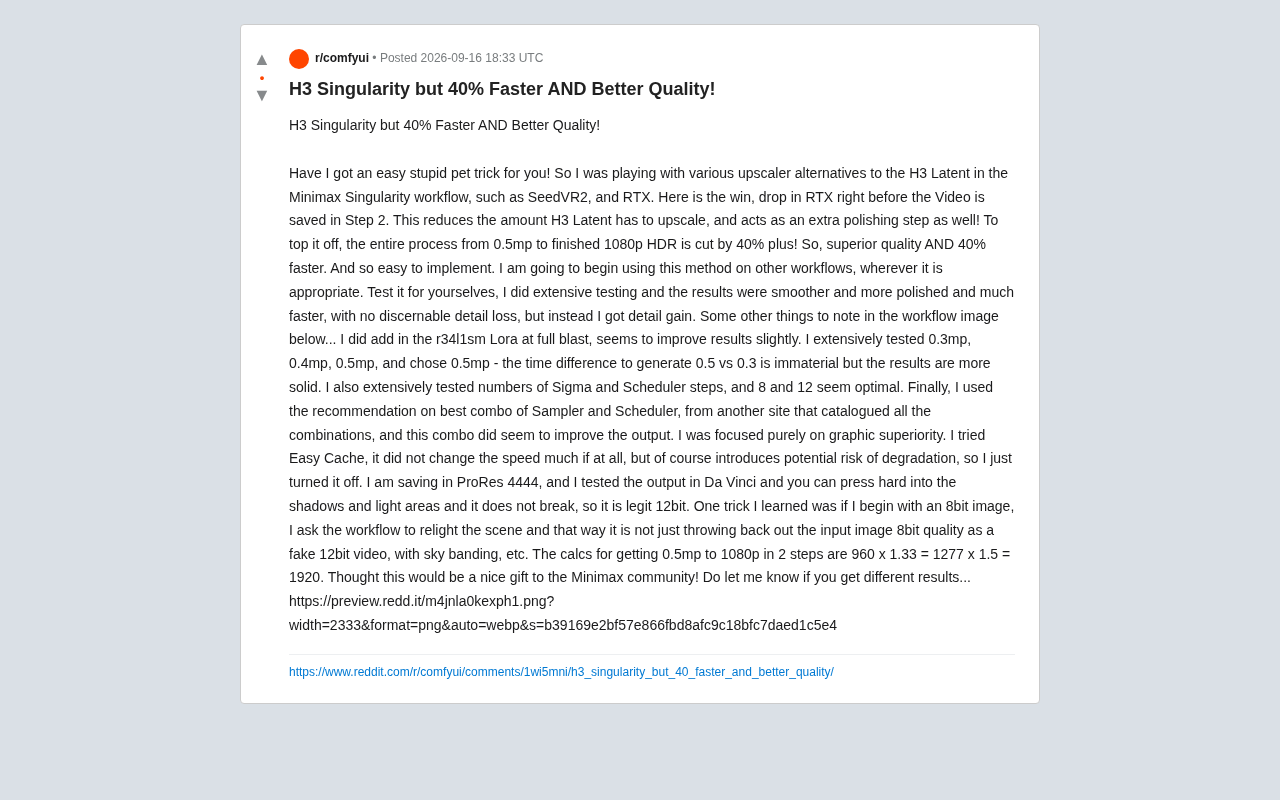
H3 Singularity Optimization: 40% Speed Boost With Better Image Quality
A Reddit user's Minimax Singularity workflow tip: insert an RTX upsampler before H3 Latent for 40%+ speed gains and better quality. Covers parameters, 12-bit output, and more.
Glyph: A Multi-Strategy Agent System for Automated Enterprise Data Catalog Annotation
Glyph is a multi-strategy LLM agent system for enterprise data catalogs that automates column description generation and sensitivity ontology tagging, grounding outputs in pipeline source code to improve accuracy.