TRIDENT and SHAKTI: New Frameworks for Hindi AI Text Detection

Researchers release SHAKTI, a Hindi AI text detection benchmark, and propose the round-trip translation-based TRIDENT framework.
To address the English-centric focus of AI text detection and the lack of benchmarks for low-resource languages, researchers built SHAKTI—a large-scale Hindi benchmark covering four genres, eight LLM families, multiple prompting strategies, and adversarial transformations—and analyzed differences between human and AI text. They then proposed TRIDENT, which uses round-trip translation to compare semantic consistency between original and back-translated text to identify AI-generated content, bypassing reliance on specific model features. TRIDENT has three variants—static threshold (S), dynamic threshold (D), and multi-distance feature logistic regression (C)—all outperforming traditional and supervised baselines, with TRIDENT-S best overall. The method was validated across seven languages and unseen LLMs but is sensitive to translation model quality.
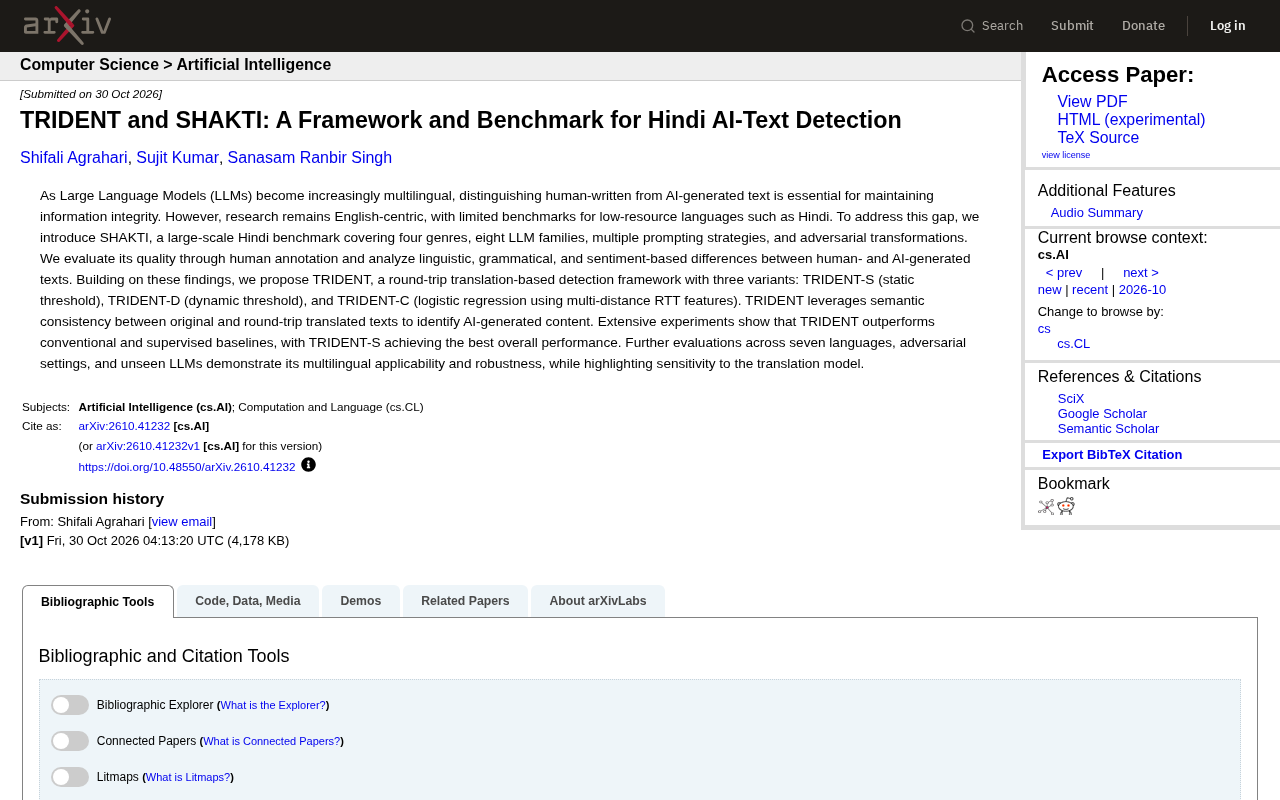
As large language models (LLMs) continue to improve their multilingual capabilities, distinguishing human-written from AI-generated text has become increasingly important. However, most existing research is English-centric, and low-resource languages like Hindi lack systematic detection benchmarks. To address this gap, researchers have introduced SHAKTI—a large-scale Hindi benchmark—and, based on its findings, proposed the TRIDENT detection framework.
SHAKTI: Filling the Benchmark Gap in Hindi AI Text Detection
According to the original paper, SHAKTI covers four text genres, eight LLM families, multiple prompting strategies, and adversarial transformations, making it one of the larger AI text detection benchmarks for Hindi to date. The research team assessed benchmark quality through human annotation and analyzed linguistic, grammatical, and sentiment-level differences between human and AI-generated text.
The significance of this multi-dimensional coverage lies in the fact that text generated by a single model with a single prompt often carries obvious stylistic fingerprints, whereas real-world AI text comes from diverse sources and prompting methods. Only a sufficiently broad benchmark can test a detector's generalization ability. SHAKTI's adversarial transformation design further simulates scenarios of deliberate detection evasion, making the benchmark more aligned with real deployment needs.
Adversarial transformations in AI text detection research refer to systematic modifications applied to generated text that are designed to evade detectors—for example, synonym substitution, sentence restructuring, insertion of redundant expressions, or changes to punctuation or tone. Their role is akin to setting up "attack-defense drills" for detectors: if a benchmark contains only raw model outputs, detectors may learn fragile surface features; with adversarial samples added, evaluation results better reflect the robustness of detection methods in realistic adversarial scenarios. By incorporating adversarial transformations into its benchmark design, SHAKTI means that its evaluation measures not only "whether ordinary AI text can be identified" but also "whether deliberately disguised AI text can be identified"—which is more valuable as a reference for real-world content governance.
TRIDENT: A Detection Approach Based on Round-Trip Translation
Building on SHAKTI's analysis, the researchers proposed TRIDENT—a detection framework based on round-trip translation (RTT). Its core hypothesis is that AI-generated text and human text differ in semantic consistency. Specifically, the text is translated into another language and then back into the original language, and AI-generated content is identified by comparing the semantic consistency between the original and the round-trip translation.
The cleverness of this approach lies in bypassing dependence on specific model features. Traditional detectors are often trained on the generation patterns of a particular LLM and may fail once the model is updated or a different model is used; round-trip translation, by contrast, exploits the semantic stability characteristics of the text itself, which in theory offers better cross-model applicability.
Three Variants: Static, Dynamic, and Multi-Distance Features
TRIDENT offers three implementation variants:
- TRIDENT-S: uses a static threshold for decision-making—simple and direct;
- TRIDENT-D: uses a dynamic threshold to adapt to different text conditions;
- TRIDENT-C: trains a logistic regression model on multi-distance RTT features.
Experimental results show that all three variants outperform traditional baselines and supervised learning baselines, with TRIDENT-S achieving the best overall performance. This result is somewhat counterintuitive—the simplest static-threshold approach performs best, suggesting that the semantic consistency signal revealed by round-trip translation is already strong enough and that the additional gains from complex models are limited.
Round-trip translation (RTT) is a classic technique in machine translation research and evaluation: the source text is translated into a target language and then back into the source language, and translation quality or semantic fidelity is assessed by comparing the differences between the original and the back-translated text. TRIDENT repurposes this as a detection signal—human text and AI text may exhibit different loss patterns after undergoing this process of "semantic compression and restoration." This approach relates to the concept of semantic consistency, typically quantified using cosine similarity of sentence embeddings, metrics such as BLEU/ROUGE, or back-translation perplexity. RTT's advantage is that it requires no access to the generative model's internals and does not rely on specific model fingerprints, making it a black-box, model-agnostic detection paradigm.
The difference between static and dynamic thresholds lies in whether the decision boundary changes with the input. A static threshold fixes a single similarity cutoff across the entire dataset—simple, but potentially sensitive to imbalances in text length, genre, or language-pair distribution; a dynamic threshold adjusts the decision criterion based on the text's own conditions (such as length or baseline similarity distribution), which in theory adapts better to heterogeneous data. The logistic regression in TRIDENT-C is a linear classifier that takes multi-distance RTT features as input; it is highly interpretable and cheap to train, and is often used as a baseline to test feature effectiveness. In the experiments, TRIDENT-S outperformed the more complex variants, suggesting that the RTT signal itself already has strong linear separability and that complex models do not necessarily bring gains.
Multilingual Applicability and Robustness Validation
The research team conducted further evaluations on seven languages and tested adversarial settings and unseen LLMs. The results show that TRIDENT has multilingual applicability and robustness, but they also reveal the method's sensitivity to the translation model—translation quality directly affects detection performance.
This limitation deserves attention: round-trip translation depends on the capabilities of the translation system itself, and detection performance may suffer for languages or domains with scarce translation resources. Moreover, if attackers understand the detection mechanism, they may also evade detection by manipulating the translation stability of the text.
Translation model sensitivity is a structural constraint of RTT-type methods: the detection signal comes from the translation system's "re-expression" of the text. If translation quality is low (e.g., low-resource language pairs or terminology-dense texts), back-translation noise can drown out the subtle differences between human and AI text, causing similarity distributions to overlap and detection performance to degrade. In addition, if attackers know the detection mechanism, they may rewrite text so that it remains highly stable across translation (for example, using simple sentence structures that are robust to translation), thereby disguising it as human text. This suggests that practical deployment requires high-quality, multilingual translation services, and that consideration should be given to combining RTT signals with other features (such as perplexity and stylistic features) to enhance resistance to evasion.
Implications for AI Content Governance in Low-Resource Languages
The combination of SHAKTI and TRIDENT provides a reusable research paradigm: first build a localized benchmark covering multiple sources and styles, then extract language-level distinguishing features from it, and finally design detection methods that do not depend on specific models. For low-resource languages like Hindi, this work fills the gap of missing benchmarks and offers a reference path for similar research in other languages.
From an application perspective, the simplicity of TRIDENT-S makes it more suitable for practical deployment, while its sensitivity to translation models suggests that engineering implementation requires supporting high-quality translation services. As LLMs' multilingual capabilities continue to improve, detection methods based on intrinsic language features like these may offer greater long-term value than fingerprint-style detection targeted at specific models.
One-line Summary
Researchers release SHAKTI, a Hindi AI text detection benchmark, and propose TRIDENT, a framework based on round-trip translation.
Paragraph Summary
To address the English-centric nature of AI text detection research and the lack of benchmarks for low-resource languages, researchers built SHAKTI—a large-scale Hindi benchmark covering four genres, eight LLM families, multiple prompting strategies, and adversarial transformations—and analyzed linguistic, grammatical, and sentiment differences between human and AI text. On this basis, they proposed the TRIDENT detection framework, which uses round-trip translation to compare the semantic consistency between original and back-translated text to identify AI-generated content, bypassing dependence on specific model features. TRIDENT includes three variants: static threshold (S), dynamic threshold (D), and logistic regression on multi-distance features (C). All outperform traditional and supervised baselines in experiments, with TRIDENT-S performing best overall. The method was validated for applicability and robustness across seven languages and unseen LLMs, but is sensitive to translation model quality.
Related articles

Qwen 3.8 Beats Opus at Coding—But Can Your Mac Run It?
Open-source Qwen 3.8 beats Opus 4.6 at coding at just 18GB, but how much Mac memory do you need? 24GB crashes; 32GB is the sweet spot. Full config guide inside.

Claude Code + Agent: Building a Fully Automated AI Testing Loop
Bilibili course breakdown: how test developers can use Claude Code terminal-based Agents to build a fully automated AI testing loop. Compares permission boundaries of terminal vs. device Agents, explains why enterprise projects choose Claude Code over Open Claude-type tools, and outlines the Node.js environment setup and DeepSeek model integration path.

Working with AI Agents Requires Nerves of Steel
The more autonomous AI agents become, the heavier the user's psychological burden. Drawing from a Hacker News discussion, this article analyzes black-box anxiety, behavior drift, and monitoring fatigue in agent collaboration, and offers practical approaches like sandbox isolation, permission control, and task granularity management to reduce cognitive load.