Triple Dragon Fractal: Recursive Generation and the Beauty of Symmetry in Dragon Curves

How three Dragon Curves combine with 120° rotational symmetry to create the stunning Triple Dragon Fractal.
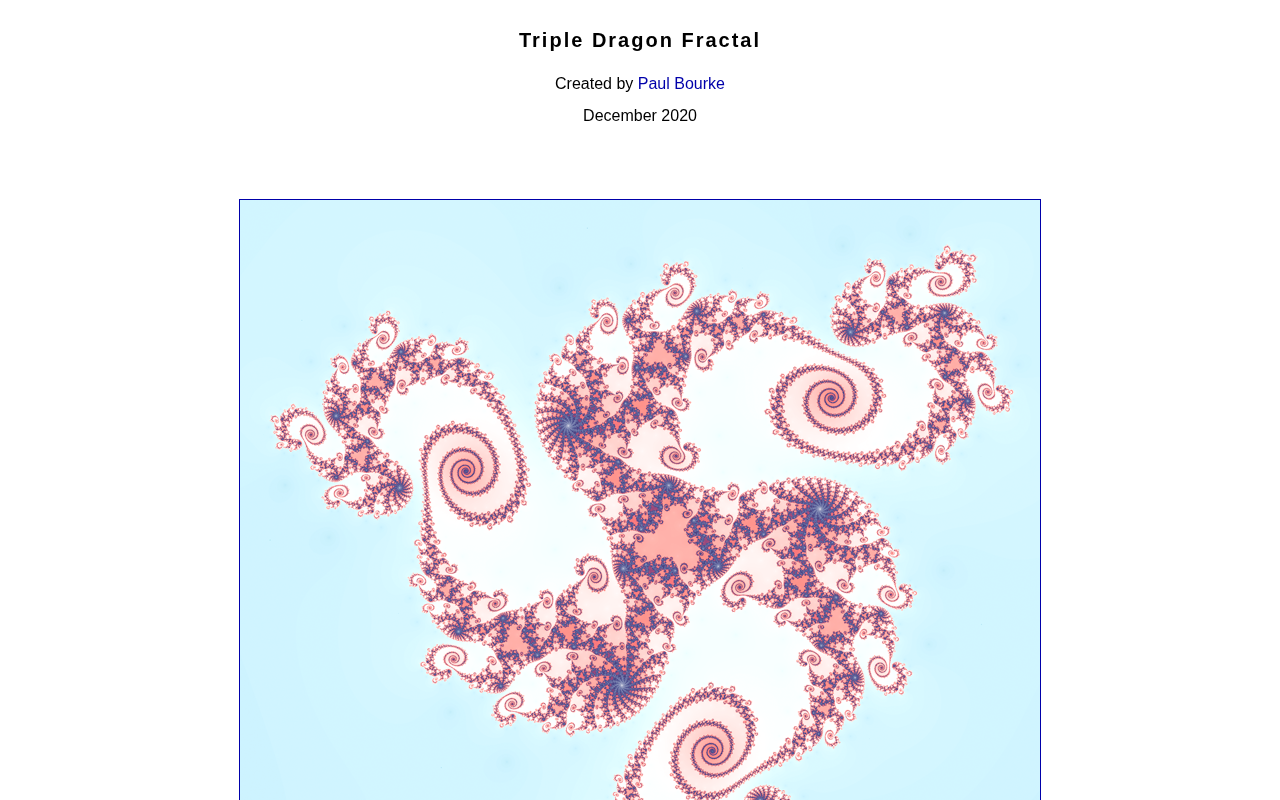
The Triple Dragon Fractal combines three Dragon Curves with 120-degree rotational symmetry, creating a visually harmonious fractal with C₃ group symmetry. Rooted in the 1966 Heighway Dragon Curve, it can be formally described using L-systems and exhibits a Hausdorff dimension of 2, making it a space-filling curve. This article explores its mathematical foundations, recursive generation, and real-world applications of fractal geometry.
What Is the Triple Dragon Fractal
Fractals are among the most captivating products at the intersection of mathematics and art — simple recursive rules give rise to infinitely complex, self-similar geometric patterns. The Triple Dragon Fractal is one of the most visually striking members of this family. Derived from the classic Dragon Curve, it achieves a fuller, more harmonious form through threefold rotational symmetry.
The Dragon Curve was first discovered by physicists John Heighway, Bruce Banks, and William Harter in 1966 while working at NASA. Named for its resemblance to a dragon from Eastern mythology, it is a continuous curve that never crosses itself — constructed simply by repeatedly "folding" a strip of paper, which is also why it's called the Paperfolding Dragon. Martin Gardner later introduced the Dragon Curve to a broader audience in his 1967 Scientific American column, cementing it as an iconic figure in recreational mathematics culture. Gardner's "Mathematical Games" column ran for 25 years and was one of the most influential platforms for mathematical popularization in the 20th century. He was known for transforming abstract mathematical concepts into hands-on explorations — and the Dragon Curve was a perfect example, since readers could literally fold a strip of paper to verify its properties. The Dragon Curve even appeared on chapter dividers in Michael Crichton's novel Jurassic Park, serving as a visual metaphor for chaos theory.
From Paper Folding to Infinity: How the Dragon Curve Is Generated
The Folding Intuition
The most intuitive way to understand the Dragon Curve is to imagine a strip of paper. Fold it once and unfold it — one crease appears. Fold it twice and unfold — three creases. Each additional fold nearly doubles the number of creases. If every crease is held at a 90-degree angle and the entire folded sequence is "unrolled" onto a plane, a Dragon Curve gradually takes shape.
This folding process can be described precisely using an elegant binary rule: the direction of the nth crease (right or left) is uniquely determined by the binary representation of the integer n. Specifically, divide n by 2 until you obtain an odd number; if the result is congruent to 1 mod 4, the crease turns right; if congruent to 3 mod 4, it turns left. This number-theoretic connection reveals a hidden correspondence between paper-folding operations and the parity structure of integers — one reason the Dragon Curve occasionally appears in number theory research.
What makes this process remarkable is that no matter how many iterations are applied, the curve remains continuous and non-self-intersecting. As the iteration depth increases, it gradually fills a region of the plane, reaching a staggering level of complexity.
Formal Description with L-Systems
In computer graphics, the Dragon Curve is commonly described using an L-system (Lindenmayer System). Proposed by Hungarian biologist Aristid Lindenmayer in 1968, L-systems were originally designed to model the growth patterns of plant cells. They are essentially parallel string rewriting systems — unlike conventional serial grammars, L-systems apply rewriting rules to all symbols simultaneously at each step, naturally mirroring the synchronous division of biological cells. Lindenmayer originally designed this formal language solely to model algae cell division, never anticipating its future widespread application in computer graphics. It was computer scientist Przemysław Prusinkiewicz who extended L-systems to the domain of fractal graphics. His co-authored book with Lindenmayer, The Algorithmic Beauty of Plants (1990), systematically documented methods for describing plant morphology using L-systems and remains an authoritative reference in the field.
The concept of turtle graphics itself originates from the LOGO programming language, developed by Seymour Papert at MIT in the late 1960s, initially designed for children's programming education. Papert's educational philosophy was influenced by Piaget's constructivism, emphasizing "learning by making" — and turtle graphics was a concrete realization of this idea. Children could understand geometric instructions by imagining themselves as the turtle, building intuition for coordinates, angles, and loops. This embodied programming metaphor is still considered one of the most successful designs in the history of computing education. When the strings generated by L-systems are translated into turtle instructions, abstract symbol sequences become visible geometric trajectories — this "symbol as action" mapping mechanism allows extraordinarily complex fractal patterns to be fully expressed with just a handful of rules.
The classic L-system definition for the Dragon Curve is as follows:
- Axiom:
FX - Rewriting rules:
X → X+YF+,Y → -FX-Y - Symbol meanings:
F= draw forward,+= turn right 90°,-= turn left 90°
Repeated application of these rules causes the string to expand; ultimately translated into drawing instructions, an intricate Dragon Curve appears on screen. In the first iteration, the axiom FX expands to FX+YF+; one more iteration yields FX+YF++FX-YF+. With each iteration, the string approximately doubles in length, and the geometric figure gains another level of folding. In practice, 10 to 15 iterations are typically sufficient to render a Dragon Curve with rich detail.
The Symmetrical Beauty of the Triple Dragon Fractal
A single Dragon Curve is already elegant, but visually it feels slightly "unbalanced." The key idea behind the Triple Dragon Fractal is to combine three Dragon Curves around a shared center point with 120-degree rotational symmetry. This threefold symmetry allows the overall pattern to achieve geometric stability and harmony while preserving fractal complexity.
From a group theory perspective, threefold rotational symmetry corresponds to the mathematical C₃ cyclic group (Cyclic Group of Order 3), consisting of three elements: rotation by 0°, 120°, and 240°, satisfying the group axioms of closure, associativity, identity, and invertibility. Group theory was founded by Évariste Galois in the early 19th century, originally to study the solvability of polynomial equations, and has since become a foundational language of modern mathematics and physics. In physics, the Standard Model of particle physics is built upon specific symmetry groups; in crystallography, all possible crystal structures are classified into 230 space groups. C₃ is one of the simplest non-trivial cyclic groups, appearing widely in nature and man-made structures — the leaves of a clover, the molecular structure of benzene, wind turbine blade arrangements, and many traditional decorative patterns all embody this threefold rotational symmetry. The combination of fractal infinite self-similarity with the algebraic symmetry of group theory is precisely the dual mathematical fascination of the Triple Dragon Fractal.
It's worth noting that Dragon Curves possess a remarkable property — multiple Dragon Curves can be seamlessly joined together, fitting perfectly without gaps or overlaps. Tessellation refers to covering a plane with one or more shapes without leaving any gaps or producing any overlaps. The mathematical foundation for the Dragon Curve's ability to tessellate lies in the self-similarity and symmetry of its boundary — two Dragon Curves can be joined back-to-back to form a "double dragon" shape, and four can fill a rectangular region. The Triple Dragon Fractal uses 120-degree rotational symmetry to join three curves around a central point, forming a closed figure with C₃ rotational symmetry — the same symmetry order as an equilateral triangle — endowing the overall pattern with a high degree of visual stability.
The Mathematical Significance Behind Fractals
Fractional Dimensions
The Dragon Curve is a classic example of fractal geometry, with a Hausdorff dimension of 2. The Hausdorff dimension was proposed by mathematician Felix Hausdorff in 1918 as a generalized dimension concept that breaks free from the constraint of integer dimensions, allowing any positive real value. The core idea is to measure the "size" of a set through "covering": the rate at which the number of balls N(ε) of radius ε needed to cover a set grows as ε approaches zero determines the set's dimension. For a line segment, N(ε) ∝ 1/ε; for a planar figure, N(ε) ∝ 1/ε²; for fractals in between, the exponent becomes a non-integer. For fractals, the Hausdorff dimension typically lies between the topological dimension and the Euclidean space dimension — for example, the Koch snowflake curve has a Hausdorff dimension of approximately 1.26, and the Sierpiński triangle approximately 1.58.
The Dragon Curve's Hausdorff dimension is exactly 2, meaning that despite being composed of one-dimensional line segments, in the limit of infinite iteration it can completely fill a two-dimensional planar region. This makes the Dragon Curve a member of the mathematical family of space-filling curves. The most famous pioneers of this family are the Peano curve, constructed by Italian mathematician Giuseppe Peano in 1890, and the Hilbert curve, proposed by David Hilbert in 1891. The Hilbert curve has found practical applications in computer science due to its excellent locality-preserving properties (nearby points on the plane tend to be nearby on the curve) — database indexing, image compression, and CPU cache optimization all make use of spatial sorting algorithms based on the Hilbert curve. The paradox of "a one-dimensional curve with two-dimensional filling capacity" is at the very heart of fractal theory's appeal.
Self-Similarity
The Dragon Curve exhibits strict self-similarity: zooming in on any portion reveals structures highly consistent with the whole. This scale invariance exists not only in mathematical abstraction but appears widely in nature — coastlines, snowflakes, mountain contours, lightning paths, and even the human vascular network all contain similar fractal characteristics.
Benoit Mandelbrot formally introduced the concept of "fractal" in 1975, pointing out the "Coastline Paradox" — the finer the measurement scale, the longer the measured coastline tends toward infinity. This insight fundamentally changed how people understand irregular geometric forms. Mandelbrot's own academic career had a distinctly fractal quality, crossing disciplines: he left marks in economics, information theory, fluid dynamics, and mathematics, always working at the boundaries between fields, searching for order hidden within noise and irregularity. During his time at IBM Research, he used early computers to visualize complex number iteration equations, discovering the set that bears his name — the Mandelbrot Set, an infinitely complex figure in the complex plane generated by the simple formula z → z² + c, harboring infinite levels of self-similar detail at its boundary, often called "the fingerprint of God."
In engineering, fractal applications have long transcended pure mathematics: fractal antennas use self-similar structures to achieve multi-band reception within extremely small volumes and are widely used in mobile communication devices; in medical imaging, fractal dimension is used to quantify the irregularity of tumor boundaries to assist cancer diagnosis; in finance, the Fractal Market Hypothesis holds that price fluctuations exhibit self-similarity across multiple time scales, offering new approaches to risk modeling. The evolution of fractal geometry from a purely mathematical curiosity to a universal language spanning physics, biology, engineering, and finance is itself a remarkable journey in the history of modern science.
Why Fractals Continue to Captivate Us
The Triple Dragon Fractal continues to attract sustained interest in technical communities (such as Hacker News) because it perfectly merges mathematical rigor with artistic intuition — just a few lines of recursive code can generate infinitely complex and beautiful patterns, representing the ultimate expression of programming creativity.
For programmers and digital art enthusiasts, implementing a fractal generator is an excellent exercise for learning about recursive algorithms, L-systems, and computer graphics. You can reproduce these stunning patterns in dozens of lines of code using Python's turtle library, JavaScript's Canvas API, or even SVG paths. It's worth noting that during implementation you will naturally encounter a classic computer science trade-off: recursive implementations are intuitively simple and clean, but face stack overflow risks at deep iteration depths; iterative implementations require explicitly maintaining a state stack but are more robust in terms of performance and memory control. This tension between recursion and iteration is one of the eternal themes in algorithm design.
From a broader perspective, fractals remind us that behind complex phenomena, there often lies a simple and elegant generative logic. The Triple Dragon Fractal is a beautiful footnote to this profound insight.
Related articles

uGAP: An AI Platform Unifying 100+ African Geospatial Datasets
uGAP is an African geospatial AI platform by a University of Cape Town team, unifying 120+ African datasets with a Python SDK for discovery, processing, and model training, already used in cyclone flood mapping.

Cursor Can Now Control Your Computer: AI Agents Can Drive Desktop Apps for Testing
Cursor adds desktop control: AI agents can drive desktop apps like the iOS Simulator to test their own features. We analyze the impact on dev workflows, possible technical approaches, and reliability concerns.

Vibecoding a Custom Inference Engine: High Hopes, Harsh Reality
A Reddit developer shares the real experience of vibecoding a custom inference engine: running GGUF Q4 models in the browser with WebGL2 and GLSL, only to fall into tokenizer debugging hell. This article analyzes the engineering challenges of browser-side LLM inference and why cloning llama.cpp is the more rational choice.