TruIntel Review: An Analytics Tool for Monitoring Brand Visibility in AI Search

TruIntel monitors brand visibility across AI search engines like ChatGPT, Gemini, and Perplexity.
TruIntel is an early-stage analytics tool that tracks how brands appear in AI-generated answers from ChatGPT, Gemini, Claude, and Perplexity. It represents the emerging GEO (Generative Engine Optimization) trend, helping brands understand their visibility in AI search, monitor competitors' AI citations, and identify optimization opportunities as search behavior shifts from traditional engines to AI assistants.
When Google Is No Longer the Only Search Gateway
For the past two decades, SEO has been essentially synonymous with "how to rank higher on Google." But that assumption is breaking down. More and more users are skipping search engines entirely, turning instead to ChatGPT, Gemini, Claude, and Perplexity — they don't want ten blue links, they want a direct answer.
The scale of this behavioral shift is backed by data. Gartner predicts that traditional search engine traffic will decline by 25% by 2026, diverted by AI chatbots and virtual agents. Perplexity AI announced over 15 million monthly active users in 2024, processing millions of queries daily; ChatGPT's weekly active users have surpassed 200 million. Meanwhile, Google itself is transforming — its AI Overviews feature now reaches over 1 billion users, presenting AI-generated summary answers at the top of search results for an increasing number of queries. Research by SparkToro founder Rand Fishkin shows that "zero-click searches" (where users get answers directly on the results page without clicking any link) account for over 60% of Google searches. This means even users still on Google are increasingly seeing AI-generated content rather than traditional blue links.
This shift raises an entirely new question: When AI generates an answer, who does it cite? Which brand does it recommend? And who gets left out? Traditional SEO tools can't answer these questions because their methodology is built on crawling search result pages and tracking keyword rankings — the generative AI "answer layer" is an entirely different black box.
To understand why this black box is so hard to penetrate, you need to understand the fundamental architectural difference between generative AI and traditional search engines. Traditional search engines use a three-stage index-retrieve-rank architecture: crawlers build inverted indexes of web content, queries are matched using algorithms like BM25, results are ranked using signals like PageRank, and presented as structured result pages. The process is deterministic — the same query returns highly consistent results within a short timeframe, making it systematically crawlable and trackable. Generative AI's answer layer, however, relies on Large Language Model (LLM) inference, using attention mechanisms in Transformer architectures to understand input and generate responses token by token. Answer generation depends on knowledge compressed in training data, real-time information introduced via Retrieval-Augmented Generation (RAG), and stochastic sampling strategies like temperature parameters. This means AI's "citation decisions" are embedded within billions of parameter weights — there's no ranking list you can simply look up.
A new tool recently featured on Product Hunt, TruIntel, targets exactly this gap. Its positioning is straightforward — "Analytics built for AI Search" — aiming to become the brand visibility dashboard for the AI era.
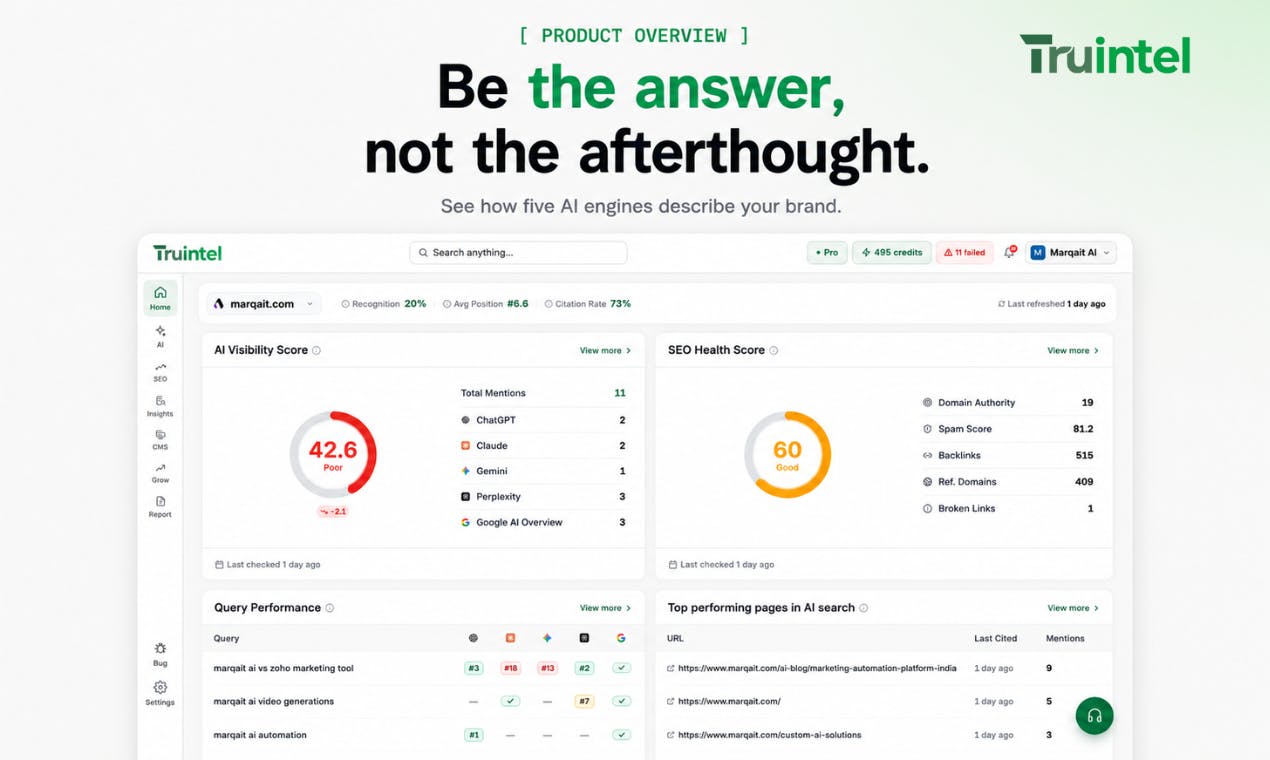
Core Features of TruIntel
Based on its Product Hunt listing, TruIntel's core capabilities can be summarized across three dimensions:
Tracking Brand Performance in AI Search
TruIntel monitors how your brand appears in responses from major AI models (ChatGPT, Gemini, Claude, Perplexity, etc.) when they answer relevant questions. It essentially visualizes "how AI sees you" — when users ask industry-related questions, does the AI mention your brand? In what way? This was previously a nearly unmeasurable blind spot.
Notably, mainstream AI search products widely employ RAG (Retrieval-Augmented Generation) technology. RAG works by converting user questions into retrieval queries, recalling relevant document fragments from external knowledge bases or the live web, then injecting these fragments as context into the LLM's prompt for the model to synthesize a final answer. This means whether brand content gets cited by AI depends on two critical stages — first, whether content can be recalled during retrieval (related to traditional SEO indexability and keyword matching), and second, whether recalled content is deemed high-quality and trustworthy by the model (involving content structure, fact density, and source authority). Understanding RAG's two-layer filtering mechanism is the technical foundation for understanding AI search visibility, and the analytical logic behind tools like TruIntel.
Revealing Competitor AI Citation Patterns
The tool shows in which contexts competitors are being cited by AI. In generative search, "being cited" often means being treated as an authoritative source or recommended option. If your competitors frequently appear in AI answers while you don't, that's a clear market signal.
One-Click Brand Visibility Fixes
TruIntel emphasizes it can not only diagnose but also help solve problems. It claims to help users discover visibility gaps, identify factors preventing AI from understanding their brand, and "fix many of them in one click," making brands easier for AI to discover, understand, and recommend.
From SEO to GEO: The New Generative Engine Optimization Arena
What TruIntel represents is a concept gaining significant industry attention — GEO (Generative Engine Optimization), also known as AEO (Answer Engine Optimization).
GEO is not purely a marketing buzzword; it's backed by serious academic research. In late 2023, a joint research team from Georgia Tech, IIT Delhi, and Princeton University published a paper titled "GEO: Generative Engine Optimization," the first systematic study on optimizing content for visibility in AI-generated answers. The research found that strategies like adding statistics, citing authoritative sources, using technical terminology, and improving content fluency and readability can significantly increase the probability of content being cited by generative engines. Notably, adding citations to authoritative sources can boost visibility by up to 40%. This research provides a preliminary methodological framework for GEO and demonstrates that AI's "citation preferences" can be studied and influenced.
The underlying logic has fundamentally shifted:
- Traditional SEO pursues "rankings" — getting pages to appear at the top of search result lists for users to click through.
- GEO pursues "being cited" and "being recommended" — making brand content a source that AI relies on when generating answers.
This means the optimization goal has shifted from "getting clicks" to "entering AI's knowledge and reasoning chain." Whether content is well-structured, whether facts are clear and verifiable, and whether brand information is repeatedly mentioned across authoritative channels all influence whether AI will "say your name."
From this perspective, tools like TruIntel are inevitable. When channels shift, analytics tools measuring channel performance follow — just as the Google era spawned SEO analytics platforms like Ahrefs and SEMrush. The history of SEO analytics tools mirrors the evolution of search behavior: in the early 2000s, tools like Google Analytics and Google Search Console helped webmasters understand traffic sources and page performance; in the 2010s, Ahrefs (founded 2011) and SEMrush (founded 2008) elevated competitive analysis to new heights, maintaining massive backlink databases and keyword ranking tracking systems — Ahrefs currently tracks over 17 billion web pages and maintains one of the industry's largest backlink indexes — transforming SEO from guesswork into a data-driven discipline. The common premise of these tools is that search engine result pages (SERPs) can be systematically crawled and structurally analyzed. AI-generated answers break this premise — there's no fixed SERP to crawl; answers are dynamically generated and non-deterministic. This is the fundamental paradigm shift that TruIntel and similar next-generation tools are trying to address.
A Measured Perspective: Limitations of an Early-Stage Product
It's worth noting that TruIntel is still at a very early stage. At the time of its launch, it had received 4 upvotes and 8 comments, ranked 19th, built by independent developer Aamir, and categorized under Marketing, SEO, and Artificial Intelligence.
This scale suggests it's closer to an MVP (Minimum Viable Product) than a mature platform. MVP is a core concept in lean startup methodology, systematized by Eric Ries in his 2011 book The Lean Startup. The core idea is to build the smallest product version that can validate key assumptions, using real user feedback to guide subsequent iterations. Launching on Product Hunt as an indie developer is a typical MVP validation path in the SaaS industry — gathering feedback through an early adopter community. It's worth noting that first-day metrics on Product Hunt are influenced by launch timing, promotion strategy, and other factors; many tools that later became successful had equally modest debuts.
Some claims in its marketing should be viewed with measured expectations:
- Measurement accuracy is questionable: AI model responses are stochastic and context-dependent — the same question may yield completely different citations at different times or with different prompts. How to stably and reproducibly measure "brand visibility" is a fundamental technical challenge for such tools. This problem is rooted in LLM generation mechanics — the temperature parameter controls output randomness, and even at temperature 0, different system prompts, conversation contexts, and model version updates all cause output variations. Obtaining statistically reliable brand visibility data requires sampling many differently worded queries multiple times and aggregating results, which poses high demands on both computational cost and methodology design.
- "One-click fix" has vague boundaries: Whether a brand gets cited by AI largely depends on its distribution across training data and real-time retrieval sources — something a frontend tool can't easily change. A more realistic approach might be providing content optimization suggestions — for example, based on findings from the GEO research mentioned above, recommending more citations and statistics in content, improving structured markup (such as Schema.org markup), and enhancing content distribution on high-authority platforms — rather than directly intervening in AI output.
- Intensifying competition: GEO/AEO has already attracted numerous startups and established SEO vendors. TruIntel needs to differentiate on data quality, model coverage breadth, and actionability.
Why Brands Need to Pay Attention to AI Search Visibility
Despite the product itself still needing maturation, the trend TruIntel points to cannot be ignored. For any brand or content creator that relies on search traffic for customer acquisition:
Users' questions are being answered directly by AI, and whether you're included in that answer is becoming the new competitive battleground.
If AI never mentions your product when answering "what are the best project management tools," then no matter how high your traditional SEO rankings are, you're at a disadvantage in this new battle. This risk of "being forgotten by AI" is an entirely new dimension that never existed in the traditional SEO framework.
Therefore, regardless of whether TruIntel or another player ultimately wins, "monitoring and optimizing brand presence in AI answers" will become a standard practice in digital marketing. For practitioners, now is the window to understand this new logic and start experimenting with related tools.
Conclusion: Brand Survival Rules in the AI Search Era
TruIntel is a quintessential product "born of the moment" in the AI search era: its value lies not in its current completeness, but in precisely hitting the fundamental shift in search behavior. It reminds every brand — the subject of analysis has expanded from search engine result pages to every answer AI provides.
For teams looking to get ahead on GEO, rather than waiting for a perfect tool, start now: personally ask major AI models questions about your industry and see if they recognize you. This simple self-test might be the best first step toward understanding the GEO era.
Related articles

"Black October": Did AI Uncover 3% of All Critical Vulnerabilities Ever?
A Reddit post claims 3% of all critical software vulnerabilities ever were found in the past month, dubbed 'Black October.' We break down the statistical issues, how AI-assisted code auditing accelerates discovery, and how developers should respond.

Microsoft Project Gecko: Using AI to Bridge Language Gaps for African Farmers
Microsoft's Project Gecko launches PharmaChat, letting African farmers ask questions in their native language and get precise video clips and farming book chapters via AI. The project also releases three interactive manuals to advance inclusive AI.

Musk's Space Dominance: How Starlink Throttling Undermines Ukraine's Defense
SpaceX's Starshield throttling disabled Ukraine's high-speed interceptor drones, exposing how Musk's private control over low Earth orbit communications affects battlefield dynamics and national security, and highlighting the risks of commercial space militarization and space governance dilemmas.