Trump Abandons Plan to Rename the Atlantic: Google CEO Talked Him Out of It
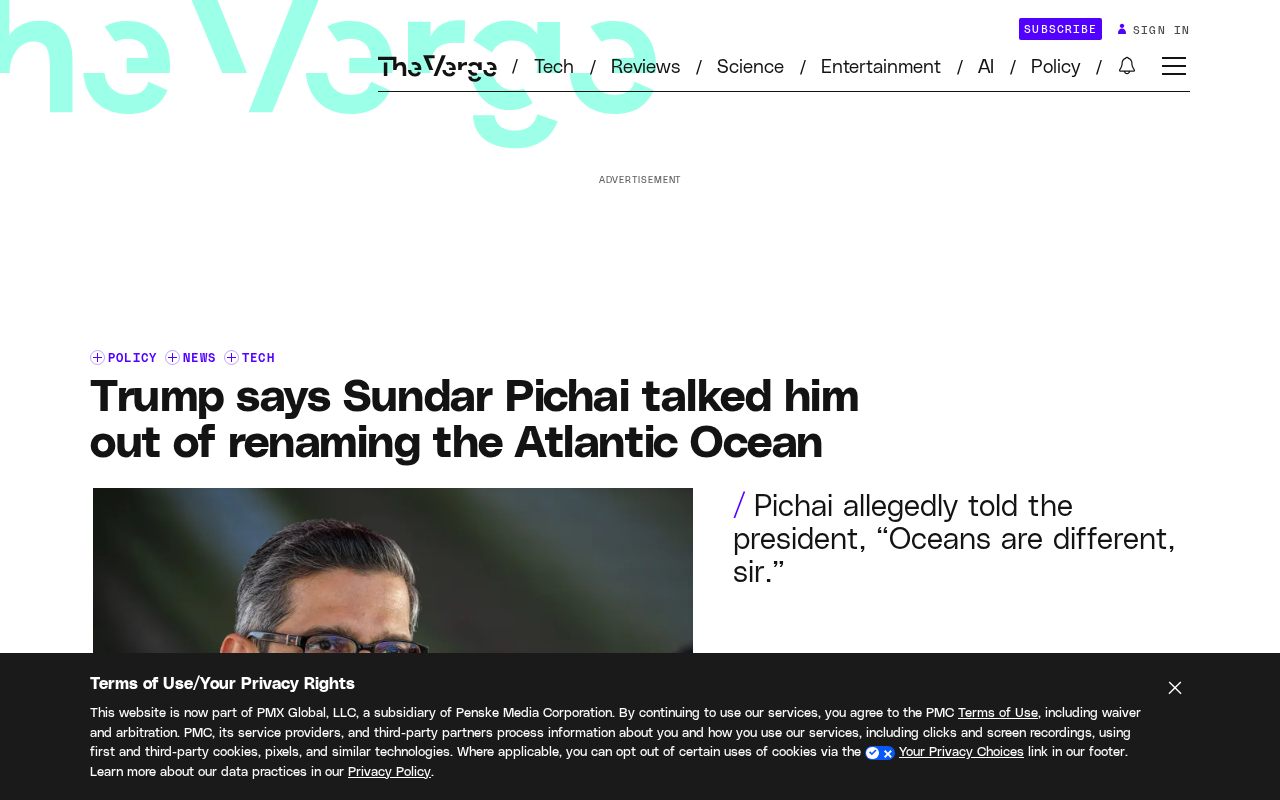
Trump wanted to rename the Atlantic but was dissuaded by Pichai, reflecting tech platforms' naming dilemma under political pressure.
The article reports that Trump revealed at a rally that he had wanted to rename the Atlantic Ocean, but Google CEO Pichai persuaded him to abandon the idea. Previously, Google Maps had changed the names of the Gulf of Mexico and Lake Ontario per executive orders, raising questions about tech platform independence. The article analyzes Google Maps' naming logic and political pressure, noting the dilemma between legal compliance and global data consistency. Trump's naming preferences are seen as symbolic politics of "America First," while Pichai's dissuasion is interpreted as mild resistance. The incident highlights the delicate game between tech giants and government power and the role of CEO personal communication in crisis management. It concludes by discussing the neutrality dilemma of tech platforms, arguing that seemingly technical decisions like place name labeling easily take on additional meaning in a polarized environment, and how platforms draw the line remains an ongoing challenge.
A Renaming Saga: From the Gulf of Mexico to Lake Ontario
According to The Washington Post, Trump revealed at a rally on Wednesday night that he had considered renaming the Atlantic Ocean, but after speaking with Google CEO Sundar Pichai, he decided to "probably let that one go." This statement comes on the heels of Google Maps having already changed the names of the Gulf of Mexico and Lake Ontario in accordance with Trump's executive order.
At the rally, Trump described his conversation with Pichai: "I called him up, I said, 'Sundar, I want to change the name of the Atlantic Ocean.' He said, 'Sir, that's a bit much.'" The specific details of this conversation have not been confirmed by Google, but Trump's public account has already sparked a new round of discussion at the intersection of technology and politics.
Google Maps' Naming Logic and Political Pressure
As one of the most widely used map services in the world, Google Maps typically follows official naming conventions and local language customs for place labels. However, when executive orders intervene, platforms often face a dilemma: should they adhere to neutral technical standards, or cooperate with political decisions?
Previously, Google Maps adjusted the names of the Gulf of Mexico and Lake Ontario in accordance with Trump's executive order, which already prompted some users and observers to question the independence of tech companies under political pressure. Pichai's reported pushback against further renaming may have been an attempt to test a boundary—cooperating with some demands to maintain an operating environment while avoiding entanglement in more absurd naming controversies.
This incident also reflects the delicate game between tech giants and government power. Google needs to maintain the accuracy and consistency of map data globally, while political intervention could undermine its credibility. Pichai's response has been interpreted by outsiders as a form of mild resistance, but some worry that this kind of "bargaining" interaction itself has already blurred the line between business and politics.
Google Maps' place name data primarily comes from official toponymic databases, commercial map suppliers, and user contributions, and its labeling policy generally follows the principle of "reflecting local official names and common usage." But when executive orders demand name changes, platforms face a conflict between legal compliance and global data consistency. For example, the U.S. Board on Geographic Names (BGN), under the Department of the Interior, is responsible for standardizing place names at the federal level; executive orders can push renaming through this agency, which in turn affects data sources for Google and other platforms. If a platform completely refuses to cooperate, it may face regulatory pressure; if it fully complies, it may damage its neutral image among global users. This tension is precisely the root of why tech companies find it difficult to maintain absolute neutrality in place name labeling.
Trump's Naming Preferences and Political Symbolism
Trump's fixation on place names is not new. In his political narrative, renaming geographic entities often carries strong symbolic meaning, aimed at reinforcing his "America First" stance. Renaming the Gulf of Mexico, in the eyes of supporters, demonstrates sovereignty; in the eyes of critics, it is a deliberate attempt to create cultural division.
Although the Atlantic renaming proposal was shelved, this episode reveals the casualness and试探 (tentativeness) in Trump's decision-making style. By publicly recounting his conversation with Pichai, he both showed his "openness to advice" and hinted at the influence tech leaders have over him. This narrative approach has a dual effect at rallies: it lets supporters see his "flexibility" while making opponents worry about the seriousness of policy-making.
Currently, Google has not responded to Trump's account. Regardless of the actual details of the conversation, this incident has become a typical case demonstrating the predicament of tech platforms in political turmoil and the role of CEO personal communication in crisis management.
"America First" is the core slogan of Trump's political brand, encompassing not only trade and immigration policy but also extending into cultural and symbolic realms. Renaming geographic entities (such as changing the Gulf of Mexico to the "Gulf of America") is a low-cost, high-visibility form of symbolic politics that can reinforce sovereignty narratives among supporters while provoking cultural anxiety among opponents. This strategy exploits the nature of place names as carriers of collective memory and political identity, turning seemingly technical naming issues into tools for political mobilization. Trump's public recounting of his conversation with Pichai at the rally is also an extension of this symbolic politics: by showcasing private interactions with tech leaders, he simultaneously signals "listening to advice" and "exerting influence."
The Neutrality Dilemma of Tech Platforms
From a broader perspective, Google Maps' naming adjustments are just one corner of the political pressure faced by tech platforms. Content moderation on social media, search engine result ranking, place name labeling on maps—these seemingly technical decisions can all take on additional meaning in a politically polarized environment.
Pichai's dissuasion of Trump from renaming the Atlantic may have temporarily avoided an even more bizarre naming controversy, but Google's compromises on the Gulf of Mexico and Lake Ontario have already set a precedent. In the future, as more executive orders touch on platform data labeling rules, how tech companies draw the line will be an ongoing challenge. For users, they want the names on maps to reflect geographic facts, not political winds.
This incident also reminds us that tech company CEOs are increasingly playing the role of political buffers. Their personal communication skills can sometimes influence policy direction more than corporate PR departments. But whether this informal channel relying on personal relationships is sustainable and transparent deserves further observation.
The neutrality dilemma of tech platforms stems from their dual role: both commercial service providers and public information infrastructure. In scenarios such as place name labeling, content moderation, and search result ranking, platform decisions appear technical but actually involve value judgments. In a politically polarized environment, any adjustment can be interpreted as taking a stance. Solutions proposed by academia and regulators include: increasing decision-making transparency (such as disclosing the basis and process for place name changes), establishing multi-stakeholder governance mechanisms, and clarifying the boundary between legal compliance and platform autonomy. However, these solutions still face challenges in practice, because there is often an irreconcilable contradiction between the legitimacy of executive orders and the expectations of global users.
One-line Summary
Trump wanted to rename the Atlantic but was dissuaded by Pichai, reflecting the naming dilemma of tech platforms under political pressure.
Paragraph Summary
The article reports that Trump revealed at a rally that he had wanted to rename the Atlantic Ocean, but Google CEO Pichai persuaded him to abandon the idea. Previously, Google Maps had changed the names of the Gulf of Mexico and Lake Ontario in accordance with executive orders, raising questions about the independence of tech platforms. The article analyzes Google Maps' naming logic and political pressure, pointing out that the platform faces a dilemma between legal compliance and global data consistency. Trump's naming preferences are seen as symbolic politics of "America First," while Pichai's dissuasion is interpreted as mild resistance. The incident highlights the delicate game between tech giants and government power, as well as the role of CEO personal communication in crisis management. The article concludes by discussing the neutrality dilemma of tech platforms, arguing that seemingly technical decisions such as place name labeling can easily take on additional meaning in a politically polarized environment, and how platforms draw the line will be an ongoing challenge.
Related articles

iPhone Duo Review Controversy: Why Apple's First Foldable Is Said to 'Should Be Called an iPad'
The Vergecast debates the iPhone Duo review controversy: is a 7 fair? Why are apps struggling? Why critics say it 'should be called an iPad'? We unpack Apple's first foldable's positioning mismatch and first-gen compromises, plus AI security flaws and agentic shopping.

Meta vs. Publishers: The AI Data Battle Over Terms of Service Changes and the Future of the Internet
Meta changed its business account terms to allow AI training on linked website data, sparking backlash from publishers and creators. Industry groups demanded negotiations, forcing Meta to remove 'training' wording and delay the effective date. The dispute reveals the deeper battle over data authorization and the future of the internet in the AI era.

When Outside Xbox Meets Blood on the Clocktower: A Legion Match in Minecraft
Outside Xbox guests Ellen and Mike play Minecraft Blood on the Clocktower in a Legion game. How can three good players fight an evil majority amid information noise? This article breaks down Legion mechanics, information-role mind games, and the endgame reversal.