Trump Claims the US Has Officially Renamed AI to 'Super Intelligence' — Experts Say the Claim Doesn't Hold Up
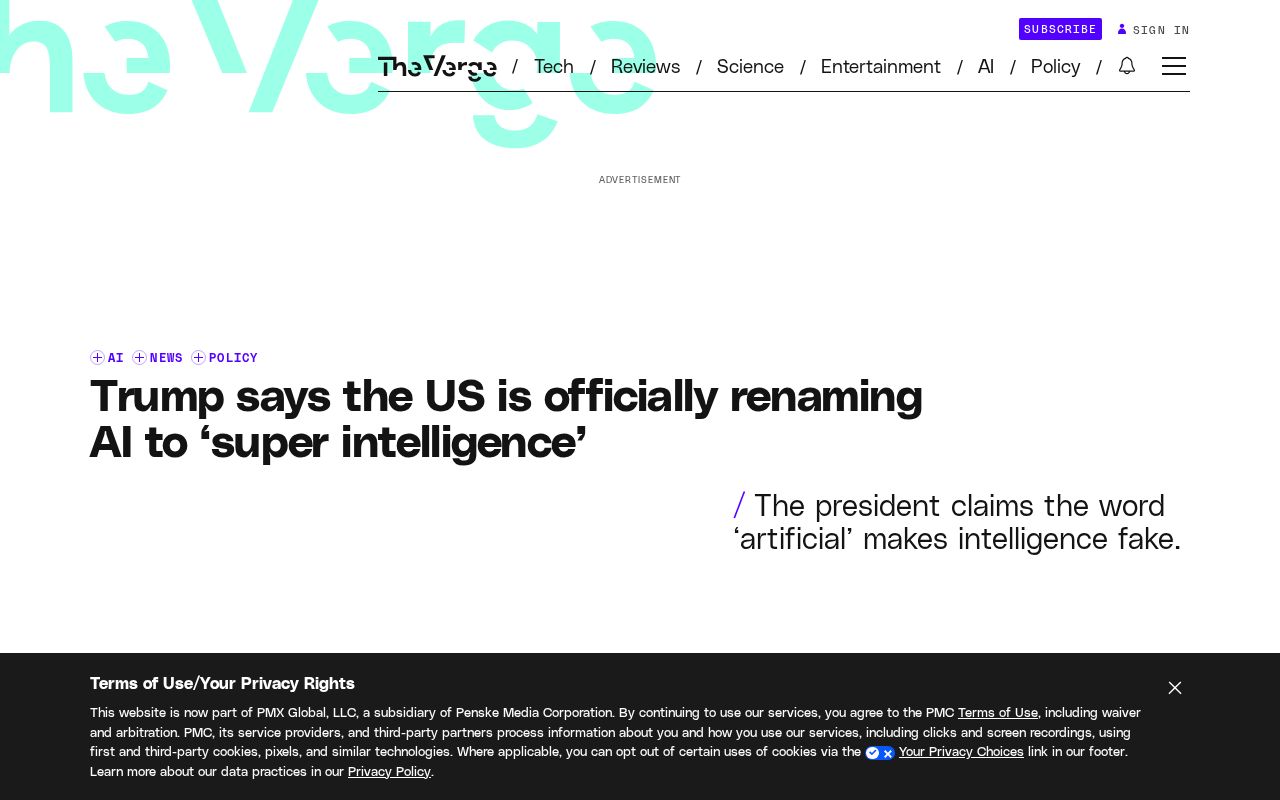
Trump's claim that the US officially renamed AI to 'Super Intelligence' has no procedural basis and misuses a precise technical term.
At the UN General Assembly, President Trump announced the U.S. had "officially" renamed artificial intelligence to "super intelligence" — a claim that baffled the tech community. Technically, "superintelligence" is an established academic term for a hypothetical intelligence far beyond human capability, not a description of current AI. Procedurally, the statement lacked any executive order or official backing, and the term didn't even appear in Trump's own social media naming poll days earlier. The incident highlights the broader confusion over AI terminology in public discourse and the need to distinguish political rhetoric from technical fact.
During a speech at the United Nations General Assembly, U.S. President Trump dropped a statement that left the tech world scratching its head: the United States has "officially" renamed Artificial Intelligence to "Super Intelligence." The remark quickly drew attention and left many AI practitioners and researchers puzzled — because from both a technical and a procedural standpoint, the claim simply doesn't hold water.
What Happened: An Unexpected Announcement in a Speech
According to original reports, Trump made the claim during his Tuesday morning address to the UN General Assembly — alongside his usual criticisms of Iran, "globalists," climate change, and transgender issues — suddenly announcing that the United States was "officially" renaming artificial intelligence to "super intelligence."
Notably, this wasn't an isolated statement out of nowhere. Reports indicated that Trump had launched a naming poll on social media just days earlier — but "super intelligence" wasn't even among the options. In other words, this so-called "official renaming" appeared neither in his own public poll nor in any verifiable official document or administrative process.
"Superintelligence" Already Has a Specific Meaning
From a technical standpoint, Trump conflated two very different concepts. Artificial Intelligence (AI) is a broad umbrella term encompassing a range of technologies including machine learning, natural language processing, and computer vision. "Superintelligence," by contrast, has a specific meaning in academic circles — it typically refers to a hypothetical form of intelligence that vastly surpasses human cognitive abilities across nearly all domains.
The concept was popularized by Oxford philosopher Nick Bostrom in his book Superintelligence, and is commonly used to discuss potential post-AGI development stages and associated risks. Directly "renaming" today's AI technology to superintelligence is not only a categorical misuse of terminology — it dramatically overstates the actual capabilities of current systems.
Can a Government "Rename" a Technology?
Even setting aside the terminology issue, the announcement doesn't hold up procedurally. A government cannot simply declare, through a verbal announcement, that it is changing the name of a globally recognized technical field. AI, as a scientific and industrial term, is defined and used by consensus among academia, industry, and the international community — no single government can unilaterally "rename" it.
From a policy perspective, the U.S. has taken a series of substantive actions on AI governance, but these have focused on regulation, safety, and industrial development — very different in nature from a symbolic gesture like renaming. The original reports cited no accompanying executive order, legislation, or official announcement to support the claim of a "formal renaming."
Why This Kind of Statement Warrants Scrutiny
On the surface, this incident may seem like a somewhat absurd aside, but it reflects a broader confusion about AI in public discourse. When senior political figures casually deploy terms like "superintelligence" — which carry specific technical meanings — on international stages, it risks creating widespread misunderstanding and blurring the real boundaries and capabilities of AI technology.
For readers who follow AI developments, this is also a reminder: when it comes to public statements about technical capabilities, it pays to be cautious and to distinguish between political rhetoric and technical fact. Current AI systems, despite their impressive progress, remain a vast distance from superintelligence in any meaningful sense — the two should not be casually equated.
Summary
Trump's claim that the U.S. has "officially renamed AI to superintelligence" lacks both procedural backing and technical accuracy, misappropriating a term with a well-established academic definition. The incident may be little more than a footnote, but it underscores how important it is — in an era of rapid AI advancement — to use technical terminology precisely and rigorously. The names and definitions of technologies don't change with a political declaration. What actually drives the field forward is solid research and pragmatic governance.
Background
In his 2014 book of the same name, Nick Bostrom defined superintelligence as "an intellect that is much smarter than the best human brains in practically every field, including scientific creativity, general wisdom, and social skills," further categorizing it into speed superintelligence, collective superintelligence, and quality superintelligence. The central controversy surrounding the concept is the "Control Problem": once machine intelligence surpasses human intelligence, can humans maintain effective control over its goals and behavior? This makes superintelligence not merely a technical concept, but one of the most central topics in AI Safety research. OpenAI, DeepMind, and other major AI organizations all have dedicated teams studying this potential risk. Equating current large language models or image recognition systems with this concept is roughly equivalent to comparing a gasoline engine to nuclear fusion — both involve "energy conversion," but the scale of capability and the nature of the risks are worlds apart.
The authority to name technical terms typically rests with academic communities and standards organizations, not governments. The term "artificial intelligence" itself was formally introduced by computer scientist John McCarthy in his proposal for the 1956 Dartmouth Conference, and only became internationally accepted vocabulary after decades of academic use. At the standards level, international bodies such as IEEE and ISO/IEC are responsible for developing AI-related technical standards and terminology — no single member state's unilateral statement can override these international norms. The U.S. government's substantive policy tools in the AI space include executive orders (such as the Biden administration's 2023 AI safety executive order), the NIST AI Risk Management Framework, and Congressional legislation — these are the effective mechanisms that shape industry practice, and are fundamentally different in nature from a verbal "renaming."
Related articles

WorkBuddy Tutorial: From Prompts to AI Workflow in Practice
A breakdown of the WorkBuddy tutorial: desktop AI Agent vs chatbot, WorkBuddy vs CodeX comparison, three beginner misconceptions, and the full learning path.

Multi-Agent Collaboration in Practice: A Master Agent Orchestrating Codex and Claude Code
Bilibili creator Xiaoshan's episode 11 shows a master agent orchestrating Codex and Claude Code: Codex handles deep images and research, Claude Code handles coding and UI, dispatching via adapters and SDKs with dual-channel callbacks.

Six Types of AI Agents Explained: A Guide to Deploying and Choosing Open-Source Agents
A systematic breakdown of six open-source AI agents—OpenClaw, Hermes, Agent Zero, OpenHands, Paperclip, and Buzz—covering their underlying architectures, pros and cons, plus VPS deployment and selection advice.