Trump Loosens Methane Emissions Rules: A Clash Between Climate and Regulation

The Trump administration plans to relax methane leak regulations, reducing burdens on the oil and gas industry but potentially exacerbating short-term climate impacts and legal risks.
The Trump administration is expected to announce relaxed methane leak regulations for the oil and gas industry, another boon for fossil fuels after multiple environmental policy rollbacks. Methane is a potent greenhouse gas with a 20-year greenhouse effect up to 80 times that of CO2, and the oil and gas sector is a major source. Previous rules required detecting and repairing leaks; relaxation means more methane enters the atmosphere, accelerating short-term warming. Supporters say it lowers compliance costs and enhances energy independence; critics fear environmental costs shift to the public. Federal environmental regulation is systematically contracting, and states and environmental groups may challenge the new rules legally. Companies gain short-term operational flexibility but face long-term reputational and legal risks.
Background: Methane Rules Weakened Again
According to RSS sources, the Trump administration is expected to announce plans today to relax regulations on methane leaks. This is another boon for the fossil fuel industry following a series of environmental policy rollbacks. Methane is not only a pollutant that contributes to smog but also a potent greenhouse gas—over a 20-year timescale, its greenhouse effect can be 80 times that of carbon dioxide. As the primary component of natural gas, methane leakage has long been a subject of concern.
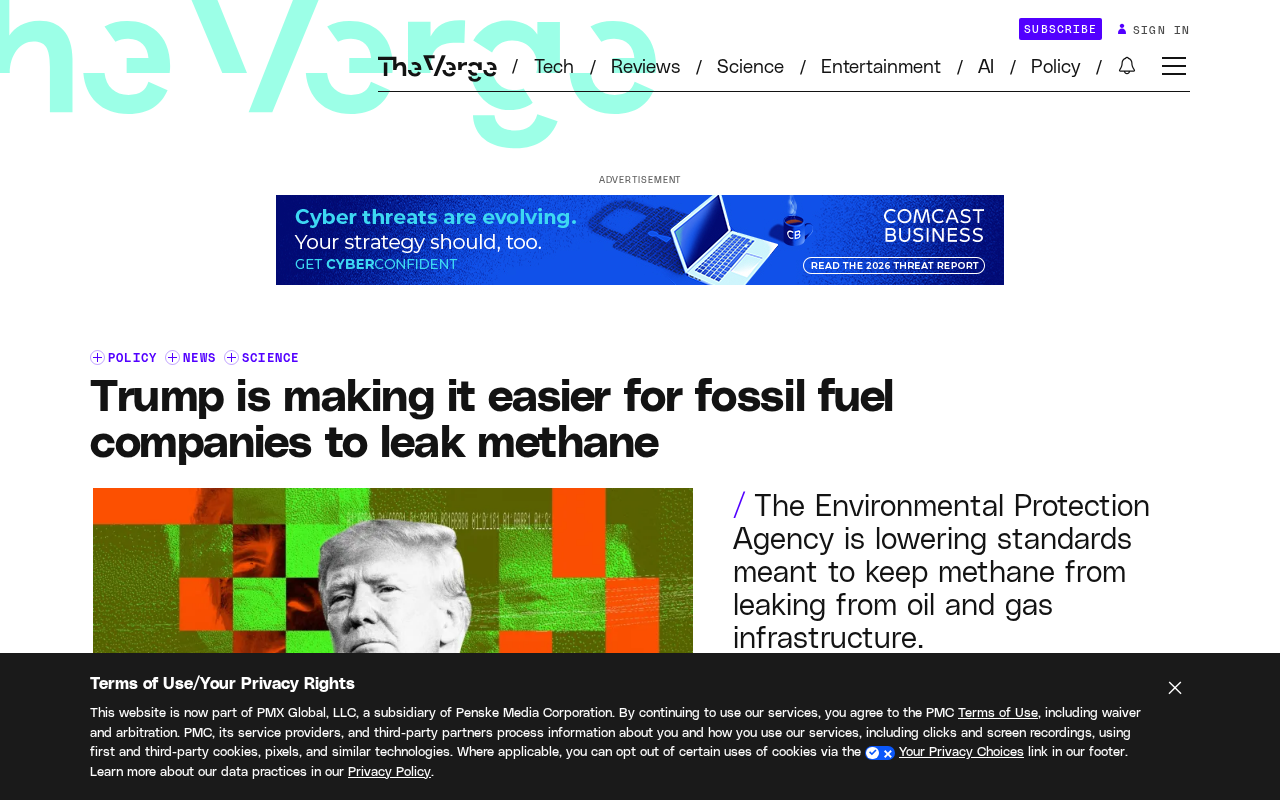
The core of this policy adjustment is to reduce compliance requirements for oil and gas companies in controlling methane emissions. Although specific details have not yet been released, the direction is clear: reduce industry burdens and loosen environmental regulation.
Global Methane Pledge and Oil & Gas Methane Partnership: At the 2021 COP26 climate conference, more than 100 countries signed the Global Methane Pledge, aiming to reduce anthropogenic methane emissions by at least 30% from 2020 levels by 2030. The United States was one of the driving forces behind this pledge. Meanwhile, the Oil & Gas Methane Partnership 2.0 (OGMP 2.0), convened by the United Nations Environment Programme, requires member companies to report methane emissions at a more granular level, and dozens of international oil and gas companies have already joined. The Trump administration's regulatory rollback directly tensions with these international commitments and industry self-regulation frameworks, potentially undermining U.S. credibility in global methane governance.
Why Methane Is in the Spotlight
Methane's greenhouse effect is far stronger than that of carbon dioxide, especially in terms of short-term climate impact. The scientific community widely agrees that controlling methane emissions is one of the key levers for mitigating climate change. The oil and gas industry is a significant source of methane emissions, with leakage risks present from drilling and production to transportation.
Previously implemented methane rules aimed to reduce emissions by detecting and repairing leaks. Relaxing these requirements means more methane will enter the atmosphere directly, exacerbating short-term warming trends.
Measurement and Detection Technologies for Methane Emissions: Quantifying methane leaks has long been controversial, relying mainly on two approaches—"bottom-up" (based on equipment counts and emission factors) and "top-down" (based on satellites, aircraft, or ground-based remote sensing)—with results often differing by several times. In recent years, satellite monitoring capabilities have rapidly improved, with platforms such as MethaneSAT, GHGSat, and Sentinel-5P now able to locate major leak events. In 2023, the United Nations Environment Programme launched the Methane Alert and Response System (MARS), which can notify countries and companies of leak sites. Increased technological transparency means that even if federal rules are relaxed, leak facts may still be exposed by third-party monitoring—one source of reputational risk for companies.
Chain Reactions of Regulatory Rollback
The Trump administration's move continues its consistent approach of loosening energy industry regulation. Supporters argue that reducing compliance burdens helps lower production costs and enhance energy independence; critics worry that environmental and climate costs will be shifted onto the public.
From a policy signal perspective, federal environmental regulation is systematically contracting. States and environmental organizations may challenge the new rules through legal channels, but policy uncertainty will persist. For oil and gas companies, operational flexibility increases in the short term, but they face reputational and legal risks in the long term.
The Clean Air Act and Paths for Judicial Challenge: U.S. federal methane rules are primarily formulated under the Clean Air Act. Environmental organizations and some states can invoke the Act's "citizen suit" provisions to sue regulators, arguing that they have failed to fulfill statutory emission reduction obligations. Historically, the EPA's authority to regulate methane emissions from the oil and gas industry has been repeatedly scrutinized in the U.S. Court of Appeals for the District of Columbia Circuit. In addition, states such as California have Clean Air Act waivers allowing them to implement stricter vehicle and stationary source emission standards independently; federal relaxation may exacerbate regulatory divergence between "red states" and "blue states." Legal proceedings typically take years, during which the rules' effectiveness remains uncertain.
Conclusion
The weakening of methane rules reflects the deep tension between climate policy and industry interests. Between scientific consensus and political decision-making, how to balance short-term economic demands with long-term climate responsibility remains an unresolved challenge.
Related articles

Android Developer Verification: Four Paths and Global Rollout Timeline
Android Developer Verification explained: Google unveils four verification paths—Play developers, independent distributors, students/hobbyists, and power users—plus developer console API automation, 24-hour safety delay, and global phased enforcement timeline.

Compose Performance Optimization: A Practical Guide to Outperforming Yourself
A deep dive into Jetpack Compose performance optimization: release-mode measurement, Baseline Profiles, Perfetto composition tracing, computed vs. derived state, effect API costs, and avoiding unnecessary recomposition.

Bitmap Memory Optimization in Practice: 5 Strategies to Reduce App Memory Usage
Based on Google I/O research across ~500 Android apps, this guide covers the Reduce, Reuse, Recycle Bitmap memory optimization strategies—CDN cropping, downsampling, Bitmap Region Decoder, cache deduplication, onTrimMemory handling, Play Console memory metrics, and local profiling toolchains.