Trump Reportedly Called Nvidia's Board to Advocate for Jensen Huang's Retention

Trump revealed he called Nvidia's board to back Jensen Huang's retention, sparking controversy over political interference in corporate governance.
According to CNBC, former U.S. President Trump confirmed in an interview that he called Nvidia's board to lobby for CEO Jensen Huang's retention, saying "I convinced them." The claim is currently Trump's unilateral account; Nvidia has not responded, and whether the board discussed Huang's position or the call's context has not been independently verified. The article notes Huang's deep ties to Nvidia's AI strategy and how external political involvement in board personnel matters raises boundary disputes over corporate autonomy.
According to a CNBC report, former U.S. President Donald Trump revealed in an interview that he had called Nvidia's board to lobby for the retention of CEO Jensen Huang. "I spoke with them, let's just say... I convinced them," Trump told CNBC. The news quickly drew attention at the intersection of technology and politics, as it offers a rare glimpse into direct interaction between political forces and the corporate governance of a semiconductor giant.
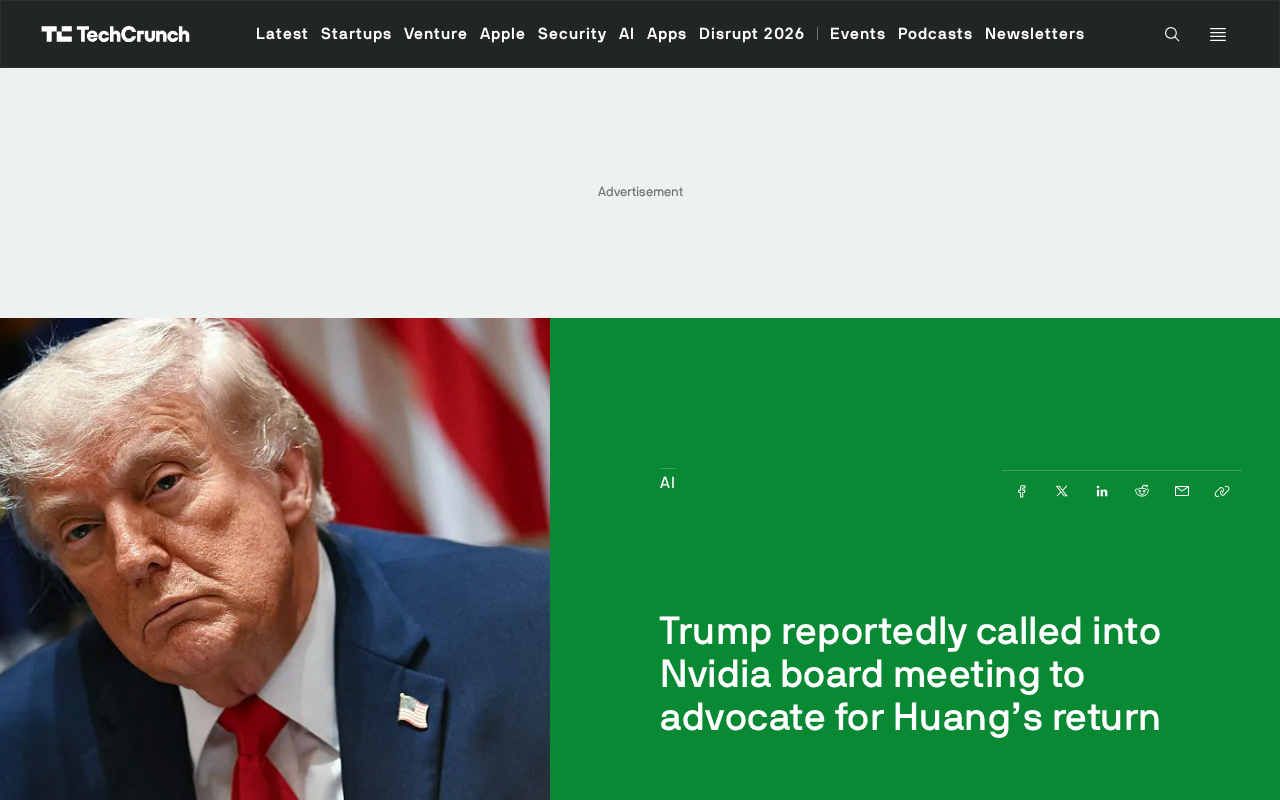
The Core of the Matter: One Phone Call and One Line — "I Convinced Them"
According to CNBC's report, Trump confirmed in the interview that he had intervened in Nvidia's board affairs, with the core demand being support for Jensen Huang to continue leading the company. He described the communication as "I spoke with them, let's just say," and stated the outcome as "I convinced them."
It should be made clear that the currently public information comes solely from Trump's own unilateral account. Nvidia has not issued any official statement on the matter, and the specific content of board-level discussions, the exact timing of the call, and whether other directors participated have not been independently verified. Therefore, the actual influence of this phone call remains open to interpretation.
What Jensen Huang Means to Nvidia
To understand why this news has sparked discussion, one must first understand Jensen Huang's position at Nvidia. As one of the co-founders, Huang has long served as CEO and is the core decision-maker for the company's strategic direction and product cadence. Against the backdrop of explosive demand for AI computing power, Nvidia's market position is highly intertwined with Huang's personal symbolism—investors, developers, and partners often directly associate the company's technology roadmap with his judgment.
This "founder-CEO" structure is not uncommon in the tech industry, but its stability is typically built on board trust and performance. Once board-level discussions of change arise, external sensitivity to strategic continuity rises significantly—which is why Trump's phone call has been amplified in interpretation.
"Founder-CEO" refers to a governance model in which a company's co-founder serves as its top executive over the long term, with typical examples including Nvidia's Jensen Huang, Meta's Zuckerberg, and Amazon's Bezos (in its early years). The advantages of this structure lie in high strategic continuity, short decision-making chains, and the founder's often deep personal investment in the company's technology roadmap; the risks lie in concentrated power, relatively weak board checks and balances, and succession planning that is easily shelved for the long term. Academic research generally holds that founder-CEOs perform better in innovation-intensive industries, but once a company enters maturity, whether governance structures should gradually become institutionalized and introduce stronger independent director oversight has long been a focus of corporate governance discussions. Nvidia's board has long been known for its strong independence, which makes any external force's involvement in its personnel discussions particularly noteworthy.
The Boundary Dispute Between Politics and Corporate Governance
From a corporate governance perspective, an external political figure directly expressing views to a board on whether a CEO should stay or go is a highly unusual move. Supporters might interpret it as concern for the stability of leadership in a key industry; critics would question whether political forces have overstepped into corporate autonomy.
The value of this report lies not in providing conclusions but in presenting a fact: at a time when semiconductors and AI have become national strategic issues, senior corporate personnel decisions are no longer purely business decisions. As a key node in the AI chip supply chain, Nvidia's leadership stability inherently carries industrial policy implications.
One of the core principles of corporate governance is that boards independently exercise the power to appoint, oversee, and dismiss executives, and external political forces should generally not directly intervene in this process. In the United States, corporate autonomy is protected by corporate law and securities regulatory frameworks, and boards bear fiduciary duties to shareholders, with decisions to be based on shareholders' long-term interests. While it is not illegal for political figures to express opinions on specific corporate personnel matters, once interpreted as pressure, it can raise ethical and reputational risks. Historically, intersections between political forces and personnel at large companies have mostly appeared in regulated industries such as defense and energy, but in semiconductors—an industry incorporated into export controls and industrial subsidy frameworks—the blurring of boundaries between politics and business is becoming a new normal.
Information Boundaries and What to Watch Next
The information currently confirmable is limited to Trump's public remarks to CNBC. The following questions remain to be clarified: whether the board actually had discussions about Huang's position, the context in which the call took place, and whether other Nvidia directors were aware of or agreed with it. Before an official response, it is premature to regard this as having "changed Nvidia's governance structure."
For those following the AI industry, what is more worth tracking is Nvidia's subsequent official statements and whether there are any changes in board composition. The true significance of this news may lie in the trend it marks: the corporate governance of AI chip giants is being drawn into a larger political narrative.
One-line Summary
Trump revealed he called Nvidia's board to back Jensen Huang's retention, sparking controversy over political interference in corporate governance.
Paragraph Summary
According to CNBC, former U.S. President Trump confirmed in an interview that he had called Nvidia's board to lobby for CEO Jensen Huang's retention, saying "I convinced them." The news offers a rare glimpse into direct interaction between political forces and the corporate governance of a semiconductor giant. Currently, the claim is solely Trump's unilateral account; Nvidia has not responded officially, and whether the board actually discussed Huang's position or the specific context of the call has not been independently verified. The article notes that Huang, as a founder-CEO, is highly intertwined with Nvidia's AI strategy, and his retention affects the market's judgment of strategic continuity; meanwhile, an external political figure directly intervening in board personnel discussions touches on the boundary dispute between corporate autonomy and political interference. As AI chips become a national strategic issue, Nvidia's corporate governance is being drawn into a larger political narrative.
Related articles

VP ≠ VNP: A Major Breakthrough in Computational Complexity Theory
A study claiming to prove VP ≠ VNP over every field sparks heated discussion on Hacker News. This article analyzes the algebraic complexity background of VP and VNP, the proof approach, community controversy, and its potential impact on computational complexity theory.

Developer Naming Woes: The Technical Names That Drive Us Crazy
Why is technical naming so maddening? From Nginx and Vite to Qt and Sudo, a YouTube creator rants about the chaos of developer naming and pronunciation, revealing the tug-of-war between creators' intentions and community habits, and the cultural roots behind spelling traps like PyPI and GNOME.

Figma Workplace Scandal: Employee Sues CEO for Forcing Confrontation with Harasser
Figma and its CEO are sued by a current employee alleging sexual harassment and discrimination, and forcing the victim to confront her harasser. This article outlines the background, potential impact, and industry reflection.