Trump's New AI Safety Plan: What Tech Leaders Think

Trump rebrands AI as 'Super Intelligence' to walk back his 'hoax' claim, but a concrete safety framework remains elusive.
After dining with top tech executives, Trump claimed his earlier dismissal of AI safety concerns as a Democratic "hoax" no longer applied — because he had rebranded the technology as "Super Intelligence." The rhetorical shift signals some softening in stance, and the term's adoption raises the perceived stakes of AI risk. Yet the signals remain largely discursive, with no enforceable regulatory plan in sight. Amid a federal legislative vacuum on AI, the uncertainty puts pressure on long-term industry decision-making and leaves the core challenge unresolved: building a stable governance framework that balances innovation with risk.
A Policy Shift After a Dinner
The Trump administration's recent statements on AI safety have drawn widespread attention. The day after dining with leaders from major tech companies, Trump was asked by reporters about his AI-related announcement — and his response was characteristically his own.
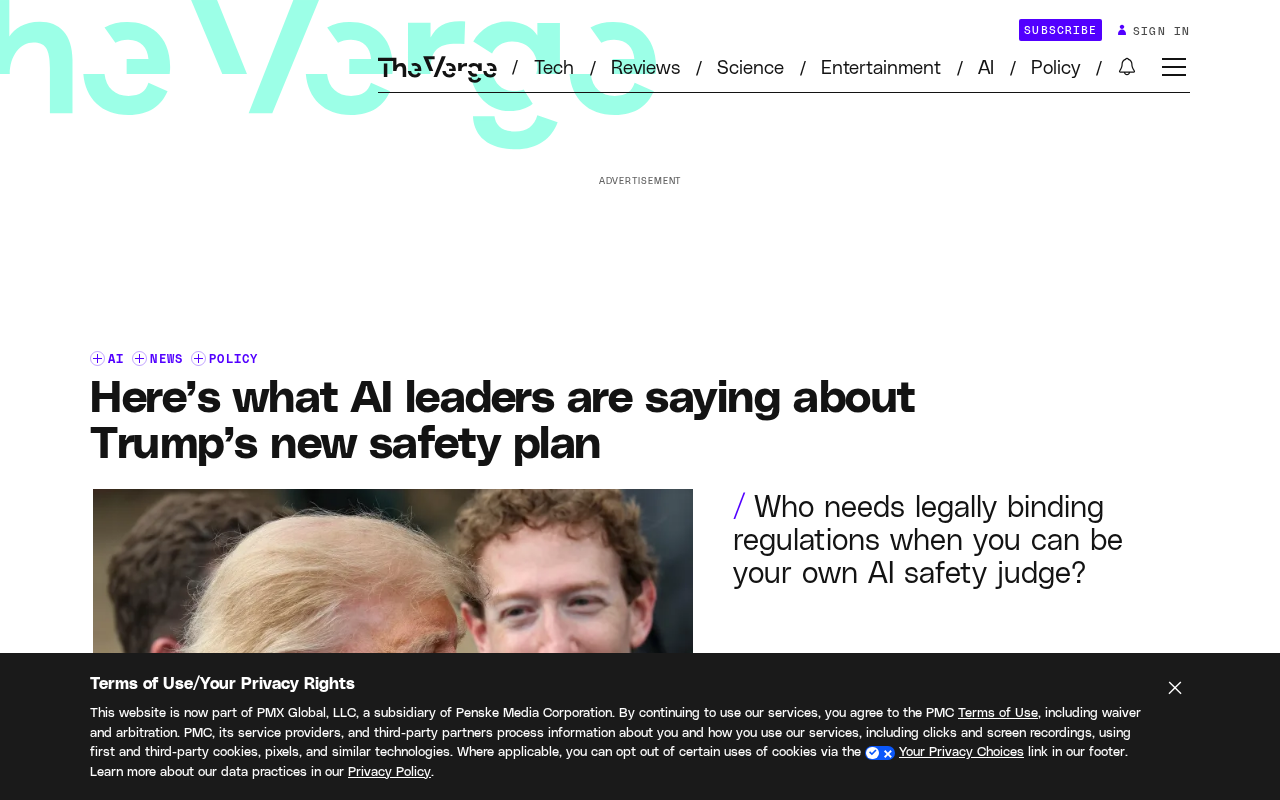
According to original reporting, Trump had previously dismissed concerns about AI safety as a "hoax" manufactured by Democrats. This time, he suggested that since he had rebranded the technology as "Super Intelligence," his earlier remarks no longer applied. The apparent reversal — and the logic of using a name change as justification for a shift in position — became the focal point of discussion.
From "Hoax" to "Super Intelligence"
Trump's attitude toward AI safety has shifted noticeably. Framing safety concerns as a political opponent's "hoax" reflected a previously dismissive stance on AI regulation. Now, by introducing the more futuristic and urgent-sounding term "Super Intelligence," he is implicitly signaling some upgrade in his perception of technological risk.
It's worth noting that naming changes in policy contexts are rarely just rhetorical games. When a technology is labeled "Super Intelligence," the risk expectations it carries, the perceived need for regulation, and public imagination all shift along with it. This explains why the tech industry remains highly sensitive to any related safety plans.
"Superintelligence" is a foundational concept in AI, first systematically articulated by philosopher Nick Bostrom in his 2014 book Superintelligence. It refers to a hypothetical AI system that significantly surpasses human cognitive capabilities across virtually all domains. Compared to the current concept of "Artificial General Intelligence" (AGI), superintelligence emphasizes a more comprehensive and overwhelming capability advantage — and is therefore regarded by many researchers as a potential source of existential-level risk. Leading AI labs including OpenAI and DeepMind list it as a central scenario in their long-term safety research. Whatever Trump's motivation, his adoption of this term has objectively pulled AI safety discourse into a framework laden with urgency and existential weight — a stark contrast to his earlier dismissal of such concerns as political manipulation.
What Tech Leaders Are Watching
The context for these policy signals matters: Trump met directly with executives from major tech companies over dinner. That format alone signals that the administration is treating industry engagement as a key part of shaping AI policy.
For tech companies, any official framework around AI safety has direct implications for their R&D roadmaps, compliance costs, and commercialization timelines. A framework that's too permissive risks being criticized for ignoring danger; one that's too strict could be seen as hampering America's lead in the AI race. Striking the right balance between innovation incentives and risk management is at the heart of what all parties are negotiating.
The Challenge of Policy Uncertainty
Based on available information, Trump's statements reflect more of an attitudinal softening than a mature, actionable safety regulatory plan. Explaining a position change by invoking a name change makes it difficult for observers to assess the actual substance or enforceability of any new plan.
This uncertainty poses a challenge for the entire industry. Companies need a stable, predictable policy environment for long-term investment decisions, and shifting official positions make planning harder. For those watching AI governance, the key questions going forward are: Will this so-called safety plan translate into specific regulations, standards, or institutional structures? And what role will major tech companies play in shaping it?
At the federal level, the United States still lacks comprehensive legislation specifically governing AI. The Biden administration's October 2023 Executive Order on the Safe, Secure, and Trustworthy Development and Use of Artificial Intelligence established a relatively systematic set of risk assessment and disclosure requirements — but Trump signed an executive order rescinding it in January 2025, pivoting instead to "removing barriers that impede AI innovation." This policy discontinuity means U.S. AI governance currently relies primarily on voluntary corporate commitments, industry self-regulation, and scattered agency rules, without a unified statutory framework. Against this backdrop, any signal from the highest executive level — whether "hoax" or "Super Intelligence" — gets amplified by industry, investors, and international regulators alike, because such statements substantially fill the expectation vacuum left by the absence of formal rules.
Summary
Trump's rhetorical shift on AI safety — from "hoax" to "Super Intelligence" — reflects the still-exploratory state of U.S. AI policy. Tech leaders' reactions combine a desire for regulatory clarity with a determination to protect room for innovation. As superintelligence gradually becomes a mainstream public topic, how to build a governance framework that both promotes development and manages risk remains an open and unresolved question.
Related articles

5 Practical Ways Real Estate Agents Can Use AI to Boost Efficiency (2026 Edition)
How can real estate agents use AI to boost efficiency? Based on a YouTube walkthrough, this breaks down five methods — ChatGPT for listing descriptions, Canva for marketing materials, forms for open house leads, Zapier for automated follow-up, and seller meeting prep — and flags risk boundaries like fair housing laws, photo authenticity, and price verification.

Grok Bot vs ChatGPT Agent: Which AI Agent Is More Powerful?
How does Grok Bot differ from ChatGPT Agent? This comparison examines how they work: Grok Bot has a cloud computer and runs persistently inside tools to execute multi-step tasks automatically; ChatGPT Agent operates web pages in a browser and is more mature at general tasks. Includes selection advice.

Walmart Agent Gateway: AI Shops for You Automatically—Why Is Amazon Going the Opposite Way?
Walmart's Agent Gateway lets ChatGPT, Gemini and other AI assistants access its product catalog to search, compare and add to cart, with spending limits and per-purchase approval. Amazon blocks external AI agents—two retail giants, opposite paths. Currently US-only, India may follow.