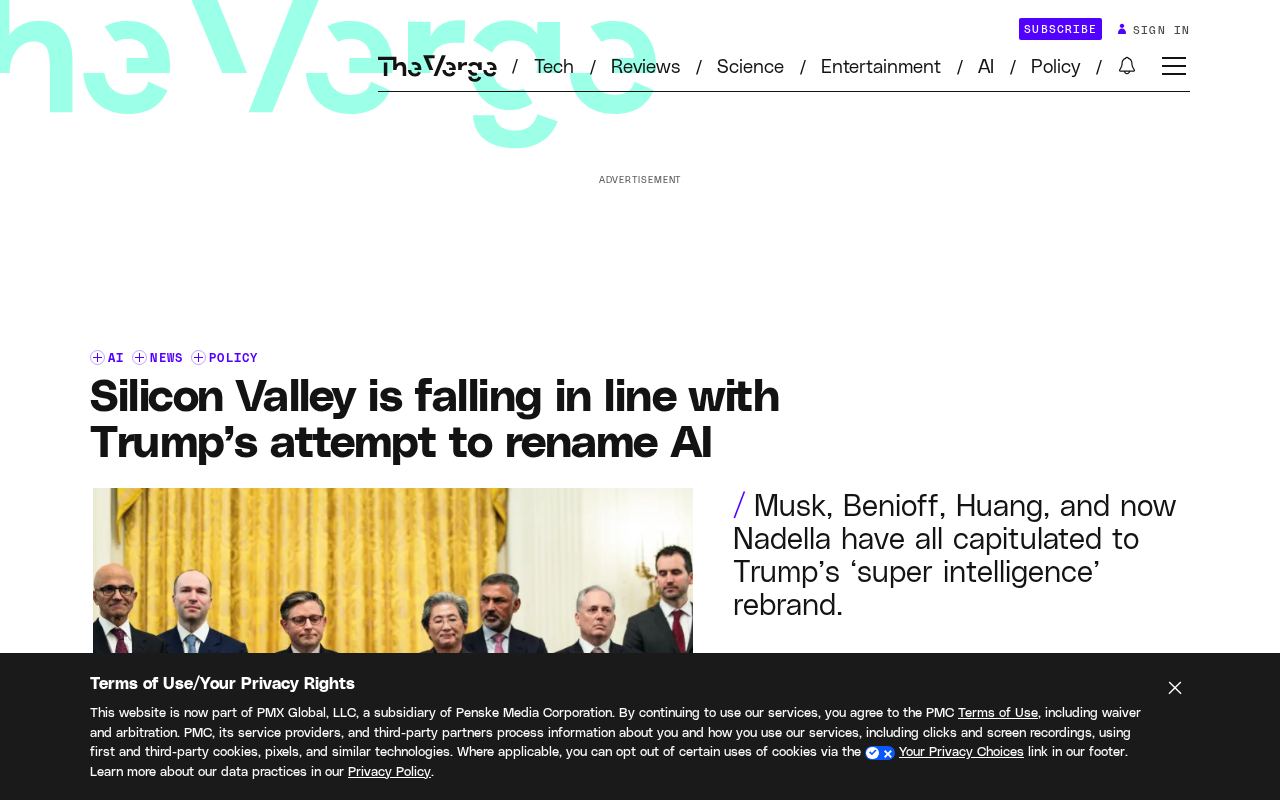
Trump Wants to Rename AI 'Super Intelligence' — and Silicon Valley Is Starting to Fall in Line

Trump's push to rename AI 'super intelligence' is gaining traction among Silicon Valley elites — here's why.
Trump has announced plans to rebrand 'artificial intelligence' as 'super intelligence' — a move that represents a significant semantic leap, since the term academically refers to a hypothetical system far beyond today's large language models. Despite this, some of Silicon Valley's most influential tech leaders are starting to cooperate with the narrative, driven by regulatory concerns, a desire to claim the 'superintelligence era' story, and classic elite herd behavior. The general public, meanwhile, continues to say 'AI,' highlighting the strong inertia resisting top-down terminology change. At its core, this renaming episode reveals how the power to define technology has become a new arena for political and commercial competition.
A Power Struggle Over a Name
When President Trump announced plans to rebrand "Artificial Intelligence" as "super intelligence," many people's first reaction was skepticism — could a top-down terminology overhaul actually catch on? After all, the public is already deeply familiar with the term "AI," and the force of habit is not to be underestimated.
Yet the way things have unfolded is telling. While most ordinary people continue to say "AI," some of Silicon Valley's most powerful figures have begun actively "aligning" themselves with Trump's so-called "great AI rebranding."
Why "Super Intelligence"?
The term "superintelligence" is not something Trump's team invented. In AI academia and industry, "superintelligence" has long been used to describe a hypothetical system that vastly surpasses human capability across nearly all cognitive tasks — typically viewed as a stage far beyond Artificial General Intelligence (AGI).
Applying the label "super intelligence" to today's AI technology is a clear semantic overreach. Current large language models and image generation tools are nowhere near "comprehensively surpassing human intelligence." The renaming therefore looks more like a narrative strategy than a technical clarification — embedding the political message that "America is leading the most advanced, most powerful technology" directly into everyday language.
The concept of "superintelligence" was first systematically articulated by Swedish philosopher Nick Bostrom in his 2014 book of the same name. Bostrom defined it as "an intellect that is much smarter than the best human brains in practically every field," distinguishing it from AGI (a system capable of performing all human cognitive tasks) — AGI means "on par with humans," while superintelligence means "categorically crushing humans." In mainstream AI research, superintelligence is generally treated as a distant, highly uncertain hypothetical that has yet to be realized. Even OpenAI co-founder Sam Altman defines it as "an AI system dramatically smarter than humans," a description fundamentally different from today's large language model products. Labeling 2025's existing AI technology as "super intelligence" is therefore a significant conceptual leap that blurs the academic community's careful distinctions between different stages of development.
Why Silicon Valley Is Choosing to Follow Along
What's truly worth examining isn't what Trump proposed — it's how Silicon Valley's power players have responded. Some of the most influential tech leaders have begun going along with the rebranding, actively helping Trump make it stick.
Several practical considerations are driving this
Related articles
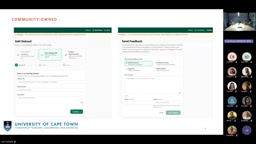
uGAP: An AI Platform Unifying 100+ African Geospatial Datasets
uGAP is an African geospatial AI platform by a University of Cape Town team, unifying 120+ African datasets with a Python SDK for discovery, processing, and model training, already used in cyclone flood mapping.

Cursor Can Now Control Your Computer: AI Agents Can Drive Desktop Apps for Testing
Cursor adds desktop control: AI agents can drive desktop apps like the iOS Simulator to test their own features. We analyze the impact on dev workflows, possible technical approaches, and reliability concerns.

Vibecoding a Custom Inference Engine: High Hopes, Harsh Reality
A Reddit developer shares the real experience of vibecoding a custom inference engine: running GGUF Q4 models in the browser with WebGL2 and GLSL, only to fall into tokenizer debugging hell. This article analyzes the engineering challenges of browser-side LLM inference and why cloning llama.cpp is the more rational choice.