TrustGraph vs Semantica: An In-Depth Comparison of Knowledge Graph Engines for Enterprise Knowledge Platforms
Architecture-focused comparison of TrustGraph and Semantica for enterprise GraphRAG knowledge platform selection.
This article provides an in-depth architectural comparison of TrustGraph and Semantica—two open-source graph engines for enterprise knowledge platforms. It covers core capabilities, scenario matching, layered coexistence strategies for large organizations, a practical decision tree based on enterprise maturity, implementation risks with mitigation approaches, and a three-phase evolution path from validation to full convergence.
Why Enterprise Knowledge Platforms Are Looking Beyond Vector Databases
As large language models penetrate deeper into enterprise production workflows, "trustworthy, explainable, and traceable" has shifted from a nice-to-have to a core development objective. While vector-based RAG has become standard in most enterprise LLM projects, its limitations become glaringly apparent once deployed in real production environments.
RAG Technical Background: RAG (Retrieval-Augmented Generation) is a core technical paradigm for modern LLM applications. The basic principle combines external knowledge bases with LLM reasoning capabilities: a retrieval system first finds relevant document fragments from a knowledge base, then feeds those fragments as context to the LLM for generation. Traditional vector RAG uses embedding models to convert text into high-dimensional vectors and retrieves the most relevant content via cosine similarity and similar methods. This approach works well for simple Q&A scenarios, but when handling queries that require understanding complex relationships between multiple entities, purely similarity-based retrieval loses structured relationship information, leading to degraded retrieval quality.
The key shortcomings of traditional vector RAG include:
- Logical gaps: Reliance on similarity-based retrieval makes it unable to handle chain-of-entity relationship reasoning. Industry benchmarks show complex multi-hop query accuracy typically only reaches 68%–72%;
- Black box problem: AI outputs are difficult to trace back to original business facts, making hallucination risk uncontrollable;
- Audit gaps: In highly regulated sectors like finance and government, vector RAG cannot maintain comprehensive decision generation ledgers or produce compliance audit evidence.
GraphRAG (native knowledge graph architecture) is purpose-built to address these pain points. Knowledge Graph Technical Overview: A knowledge graph organizes knowledge in a graph structure, with entities as nodes and relationships (relations) between entities as edges, forming a semantic network. Unlike the tabular structure of traditional relational databases, graph databases are inherently suited for storing and querying complex associations. Typical graph query languages like Cypher and SPARQL can efficiently execute multi-hop queries—reasoning across multiple layers along relationship chains. GraphRAG supports multi-hop relationship reasoning across entities, boosting complex query accuracy to 83%–87%. By introducing bitemporal capabilities to record contextual timestamps and adhering to W3C provenance standards, it builds a complete, tamper-proof provenance chain that ultimately makes outputs explainable—completing the upgrade from "usable LLMs" to "trustworthy enterprise AI."
Bitemporal Technical Explanation: A bitemporal database simultaneously maintains two time dimensions: Valid Time records when a fact is true in the real world, and Transaction Time records when the data was entered into the system. For example, an employee is promoted on January 1 (valid time), but the HR system doesn't update the record until January 15 (transaction time). Bitemporal capabilities allow the system to answer two distinct types of questions: "what the system believed at a given point in time" and "when did the fact actually occur." This is critical for audit and legal compliance scenarios. In AI decision systems, recording when the AI made a decision (transaction time) and what data the decision was based on (valid time) enables complete reconstruction of the information state at the time of the decision, supporting post-hoc audit analysis.
This article provides a thorough architectural evaluation of two popular open-source knowledge graph engines—TrustGraph and Semantica—targeting enterprise architecture teams, AI engineering leads, and data governance decision-makers.
The Real Role of Graph Engines in a Layered Architecture
Many architecture teams share a common misconception: adopting a graph engine means ripping out and replacing existing vector databases and LLM infrastructure. This is simply not the case.
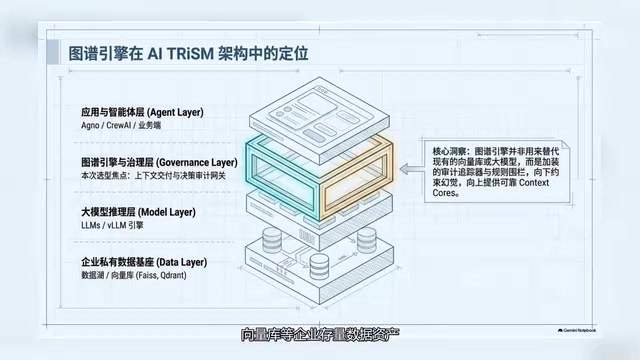
A graph engine isn't a replacement for vector databases or LLMs. Rather, it's an added layer serving as an audit tracker and rule guardrail—constraining LLM hallucinations from below while providing reliable context and fusion capabilities for upstream Agent applications.
The full AI platform can be divided into four layers:
- Enterprise Private Data Layer: Hosts data services, vector databases, and existing data assets;
- LLM Inference Layer: Handles foundational LLM generation capabilities;
- Graph & Governance Layer: The core focus of this evaluation—responsible for context delivery and decision audit gateway;
- Agent Application Layer: Runs various business Agents and workflow orchestration.
As you can see, the graph engine is essentially a middle governance layer that coexists and collaborates with existing data model systems, rather than wholesale replacing current technology assets.
TrustGraph: A Full-Stack Integrated Knowledge Management Platform
TrustGraph is released under the Apache 2.0 open-source license, with community Stars exceeding 2.5K. Open-Source License Note: Apache 2.0 is a permissive open-source license that allows commercial use, modification, and redistribution. Compared to the MIT license, Apache 2.0 includes explicit patent grant provisions, requiring contributors to grant users a perpetual patent license, along with a patent retaliation clause (if a user sues the project for patent infringement, they lose their patent grant). This provides stronger patent protection for enterprise users. Apache 2.0 also requires that modified files retain the original copyright notice and that changes are documented in the NOTICE file, offering better intellectual property protection for enterprise use.
TrustGraph positions itself as a "full-stack AI knowledge management platform." Its core philosophy is delivering a complete, out-of-the-box integrated knowledge platform with zero external API dependencies.
Core Technical Modules
- Holonic Context Graph: Packages entities, relationships, and evidence into portable, reusable context cores that can be directly consumed by upstream business applications;
- Ontology RAG Architecture: Built on the SKOS strong ontology specification, it constrains the entire knowledge extraction process from the source, fundamentally mitigating "ontology drift"—a persistent industry challenge. Ontology Engineering Note: In knowledge engineering, an ontology refers to a formal specification of concepts and their relationships within a specific domain. SKOS (Simple Knowledge Organization System) is a W3C-recommended lightweight ontology standard primarily used for representing controlled vocabularies, taxonomies, and thesauri. SKOS defines Concepts, ConceptSchemes, and hierarchical relationships between concepts (broader/narrower) as well as associative relationships (related). Ontology RAG predefines strict ontological constraints that standardize entity types and relationship types during knowledge extraction, preventing ontology drift problems such as 'CEO' and 'Chief Executive Officer' being identified as different entity types, thereby improving knowledge graph consistency and reasoning accuracy;
- Built-in Full Capability Suite: Includes a visual UI workbench, Agent orchestration, LLM inference engine, multimodal storage distribution, and data ingestion pipelines—essentially everything a knowledge platform needs is built in.
Choosing TrustGraph means getting an end-to-end, closed-loop knowledge management system without having to stitch together numerous third-party components. Its knowledge modeling ceiling is very high, but the demands on data quality and operational capabilities are correspondingly higher.
Semantica: A Bolt-On Decision Audit Device
Semantica is released under the MIT open-source license, with community adoption reaching 8.4K Stars. MIT License Note: The MIT license is one of the simplest permissive open-source licenses, requiring only that users retain the original copyright notice while allowing any modification, commercial use, and redistribution, without addressing patent grants. Compared to Apache 2.0, the MIT license has simpler compliance requirements but is less explicit regarding patent protection.
Semantica's positioning is distinctly different from TrustGraph: Semantica is a deterministic decision graph bolt-on audit device, focused on minimal-footprint, low-intrusion integration.
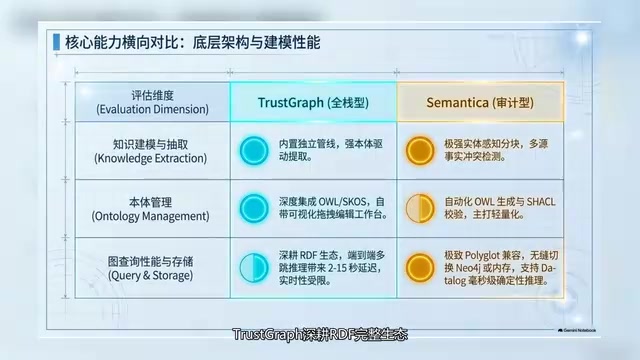
It can be mounted directly onto existing enterprise LangChain, LlamaIndex, and various Agent applications. At its core is an MCP service that can connect to existing backends like Snowflake, Databricks, and vector databases without requiring any changes to upstream business code.
MCP Protocol Technical Note: MCP (Model Context Protocol) is an emerging interoperability protocol for AI systems, similar to ODBC/JDBC standards in the database world. MCP defines a unified interface specification that allows AI applications (clients) to access various data sources and tools (servers) through a standardized approach, without writing custom adapter code for each data source. MCP servers wrap the capabilities of external data sources (such as databases, APIs, and file systems) into standard MCP interfaces, and AI applications only need to implement an MCP client to access all compatible data sources. This design dramatically reduces system integration complexity, enabling enterprises to add new data access capabilities to AI systems without modifying existing business code.
Semantica adheres to the W3C PROV-O provenance standard, instantiating every AI decision as a graph node and generating a tamper-proof causal chain. PROV-O Standard Explained: PROV-O (Provenance Ontology) is a W3C provenance ontology standard for describing the origin, generation process, and accountability of digital objects. The standard defines three core classes: Entity (a data object), Activity (a processing step), and Agent (a responsible party), along with relationships such as wasGeneratedBy, used, and wasAttributedTo. Applying PROV-O to AI systems enables recording which model produced each AI output, what input data it was based on, and what processing steps it went through, forming a complete chain of accountability that meets audit requirements in heavily regulated industries like finance and healthcare.
Semantica doesn't attempt to parse internal LLM weights—it faithfully records external inputs, matching strategies, and all output traces, while also providing bitemporal awareness that captures both event occurrence time and Agent perception time.
In short, TrustGraph focuses on "how knowledge assets are accumulated," while Semantica focuses on "how AI decision processes are audited."
Scenario Matching: When to Use Which
Selection isn't about judging which is "better"—it's about finding the right fit based on existing technology assets, compliance pressure, and team capabilities.
Scenarios Favoring TrustGraph
Existing AI system complexity is low, but compliance and traceability requirements are high; building a unified enterprise knowledge network from scratch; handling complex multi-tier supply chain dependencies; building a proprietary multi-tenant AI platform. These heavy-duty platform scenarios require comprehensive ontology management, multi-tenancy, and full lifecycle management capabilities.
Scenarios Favoring Semantica
The enterprise has already invested heavily in AI infrastructure and existing system complexity is high, with primary needs concentrated on compliance auditing—such as financial/healthcare regulatory reporting, SecOps security operations log tracing, or retrofitting existing AI systems with explainability.
Note that these scenario categories are not absolute. Large organizations can choose different technical approaches for different business domains rather than forcing a single graph engine across the entire company.
Layered Coexistence: Best Practice for Large Organizations
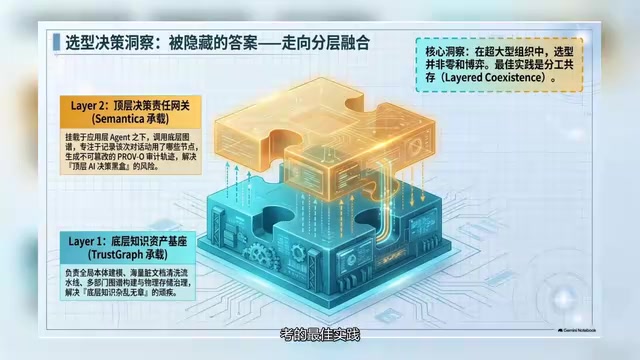
Many teams approach selection as an "either/or" decision, but a more mature approach is layered coexistence.
In very large enterprises, the following architecture can be adopted:
- TrustGraph handles the bottom layer: Serving as the knowledge asset foundation, it manages global ontology modeling, large-scale document cleansing pipelines, multi-department graph construction and storage governance, accumulating enterprise-wide knowledge assets;
- Semantica handles the top layer: Serving as the decision accountability gateway, it mounts behind various business Agent applications, consuming graph assets produced by the underlying TrustGraph layer, comprehensively recording every graph node invocation and generating tamper-proof PROV-O audit trails.
This combination provides both a powerful and comprehensive knowledge construction foundation and complete runtime audit and traceability capabilities, fully leveraging the strengths of both products.
Selection Decision Tree: Judgment Logic Starting from Enterprise Reality
This decision logic starts from enterprise reality, rather than purely evaluating product features:
- Does the organization already have mature AI infrastructure (LangChain / LlamaIndex / vector databases)? If yes, prioritize Semantica;
- Is there a need to build a unified knowledge platform from scratch with multi-tenancy and resource isolation? If yes, go directly with TrustGraph for full-stack construction;
- Is the project's most critical pain point addressing external regulatory requirements and high-standard compliance audits? If yes, still prioritize Semantica;
- Does the architecture team have expertise in K8s, DBT, and Spark? If capabilities are sufficient, consider TrustGraph's heavy-ops mode; if not, consider lightweight graph solutions or a simplified Semantica deployment.
This framework incorporates all three core factors—enterprise assets, business requirements, and team capabilities—into the decision, avoiding technology selection divorced from reality.
Implementation Risks and Mitigation Strategies
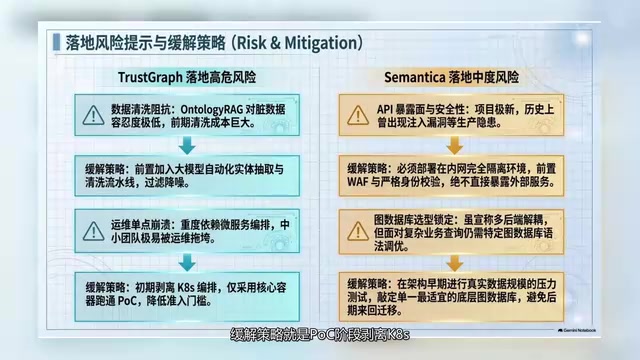
High-Risk Areas for TrustGraph
- Low dirty data tolerance: Ontology RAG has demanding data quality requirements, resulting in massive upfront data cleansing workloads. Mitigation: introduce automated LLM-powered entity extraction and cleansing pipelines early in the process to filter dirty data proactively;
- Heavy microservices operations burden: Heavy reliance on microservices orchestration is difficult for small teams to manage. Mitigation: during the POC phase, strip away complex K8s orchestration and spin up only core containers to complete business validation, lowering the initial barrier.
High-Risk Areas for Semantica
- API exposure security concerns: Historical injection vulnerabilities have been identified. Mitigation: deploy in an isolated intranet environment, add a WAF with strict parameter validation, and never directly expose the service externally;
- Underlying graph database lock-in risk: While multi-backend compatibility is claimed, complex queries are highly dependent on tuning the selected graph database. Conduct stress tests with real business data early in the architecture phase, lock in the underlying graph database, and avoid costly large-scale migration later.
Three-Phase Evolution Path: From Validation to Convergence
GraphRAG is driving enterprise knowledge from "fuzzy retrieval" toward "deterministic reasoning." Organizations should avoid trying to achieve everything at once and instead progress through three steady phases:
- Agile Validation (1–2 weeks): Rapidly deploy Semantica locally, reuse the existing vector RAG pipeline, complete closed-loop testing, and validate whether compliance audit capabilities match business needs;
- Domain Deep-Dive (1–2 months): Select an independent core business scenario such as supply chain tracking, deploy the TrustGraph workbench, and complete domain ontology modeling and operation;
- MCP Convergence (3–6 months): Use the MCP protocol to bridge the two validated capabilities, connect to the enterprise-wide Agent orchestration gateway, and finalize the layered coexistence architecture.
Conclusion: No Universal Answer, Only What Fits Your Reality
Real-world architecture selection never has a one-size-fits-all answer. Every technical solution must be evaluated against the enterprise's actual constraints. Beyond assessing the products' technical capabilities, we must also factor in legacy system migration costs, security and compliance constraints, team tech stacks, project timelines, and budgets.
TrustGraph represents a heavy asset management model, oriented toward comprehensive knowledge asset accumulation. Semantica represents a lightweight process audit model, focused on AI runtime decision tracing. The two are fundamentally different approaches, and the choice is a trade-off between these models. Ultimately, only by continuously tracking open-source community evolution and incorporating cost into the decision can you select the knowledge platform path that best fits your current reality.
Key Takeaways
Related articles

OpenAI Launches ChatGPT Images 2.5: A New Breakthrough in AI Image Generation
OpenAI launches ChatGPT Images 2.5, supporting sketch, reference image, and text multimodal input, significantly enhancing personalized image generation and refinement.
Devin's Parent Company Cognition Raises $2B, Valuation Soars to $48B
Cognition closes $2B funding round at $48B valuation, joining the ranks of highest-valued AI startups. Deep dive into Devin's technical positioning, capital logic, and competitive landscape.
AgentWall: A Security Interception Solution for LangChain Tool Calls
AgentWall provides pre-execution security interception for LangChain Agents through three-tier risk classification, human approval, and rollback hooks, addressing architectural risks of unchecked autonomous tool execution.