Trusting Trust Attack: How to Poison the Trust Chain of an Entire Linux Distribution
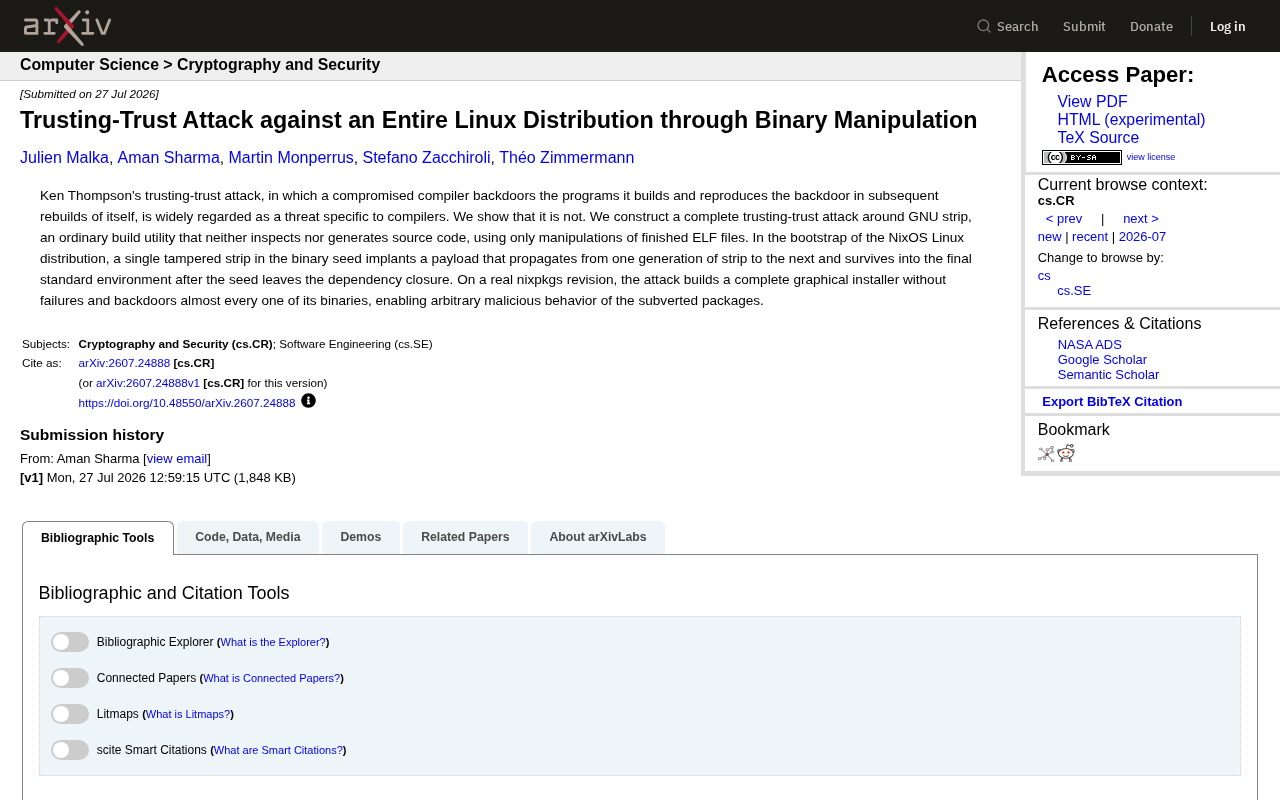
How Thompson's compiler backdoor attack could compromise an entire Linux distribution's trust chain
Explores the evolution of Ken Thompson's 1984 Trusting Trust Attack from theoretical concept to practical threat against entire Linux distributions. Examines the binary bootstrapping problem, traditional defense limitations, and modern solutions including reproducible builds and bootstrappable builds that reduce trust to minimal auditable seeds.
Introduction: Can Compilers Lie?
In 1984, Turing Award laureate Ken Thompson delivered his famous lecture "Reflections on Trusting Trust." Thompson is a legendary figure in computer science who, together with Dennis Ritchie, created the Unix operating system and the C programming language. In 1983, he and Ritchie jointly received the Turing Award for their contributions to operating system theory and practice—the highest honor in computer science, often called the "Nobel Prize of Computing." Thompson's lecture not only demonstrated technical insight but revealed a fundamental philosophical dilemma: when we rely on tools to verify the tools themselves, where does the foundation of trust lie?
He posed a chilling question: if even the compiler itself is implanted with a backdoor, how can we trust any software we run? This thought experiment, known as the "Trusting Trust Attack," has remained one of the most profound and unsettling propositions in software supply chain security for four decades.
Recently, an article on Hacker News titled "Trusting-Trust Attack against an Entire Linux Distribution" sparked widespread discussion in the tech community. It pushed Thompson's theoretical concept to a grander scale—poisoning the trust chain of an entire Linux distribution. This is no longer about attacking a single binary file, but fundamentally shaking our confidence in the verifiability of open-source software.
What is a Trusting Trust Attack?
The Principle of the Classic Compiler Backdoor Attack
To understand the core of this discussion, we must return to Thompson's original concept. Before diving into attack details, we need to understand the nature of compilers: a compiler is a program that converts high-level programming languages (such as C, C++) into machine-executable binary code. This conversion process includes multiple stages such as lexical analysis, syntactic analysis, semantic analysis, optimization, and code generation. The key point is that compilers themselves are programs written in programming languages and therefore also need to be compiled. Modern compilers like GCC (GNU Compiler Collection) are typically written in C/C++, creating a circular dependency: compiling a C compiler requires an already-existing C compiler. This self-bootstrapping characteristic is the technical foundation that makes Thompson's attack possible.
The attack proceeds in two escalating steps:
Step one: modify the compiler so that when it compiles a specific program (such as the login program login), it quietly inserts a backdoor—for example, accepting a master password.
Step two, and the most ingenious part: make the poisoned compiler, when compiling the compiler itself, re-inject both malicious logic segments mentioned above. This way, even if you audit the compiler's source code and find it completely clean, the compiler compiled from this clean source code will still contain the backdoor. Because the backdoor exists in the binary of "the compiler that compiles the compiler," not in the source code.
In other words, source code auditing becomes completely ineffective against this type of attack. You cannot discover the threat by reading code because the threat isn't in the code at all—it's in the build toolchain you trust.
From Single-Point Attack to Global Supply Chain Contamination
The classic Thompson attack targets the compiler as a single critical node. The scenario depicted in this discussion is even more alarming: extending the attack surface to a complete Linux distribution.
A complete Linux distribution (such as Ubuntu, Debian, Fedora) contains tens of thousands of software packages, with an extremely complex build process. From the underlying toolchain (binutils, gcc, glibc) to upper-layer applications, every package depends on other packages. For example, compiling the kernel requires a compiler, compiling the compiler requires an assembler, and compiling the assembler requires even more primitive tools. This forms a massive dependency graph, whose root is typically a set of precompiled binary tools. Building an entire distribution may require thousands of compilation operations involving tens of gigabytes of source code.
If an attacker can plant a backdoor at the root of this tree—the initial bootstrap compiler—theoretically the contamination can propagate upward along dependency relationships, ultimately penetrating every corner of the distribution. This scale makes comprehensive auditing nearly impossible.
Why Trusting Trust Attacks Are So Difficult to Defend Against
The Original Sin of Binary Bootstrapping: The Chicken-and-Egg Problem
Modern software building faces a fundamental dilemma: to compile GCC, you need an already-existing C compiler; and that C compiler itself was also compiled. Tracing back to the source, nearly all distribution build chains ultimately depend on a pre-existing binary seed.
This binary seed often cannot be completely reproduced from pure source code, making it the most fragile link in the entire trust chain. The binary seed that traditional distributions depend on may be hundreds of megabytes, containing millions of instructions that cannot be manually audited. As long as it's contaminated, all subsequent build artifacts may be poisoned, and this is extremely difficult to detect. This is the realistic soil that enables trusting trust attacks.
The Limits of Traditional Security Detection Methods
Traditional security measures—code auditing, static analysis, hash verification—are mostly powerless against this type of attack. Hashing can only verify "whether this binary and that binary are identical," but cannot answer "whether this binary itself is trustworthy." When everyone starts from the same contaminated source, the hash values everyone calculates will be completely identical, instead creating a false sense of security where "everyone's verification passes."
Breaking the Deadlock: Reproducible Builds and Bootstrappable Builds
Reproducible Builds: Decentralized Multi-Party Verification
In recent years, the Reproducible Builds movement promoted by the open-source community is a systematic response to trusting trust attacks. Its core principle is: given exactly the same source code and build environment, anyone on any machine should compile artifacts that are byte-for-byte identical.
Achieving this goal requires eliminating all non-deterministic factors in the build process. Traditional builds introduce timestamps, filesystem paths, compilation order, environment variables, and other random factors, causing the same source code to produce different binaries in different environments. Achieving reproducible builds requires: fixed build timestamps, normalized file paths, deterministic ordering, and isolated build environments. The Debian project began promoting this work in 2013, and over 90% of packages have now achieved reproducible builds. Other distributions like Arch Linux and openSUSE are also following suit.
This way, multiple independent builders can cross-verify each other's results. If an officially released binary doesn't match the community's independently reproduced results, it indicates possible contamination in the build process. This essentially uses "decentralized multi-party verification" to hedge against "single-point trust" risks. This allows anyone to independently verify whether officially released binaries truly come from the claimed source code.
Bootstrappable Builds: Rebuilding the World from a Few Hundred Bytes of Seed
Another more thorough path is Bootstrappable Builds. This work attempts to compress the starting point for building the entire software stack to an extremely small, manually auditable binary seed—ideally just a few hundred bytes of assembly code, small enough to inspect instruction by instruction.
GNU Guix is a functional package manager and Linux distribution that is at the forefront of bootstrappable builds. It reduces the starting point for building the entire software stack to approximately 300 bytes of hexadecimal seed, small enough to manually audit every instruction. Starting from this tiny seed, Guix gradually builds through the 'Reduced Binary Seed' project: first using a hexadecimal assembler to build a more complex assembler, then building a simplified C compiler, and finally obtaining complete GCC and glibc. The entire process forms a complete, auditable trust chain.
Starting from this tiny seed, they gradually build an assembler, a C compiler, and work their way up to a complete distribution. GNU Guix and some cutting-edge projects have made substantial progress on this path, reducing the size of unauditable binary seeds to historic lows. This directly dismantles the premise of "massive unauditable binaries" that Thompson's attack relies on.
Profound Implications for the Open-Source Security Ecosystem
The value of this discussion lies not in announcing an impending disaster, but in reminding the entire industry once again: the foundation of software supply chain security is far more fragile than we imagine.
In today's era where software deeply depends on open-source components, a successful trusting trust attack would have catastrophic consequences—it could lurk silently in millions of servers and devices.
In March 2024, the open-source compression tool XZ Utils was discovered to contain a carefully designed backdoor, one of the most serious supply chain attacks in recent years. The attacker, through years of building trust, eventually gained project maintenance privileges and inserted malicious code into versions 5.6.0 and 5.6.1. This backdoor targeted SSH services and could potentially allow unauthorized remote access. The incident was discovered in time to avoid disaster, but it exposed the fragility of the open-source ecosystem: even with public code, complex build systems and limited review resources can still allow malicious code to lurk. This incident made Thompson's warning from 40 years ago particularly real, giving people a visceral understanding of the realistic threat of supply chain attacks.
Fortunately, compared to 1984 when Thompson raised the question, today we not only have concerns but also practical defensive tools like reproducible builds and bootstrappable builds. True security perhaps comes not from "trusting" some authority, but from engineering practices that minimize trust and distribute verification everywhere.
Conclusion
"The only thing you can trust is what you build with your own hands and verify with your own eyes." Thompson's warning from forty years ago still resonates powerfully today. A trusting trust attack against an entire Linux distribution, while extremely challenging from an engineering perspective, is not purely theoretical fantasy.
For developers and operations personnel concerned with open-source security, understanding this attack model and supporting the practices of reproducible builds and bootstrappable builds may be the most rational choice we can make in this era of increasingly severe supply chain threats. Trust should not be blind, but verifiable and traceable.
Related articles
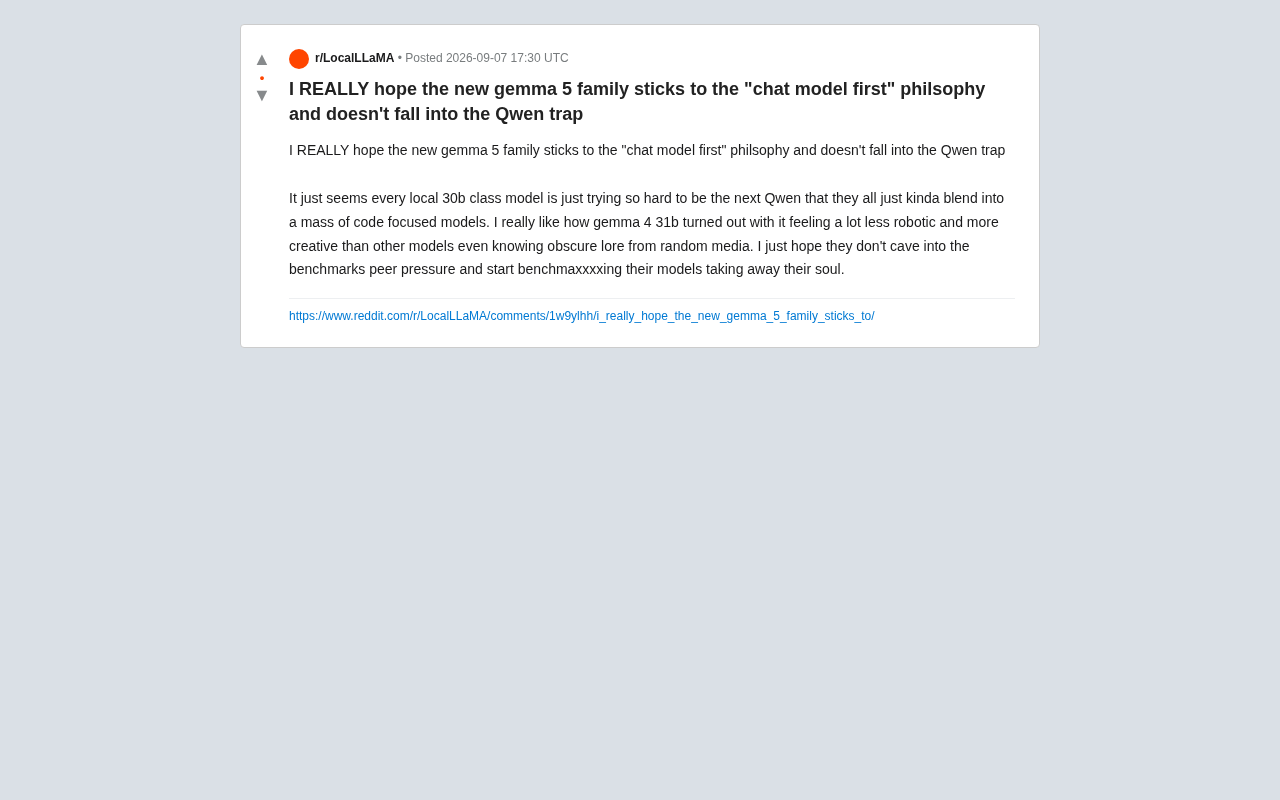
Can Gemma 5 Stay True to Chat-First? Avoiding the Homogenization Trap in Local Models
Can Gemma 5 maintain its chat-first philosophy or fall into the benchmaxxxing trap? Analyzing model homogenization, Gemma 4 31B's strengths, and what local LLMs really need.

216 Million LG Smart TVs Privacy Crisis: Recording Audio Even When Screen Is Off
Security researchers expose severe privacy flaws in LG smart TVs—over 216 million devices worldwide continue recording audio and scanning home network devices even when screens are off. Details on data collection scope, privacy risks, and user protection measures.
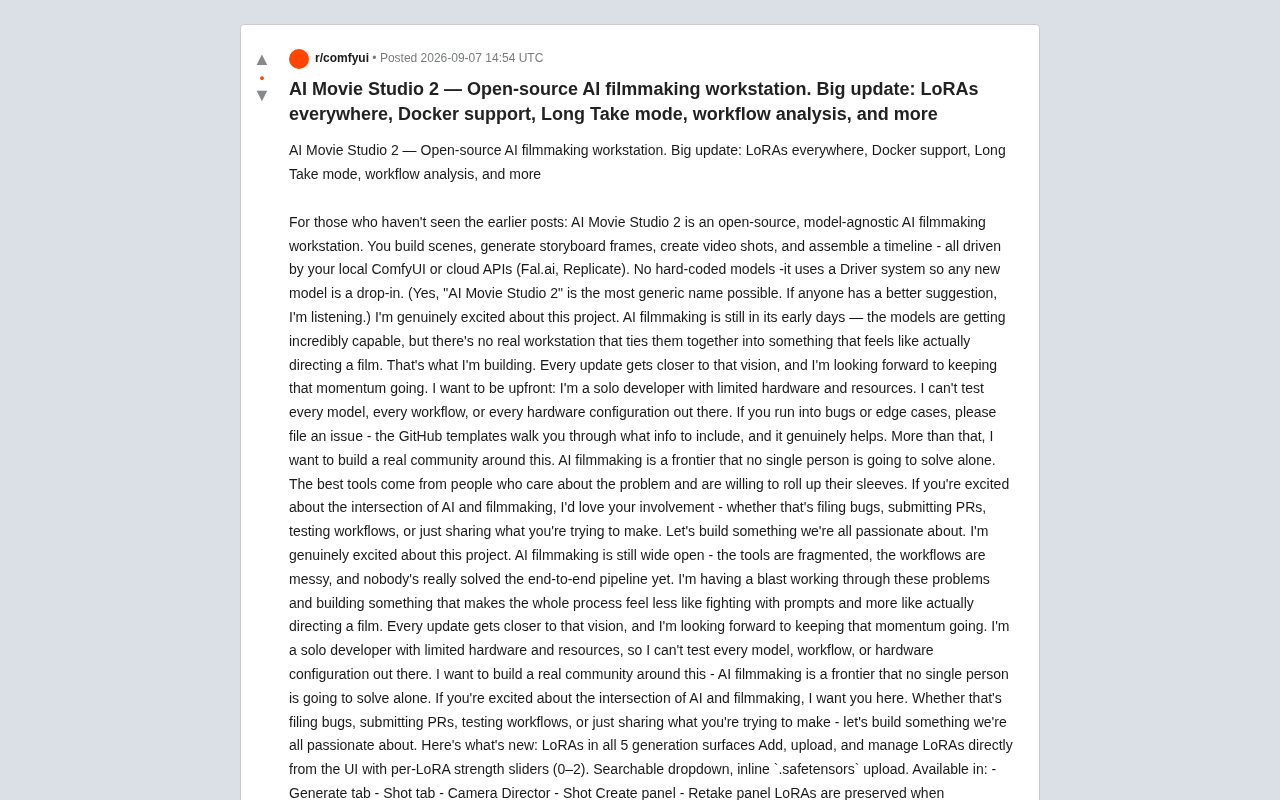
AI Movie Studio 2: In-Depth Analysis of the Open-Source AI Filmmaking Workstation
In-depth analysis of AI Movie Studio 2's five major upgrades: LoRA coverage across all scenarios, Long Take mode, Docker one-click deployment, workflow model analysis, and more. Learn how this model-agnostic AI director tool is transforming the creative workflow.