Turn Your Phone into a Virtual Camera: A Real-Time AI Director Workflow with ComfyUI
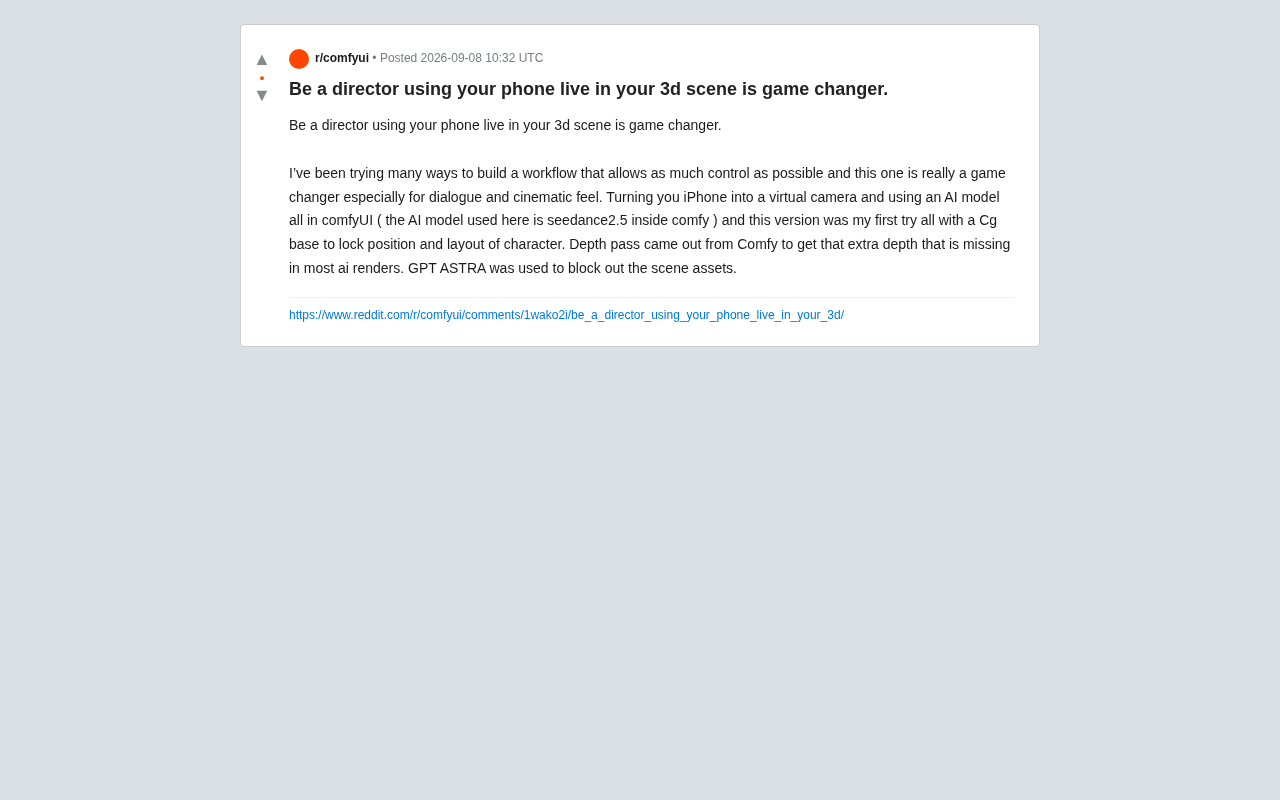
A hybrid CG + AI workflow turns an iPhone into a virtual camera for director-level AI video production.
A Reddit creator's workflow transforms an iPhone into a real-time virtual camera using 6DoF tracking, CG scene foundations, depth passes, and ByteDance's Seedance 2.5 model within ComfyUI. This hybrid pipeline bridges Hollywood-style virtual production with desktop AI rendering, enabling precise directorial control over camera movement, composition, and spatial depth — a significant step from random AI generation toward intentional filmmaking.
When Your Phone Becomes a Virtual Camera
In the world of AI video generation, the biggest pain point has always been the lack of control. Traditional text-to-video or image-to-video workflows often feel like opening a mystery box — you type in a prompt and pray the model delivers something close to what you had in mind. Camera movement, character placement, depth relationships — these critically important elements of cinematic language are notoriously difficult to control precisely in most AI rendering pipelines.
Recently, a Reddit creator shared a workflow that has been turning heads. He transformed an iPhone into a real-time virtual camera, performing director-style camera movements directly within a 3D scene, then completing the final render through ComfyUI combined with an AI model. In his words, this pipeline is a "game changer" for "dialogue scenes and achieving cinematic quality."
At its core, this approach democratizes Hollywood-level Virtual Production concepts. Virtual Production is one of the most important technological innovations in Hollywood in recent years, with its landmark application being Disney's LED wall system used in The Mandalorian (known as StageCraft technology) — using a real-time rendering engine to display digital environments on massive LED screens while the camera's movement is tracked in real time to synchronize the virtual scene's perspective. A complete Virtual Production LED stage typically costs anywhere from several million to tens of millions of dollars, and requires professional motion capture equipment like OptiTrack or Vicon to track the camera. Now, leveraging a phone's sensors and inertial tracking capabilities, this kind of real-time camera work — which previously required motion capture stages and professional tracking equipment — can be initially replicated in a desktop-level workflow.
The reason modern iPhones can fill this role is that they have a built-in Inertial Measurement Unit (IMU) composed of an accelerometer, gyroscope, and magnetometer, along with a LiDAR scanner (on Pro models). Apple's ARKit framework fuses this sensor data to achieve 6 Degrees of Freedom (6DoF) tracking — simultaneously capturing the device's position (X/Y/Z translation) and orientation (pitch/yaw/roll rotation) in 3D space. While this tracking precision can't match professional-grade tracking systems, it's more than sufficient for individual creators' previsualization and camera movement recording.
Workflow Breakdown: A Hybrid Pipeline of CG Foundation + AI Rendering
This approach doesn't rely purely on AI generation. Instead, it takes a Hybrid Pipeline approach, organically combining traditional CG with AI generation. Based on the creator's description, the entire workflow includes several key stages:
Locking Down Composition with a CG Foundation
The creator first uses a "CG base" to lock down character positions and layout. This step is crucial — it solves the classic problems of character position drift and unstable composition in pure AI generation. When you have a clear 3D foundation serving as a skeleton, the AI is no longer wildly "imagining" the scene from scratch but rather performing stylized rendering within a predefined spatial framework. This "CG skeleton + AI skin" approach actually shares the same underlying principle as ControlNet — providing structural conditional constraints to the AI model to keep generated results within the expected spatial range.
GPT ASTRA Handles Scene Construction
The initial block out of scene assets is handled by GPT ASTRA. Block out is a standard pre-production process in film and game production, referring to the rapid construction of a scene's approximate spatial structure and proportions using simple geometry — cubes, cylinders, spheres, and other basic shapes — without any detailed modeling or materials. The purpose of this step is to validate spatial layout, camera angles, and character blocking at the lowest possible cost. In traditional workflows, block out is typically done manually by artists or level designers in 3D software like Maya or Blender, potentially taking hours. Having an AI tool like GPT ASTRA handle this tedious spatial construction work can compress this stage down to minutes, significantly improving pre-production efficiency.
Depth Passes Fill in Spatial Depth
The creator specifically mentions exporting a Depth Pass from ComfyUI to achieve "extra depth that most AI renders lack." This is a highly professional detail. A depth pass is an auxiliary data channel in 3D rendering that records not color information, but the distance from each pixel in the scene to the camera, typically presented as a grayscale image: objects closer to the camera appear lighter, while distant objects appear darker. In traditional film post-production, depth passes are widely used for Depth of Field simulation, atmospheric fog effects, and Z-depth compositing.
In the context of AI video generation, depth passes serve as input signals for conditional control mechanisms like ControlNet, telling the AI model "what the spatial structure of the scene should look like." AI generation without depth guidance often produces images with confused spatial relationships — incorrect focus falloff between foreground and background, disproportionate object sizes, and similar issues. With depth pass input, the AI model has clear spatial constraints during generation, producing images with correct perspective and well-defined layers. This is also one of the key sources of cinematic quality — genuine spatial depth, rather than a flat, "texture-mapped" look.
Seedance 2.5: The AI Rendering Engine Inside ComfyUI
In this workflow, the final AI rendering is handled by the Seedance 2.5 model running inside ComfyUI. Seedance is ByteDance's AI video generation model series, and version 2.5, as its latest iteration, supports multiple generation modes including Image-to-Video, with significant improvements in motion coherence and image quality.
ComfyUI, as a node-based AI workflow platform, follows a design philosophy similar to node editors in traditional image processing software (such as Nuke or Houdini) — breaking down every step of the AI generation process, from model loading, prompt encoding, sampling and denoising, to VAE decoding and ControlNet condition injection, into independent visual nodes. Users connect these nodes through wires to form a complete generation pipeline. The greatest advantage of this design is its highly composable and controllable nature — every stage is an adjustable node, allowing creators to precisely intervene at every step from depth and composition to style. Compared to pure cloud API calls, running models within ComfyUI gives creators finer parameter control and faster iteration speeds.
The creator admits this was only his "first try," but even so, the level of control demonstrated is impressive. Connecting the phone's real-time camera movement data, CG composition foundation, depth passes, and the Seedance model within a single ComfyUI workflow essentially constructs an AI production system where the director can intervene in real time. The signal flow of this pipeline can be summarized as: phone sensors capture 6DoF motion data → real-time driving of the virtual camera in 3D software → rendering CG base frames and depth passes → ComfyUI receives these conditional signals → Seedance 2.5 generates the final frames under these constraints.
Why This Is a "Game Changer"
The significance of this workflow goes far beyond showing off technical prowess. It points to a critical evolutionary direction for AI video creation: moving from random generation to precise directing.
For narrative content — especially the dialogue scenes the creator emphasizes — camera movement, character positioning, and shot selection all carry emotion and information. A slow push-in to a close-up conveys intimacy, a rapid pan creates tension, a static medium shot reveals character relationships — these are all well-refined narrative tools in the grammar of cinema. Purely prompt-driven generation struggles to meet these precise needs, because natural language itself is not a precise language for describing camera movement. But when creators can hold a "camera" and move through a scene like a real director, staging and choreographing shots, AI transforms from an uncontrollable black box into an obedient rendering engine.
This also confirms an important trend in the current AI creative landscape: the most powerful results often come from the fusion of traditional techniques and AI, not from replacing everything with AI. CG provides structure and control, AI provides texture and efficiency, and only by combining the two can you achieve both "controllable" and "stunning." This hybrid pipeline approach is, in fact, the current industry consensus — whether it's VFX companies or game studios, everyone is exploring how to embed generative AI into existing production pipelines rather than using it to overturn the entire workflow.
Technical Barriers and Future Outlook
It's worth noting that the information in this article is based on a single Reddit creator's share, and the complete technical details and reproducibility still require further verification. Setting up this pipeline also requires a certain level of CG expertise, ComfyUI experience, and hardware resources — it's not a zero-barrier plug-and-play solution. Specifically, creators need at least basic 3D software skills (for creating the CG base), an understanding of ComfyUI's node connection logic, GPU computing power capable of running the Seedance 2.5 model, and a bridging toolchain for importing phone tracking data into 3D software.
But the picture it paints is undeniably exciting: when a phone can become a directing tool for a virtual soundstage, when AI rendering can be controlled with precision down to composition and depth of field, the technological gap between independent creators and professional film production is being rapidly closed. Looking back at the democratization of filmmaking technology — from film to digital cameras, from expensive linear editing to the free version of DaVinci Resolve, from professional color grading consoles to LUT presets — each wave of technological accessibility has given rise to a new generation of creators. The democratization of Virtual Production may well be the latest link in this chain. This workflow is an early signal worth paying attention to in this ongoing wave.
Key Takeaways
Related articles

GPT-6 Astra Completes All 48 Levels of 'I'm Not A Robot' Game
GPT-6 Astra successfully completes all 48 levels of the 'I'm Not A Robot' game, demonstrating remarkable visual understanding, logical reasoning, and task adaptation. This article analyzes the technical capabilities behind this breakthrough and its implications for CAPTCHA verification and AI safety.

Stuxnet Source Code Reconstruction: Dissecting the Attack Chain of History's Most Complex Cyber Weapon
In-depth analysis of the Stuxnet source code reconstruction open-source project, examining how this cyber weapon targeting Iranian nuclear facilities exploited four zero-day vulnerabilities, stole digital certificates, covertly manipulated PLC centrifuges, and exploring industrial security lessons and ethical controversies of open-source reconstruction.
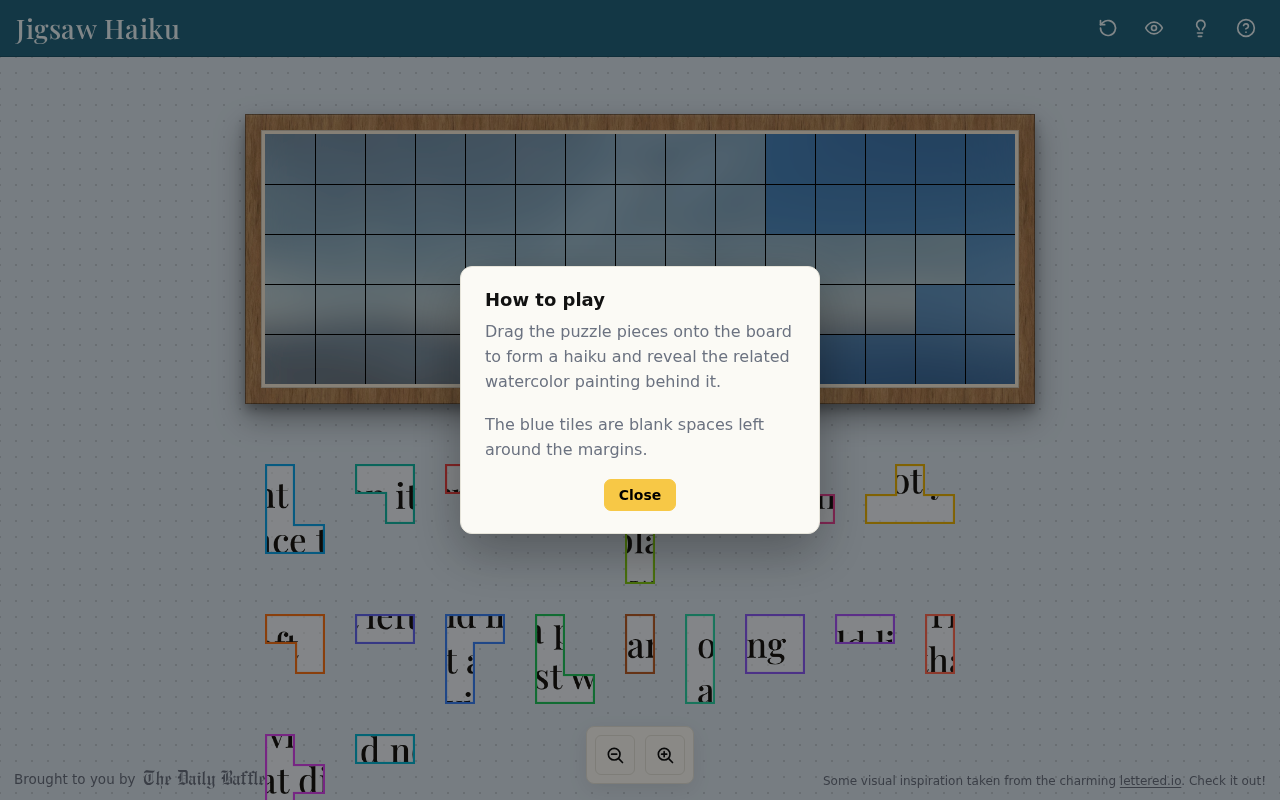
Minimalist Aesthetic Puzzle Game Development: Insights from Independent Creation
An in-depth analysis of an independent developer's aesthetic puzzle project shared on Hacker News, exploring minimalist design philosophy, Show HN community culture, and aesthetics-first product thinking in independent development.