Turning Regular JavaScript Code into Neural Networks

A Hacker News post explores turning regular JavaScript code into neural networks, lowering the barrier for web developers to use AI.
The article discusses a Hacker News project that turns regular JavaScript code into neural networks. Traditional neural network development requires Python and deep learning frameworks, while regular JS code is imperative, deterministic business logic; the mental models of the two are vastly different. The article analyzes two possible technical paths: static conversion of purely functional JS into a computation graph through AST parsing, or runtime tracing of numerical operations to dynamically build a computation graph and inject gradients. The core challenge is that neural networks require differentiability and parameterization, while regular JS code is discrete and deterministic. This direction aligns with neuro-symbolic and differentiable programming trends, but the project is still at an early concept-validation stage and tools can lower the barrier without replacing an understanding of machine learning fundamentals.
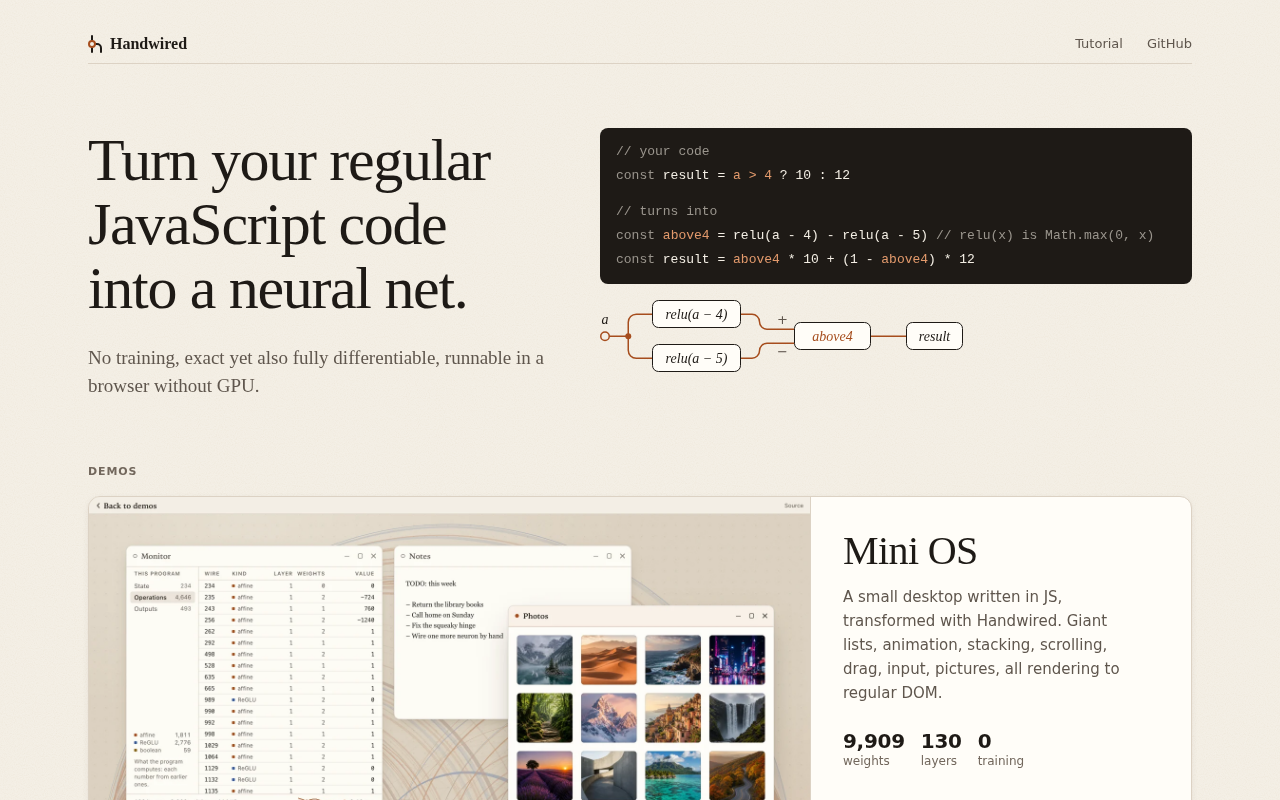
On Hacker News, a post titled "Turn your regular JavaScript code into a neural net" caught the attention of the tech community. The title plainly describes a highly appealing concept: letting developers take everyday JavaScript code and automatically or semi-automatically convert it into a neural network model. Although the post itself contains only a brief description and a small amount of discussion, it touches on an increasingly hot direction in today's AI development toolchain—lowering the barrier to building neural networks and blurring the line between business logic code and machine learning models.
Why This Idea Is Worth Paying Attention To
Traditionally, building neural networks requires developers to master Python, deep learning frameworks (such as TensorFlow or PyTorch), and understand concepts like tensor operations, gradient descent, and backpropagation. Regular JavaScript code, by contrast, represents imperative, deterministic business logic. The mental models of the two are vastly different. If regular JS code could truly be turned into neural networks, it would mean front-end engineers or full-stack developers could use the language and thinking habits they are familiar with to directly gain trainable model capabilities.
The technical approach behind this may include: mapping conditional branches, loops, and mathematical operations in JS to computation graph nodes, then through automatic differentiation or weight binding, turning fixed logic into learnable parameterized structures. Similar research has been explored in program synthesis and neuro-symbolic programming, but practical tools aimed at the JavaScript ecosystem remain scarce.
Automatic Differentiation is the technical cornerstone of such tools. It is an exact and efficient differentiation technique that sits between symbolic differentiation and numerical differentiation: symbolic differentiation causes expression swell, numerical differentiation suffers from truncation error, while automatic differentiation applies the chain rule to basic operations on the computation graph (addition, multiplication, sin, exp, etc.), accumulating local derivatives during forward or backward propagation, thereby obtaining exact gradients at a cost close to that of the original computation. Reverse-mode automatic differentiation is precisely the engine behind neural network training in frameworks such as PyTorch and TensorFlow. To turn JS code into a trainable model, a tool must first build a computation graph that records all operations, then implement reverse-mode differentiation on it. This is also why pure functions with no side effects are easier to convert—computation graphs require a clear order of operations and traceable dependencies.
Two Possible Technical Implementation Paths
From the post title and the limited discussion, this kind of tool most likely takes one of the following two routes.
Path One: Static Conversion from Code to Computation Graph
Developers write purely functional JS code, and the tool extracts the computation flow through AST parsing, converting each operator into a neural network layer or differentiable node. For example, a simple if (x > 0) return x * 2; else return 0; might be converted into a gated linear layer. The advantage of this approach is that it preserves code readability; the disadvantage is that it can only handle a restricted subset of JS, and fails when encountering complex control flow or side effects.
AST (Abstract Syntax Tree) is a tree-like representation of source code structure, where each syntactic construct (if statement, function call, binary operation) corresponds to a node. Static conversion tools parse JS source code to generate an AST, traverse the nodes, and map them to operators in a computation graph. For example, binary operation nodes map to addition, subtraction, multiplication, and division layers; conditional branches map to gating units; function calls can map to subgraphs. The difficulty in this process is that the AST only describes syntactic structure and does not contain runtime type information, while a neural network needs to know the tensor shape and data type of each node explicitly. Therefore, tools often require developers to use a restricted subset (such as pure functions, immutable data, and explicit type annotations) in order to reliably complete the conversion from syntax tree to computation graph.
Path Two: Runtime Tracing and Gradient Injection
Another approach is to record all numerical operations at JS runtime, dynamically build a computation graph, and use numerical differentiation or symbolic differentiation to compute gradients. This is similar to JAX's grad function, but the target language is JavaScript. In this way, developers hardly need to change their coding habits, but performance overhead and memory usage rise significantly, and it is powerless for non-numerical operations (such as string processing and DOM operations).
Whichever path is taken, the core challenge lies in the fact that neural networks require differentiability and parameterization, while regular JS code is discrete and deterministic. How to define "which parts should become learnable parameters" is the most critical decision point in tool design.
Neuro-Symbolic Programming is an important academic background for this direction. It attempts to combine the perception and learning capabilities of neural networks with the logical reasoning and interpretability of symbolic programs. Common approaches include: relaxing the discrete operations of symbolic programs into differentiable soft operations (such as approximating if-else with sigmoid), or using the output of a neural network as the input to a symbolic solver. Such research has already made progress in program induction and differentiable programming languages (such as Datalog variants for differentiable programming). Turning JS code into neural networks is essentially also a neuro-symbolic attempt—preserving the logical structure of the code while making its parameters learnable. Understanding this background helps in judging the boundaries of such tools: they are more likely to generate differentiable hybrid models rather than fully end-to-end black-box networks.
Practical Significance for Developers
Judging from the level of attention in the Hacker News comments (only 6 points and 2 comments), this project may still be in an early stage or proof of concept. But it reflects a real demand: a large number of web developers want to use AI capabilities within their own tech stack without having to switch to the Python ecosystem.
If such tools mature, we can imagine these scenarios: using a few lines of JS to describe a recommendation rule, then letting a neural network automatically optimize its thresholds and weights; or converting form validation logic into an anomaly detection model. This is more controllable and easier to debug than training a black-box model from scratch.
However, we also need to be wary of overpromising. Neural networks are not magic. After "converting" JS code into a neural network, whether the model can converge and whether it has generalization ability still depends on the data distribution and the task itself. Tools can only lower the barrier; they cannot replace an understanding of the fundamentals of machine learning.
Summary and Outlook
"Turn your regular JavaScript code into a neural net" represents an interesting direction: making the code itself part of the model definition, rather than describing the model with a completely separate framework. Although public information is currently limited, it is consistent with the trends of neuro-symbolic programming and differentiable programming. For the JavaScript community, if a mature open-source implementation appears, it may give rise to a batch of lightweight, interpretable intelligent web applications. It is worth continuing to follow subsequent updates to the code repository and documentation.
One-line Summary
A Hacker News post explores turning regular JavaScript code into neural networks, lowering the barrier for web developers to use AI.
Paragraph Summary
The article discusses a Hacker News project that turns regular JavaScript code into neural networks. Traditional neural network development requires Python and deep learning frameworks, while regular JS code is imperative, deterministic business logic; the mental models of the two are vastly different. The article analyzes two possible technical paths: one is statically converting purely functional JS into a computation graph through AST parsing; the other is runtime tracing of numerical operations to dynamically build a computation graph and inject gradients. The core challenge is that neural networks require differentiability and parameterization, while regular JS code is discrete and deterministic. This direction is consistent with the trends of neuro-symbolic programming and differentiable programming, but the project currently has low discussion热度 and may be in an early proof-of-concept stage. Tools can lower the barrier but cannot replace an understanding of the fundamentals of machine learning.
Related articles

Ollama Decision Models Tested: Local Inference Far Outpaces Claude
Hands-on test of Ollama decision models: a 0.8B model does email classification and scoring locally over twice as fast as the Claude API, and can even classify images on a Dell Pro Max. Deployment steps, speed comparisons, and multimodal results included.

5 Hidden Money-Making Projects on GitHub: A Complete Guide from AI Side Hustles to Remote Work
Five money-making projects on GitHub: AI side hustle playbook, remote job boards, group & bot index, OSAM tool library, and n8n automation — with tips and combo paths.

Claude Code Cost Varies 11.9x: A Guide to Saving Money with Effort Subagents
Claude Code's official cost table reveals Effort thinking budget tiers: the same model on the same task can cost 11.9x more. This article breaks down each tier's cost index, how to assign work to subagents individually, and three default-setting pitfalls, plus three practical commands to finely control AI coding expenses.