Twigg: A Stateful API That Automates LLM Context Management
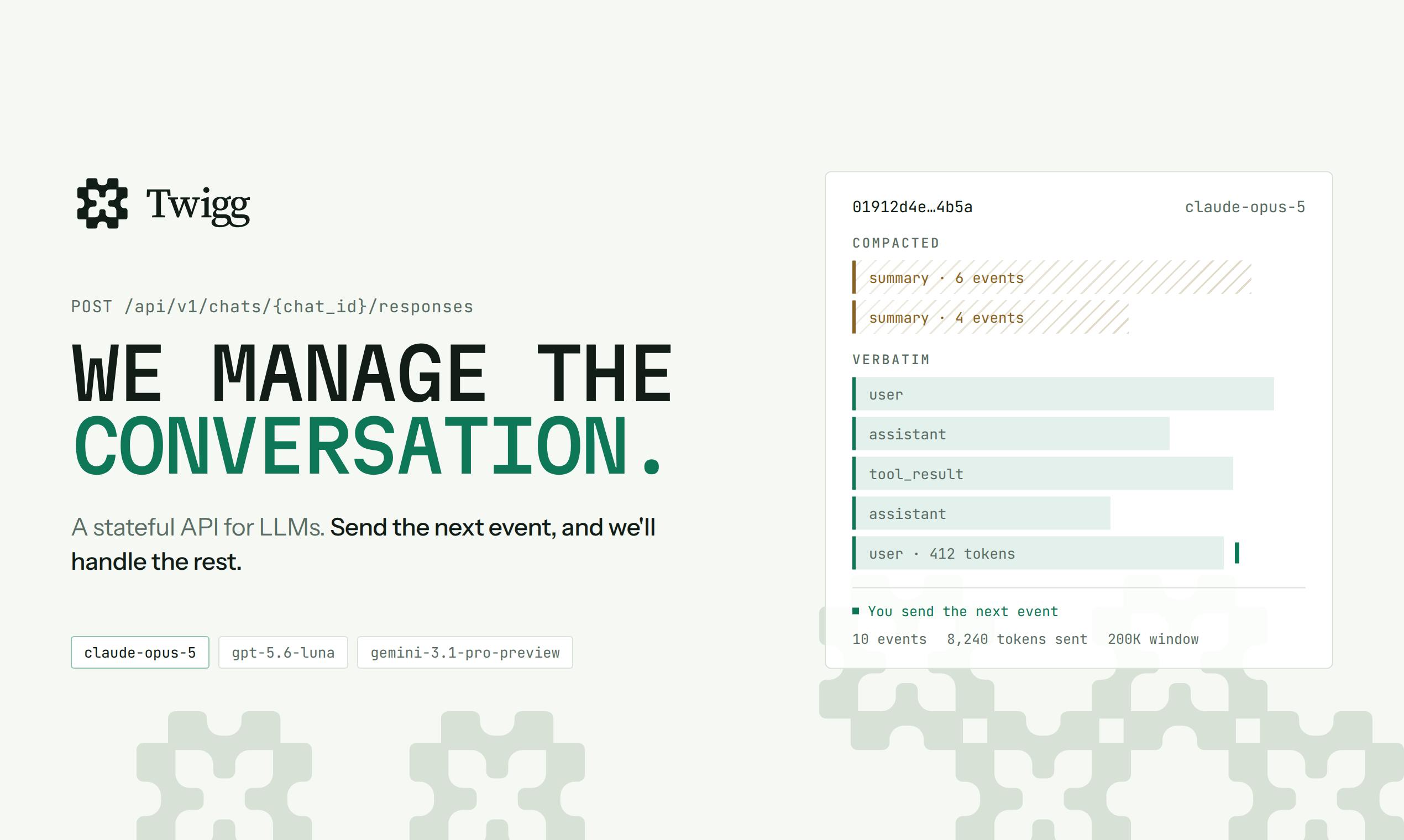
Twigg is a stateful LLM API that fully automates context management on the server side.
Twigg is a stateful LLM calling API for developers that eliminates client-side context management. Instead of manually assembling conversation history on every request and handling context overflow or multi-model format differences, developers create a session once and send incremental events — while Twigg handles schema adaptation, context compaction/truncation, and call routing automatically. A built-in dashboard centralizes tool definitions, system prompts, and usage billing. Twigg positions itself as a general-purpose context infrastructure layer for use cases ranging from personal agents to enterprise apps, though third-party context hosting introduces dependency and data risks worth evaluating.
One of the most frustrating challenges when building large language model (LLM) applications is context management. Every model call requires reassembling and resending the entire conversation history — resulting in verbose code and a never-ending stream of manual work: handling context overflow, adapting to different model formats, and more. Twigg, a newly launched developer tool on Product Hunt, aims to solve this problem at its root. Its pitch: "the context layer you never have to build."
What Is Twigg?
Twigg is a stateful LLM calling API. The key difference from conventional stateless approaches is this: traditional implementations bundle the entire conversation history into every request, while Twigg lets you create a chat session once and then only send "the next event" — leaving all state maintenance to the service.
In other words, Twigg moves the responsibility of "remembering context" to the server side. Developers no longer need to repeatedly assemble prompts on the client, nor write custom truncation logic every time a context window fills up. The product targets a high-frequency, repetitive, and error-prone piece of infrastructure that every LLM application has to deal with.
Twigg currently has 86 upvotes and 3 comments on Product Hunt, ranking 9th for the day. It's listed under the API, Developer Tools, and Artificial Intelligence categories, and was built by Louis Ellis and his team.
Core Capabilities, Broken Down
Twigg breaks context management into several automated steps — each worth examining.
Automatic Model Schema Adaptation
Different target models have their own input formats and structural requirements. Twigg automatically "adapts the context to the target model's schema," which means switching underlying models doesn't require rewriting data assembly logic. For teams that need to switch between models or run A/B comparisons, this can eliminate significant adaptation overhead.
The input format requirements across LLM providers vary considerably. Take function calling as an example: OpenAI passes JSON Schema via a
toolsfield; Anthropic Claude also usestoolsbut with a slightly different structure; Google Gemini usesfunctionDeclarations. Message role names (e.g.,assistantvs.model), the placement of system prompts, and how multi-turn conversations are concatenated all differ across providers. Developers supporting multiple models or migrating between them often need to maintain a separate data transformation layer for each provider. Twigg's automatic schema adaptation layer is essentially performing this "format normalization" work, decoupling the upstream application from the specifics of each model's API.
Intelligent Compaction and Truncation
When a conversation grows long and approaches or exceeds the context window, Twigg automatically performs compaction or truncation. This is an extremely common production problem — long conversations can cause costs to spike or requests to fail outright. Handling this strategy server-side, rather than having every application implement it independently, is far more reliable.
A context window is the maximum number of tokens a large language model can process in a single call — ranging from a few thousand to hundreds of thousands of tokens depending on the model. When conversation history exceeds this limit, requests either error out or the model silently drops older content, causing it to "forget" earlier parts of the conversation. Common mitigation strategies include: sliding windows (keeping only the most recent N messages), summary compression (using the model to summarize history before replacing it), and semantic retrieval (injecting only the most relevant historical snippets for the current query). Each strategy involves trade-offs in accuracy and latency, and must be tuned for specific use cases — which is exactly why every team ends up reinventing this wheel. Twigg attempts to centralize both the selection and execution of these strategies on the server side, so developers don't need to think about the implementation.
Call Routing
Twigg also handles "routing the call" — dispatching requests to the appropriate model endpoint. Combined with the schema adaptation capability above, routing makes multi-model architectures significantly easier to deploy.
A Developer-Facing Control Panel
Beyond API-level automation, Twigg provides a dashboard where developers can centrally manage several key configurations:
- Tool schemas: Define the tool interfaces available to models
- System prompts: Maintain application role and behavior settings in one place
- Context windows: Control context length policies
- Usage and billing: Track call consumption and costs
The benefits of pulling these configurations out of code and into a dashboard are clear: adjusting system prompts or tool definitions no longer requires redeployment, and operations or product teams can get a more intuitive view of usage costs.
Use Cases and Positioning
According to the official description, Twigg's target range spans from "personal agents" all the way to "enterprise apps." This breadth signals a positioning as a general-purpose infrastructure layer, rather than a tool built for any specific vertical.
For indie developers, Twigg makes building a memory-capable chatbot lightweight. For enterprise teams, a unified context layer with centralized configuration management and usage tracking helps with governance and cost control. The core value proposition remains consistent throughout: "you never have to manage context again."
A Quick Take
Context management is genuinely one of the most repeatedly reinvented wheels in LLM application development, and abstracting it into a managed service is a reasonable direction. The stateful API pattern shares conceptual overlap with some session state features OpenAI has introduced recently — but Twigg's emphasis on multi-model schema adaptation and a centralized dashboard is where it tries to differentiate.
It's worth noting that delegating context state to a third party means accepting additional service dependencies, data flow complexity, and potential vendor lock-in. For data-sensitive enterprise applications, these are unavoidable factors in any evaluation. Most available information currently comes from the Product Hunt listing; the actual effectiveness of the compaction algorithms, latency characteristics, and pricing details remain to be verified through hands-on testing.
For developers currently struggling with context assembly logic, Twigg is at least a new option worth keeping an eye on.
OpenAI's Responses API, introduced in 2025, added server-side session state (
store: true), allowing multi-turn conversations to be chained viaprevious_response_idwithout the client resending history. This aligns closely with Twigg's core approach, and suggests that "stateful LLM calling" is becoming a recognized direction across the industry. The main difference: OpenAI's solution is limited to its own model ecosystem, while Twigg emphasizes cross-model generality. Teams already deeply committed to a single provider may find that the native state API offers better trust and lower integration overhead; teams requiring flexible multi-model orchestration will find an independent context layer more appealing.
Related articles
Why Do All AI-Generated Projects Look the Same? The Aesthetic Homogenization Problem in Vibe Coding
Why do vibe coding projects all use purple gradients and dark glassmorphism? We break down the technical roots of AI aesthetic homogenization and how to escape it.
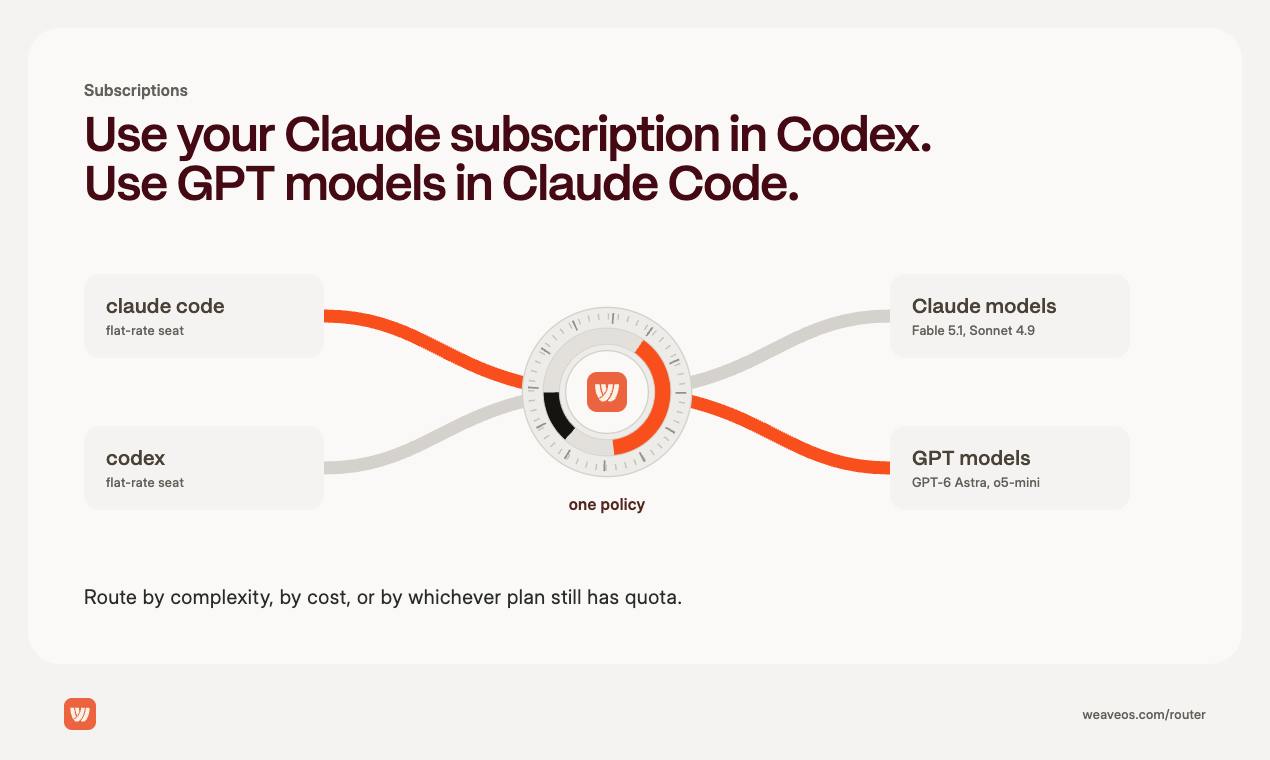
Weave Router 2.0: A Subscription-Aware AI Coding Agent Router with Cross-Service Intelligent Dispatch
Weave Router 2.0 is a subscription-aware AI coding agent router that auto-dispatches requests across Claude, Codex, and GPT subscriptions — claiming half the cost and double the speed of GPT-6 Astra.
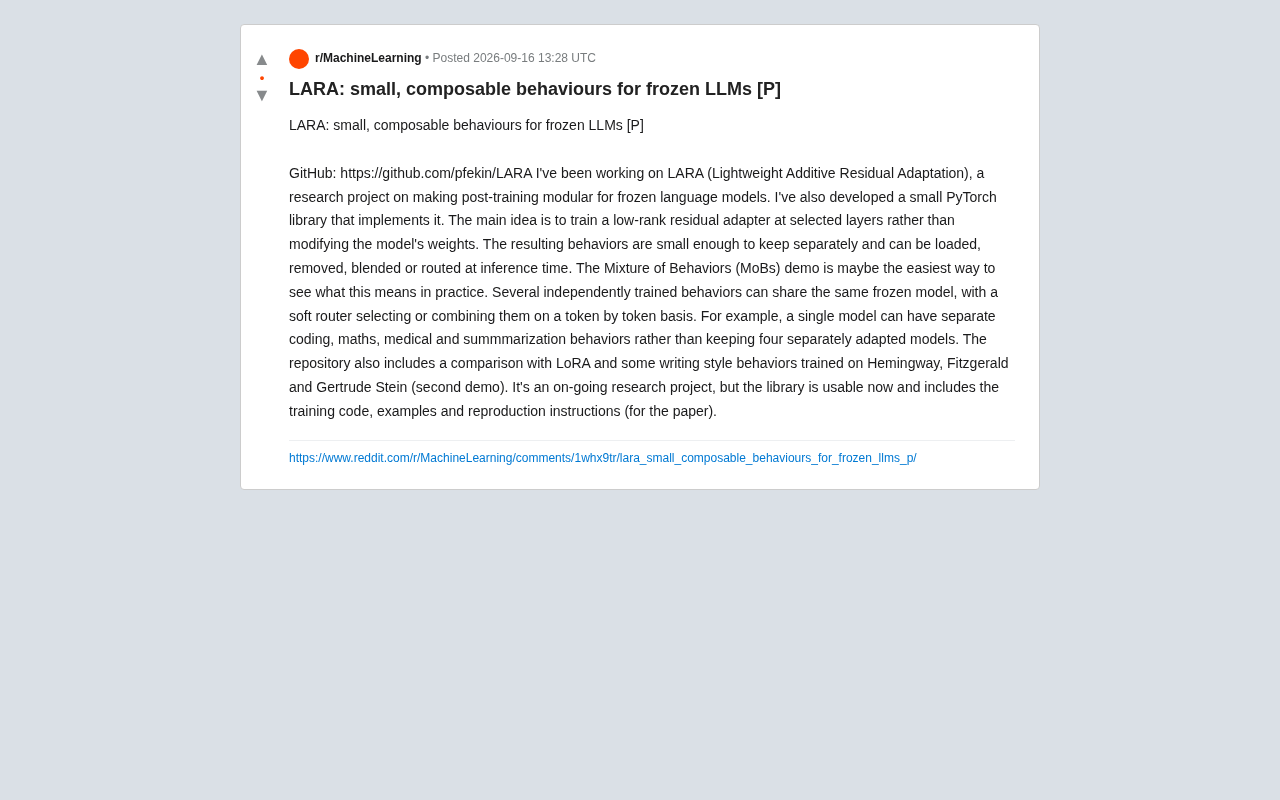
LARA: A Lightweight Adaptation Framework for Injecting Composable Behaviors into Frozen LLMs
LARA (Lightweight Additive Residual Adaptation) is an open-source framework that injects pluggable, composable behaviors into frozen LLMs via low-rank residual adapters with soft routing and Mixture of Behaviors support.