Two Proofs of the Riemann Hypothesis in 48 Hours: AI vs. Human Mathematics
AI and humans each produced a Riemann Hypothesis proof within 48 hours; machine verification passed but humans struggle to digest it, posing challenges of trust and understanding.
The article reports two challenges to the Riemann Hypothesis within 48 hours: Anthropic mathematician Alpöge and Claude generated 17 million lines of Lean code in 41 days for a formal proof, cross-verified by five independent kernels but heavily AI-dependent; the same day, human mathematician Masullo's 940-page manual proof was publicized and had problems found by AI within 8 hours. GPT then proved the Weil Conjecture in under 6 pages with almost no human involvement. The community acknowledges the milestone but stresses digestion will take time; the Clay Institute still marks it unsolved. The article explores machine proof inflation, misaligned incentives, and humanity's ability to catch the answer.
Two Proofs of the Riemann Hypothesis in 48 Hours: AI vs. Human Mathematics
The 167-year-old unsolved Riemann Hypothesis was suddenly challenged by two radically different proofs within 48 hours: one consisting of 17 million lines of AI-generated code, and the other a 940-page human manuscript. This is not just a mathematical milestone—it forces us to confront an awkward question: when a machine verifies a proof that humans cannot yet understand, does that count as proven?
The Riemann Hypothesis: The Ultimate Puzzle of Prime Distribution
Primes (2, 3, 5, 7, 11…) are the atoms of the number world; any integer greater than 1 can be uniquely factored into a product of primes. But primes appear with no discernible pattern: sometimes adjacent like 11 and 13 differing by only 2, sometimes separated by hundreds of integers. Mathematicians turned to ask: roughly how many primes are there up to x? The Prime Number Theorem, proven in 1896, gives the answer: approximately x/ln x. But how small can the error be? The Riemann Hypothesis is precisely the key to answering this question.
Riemann extended the infinite series studied by Euler to the complex plane, obtaining the ζ function. Its nontrivial zeros all lie within the critical strip between 0 and 1, and Riemann conjectured that they all line up on the line Re(s)=1/2. Each zero corresponds to a "voice" in the error of prime distribution; the farther a zero is from the center line, the larger the error. All zeros lying on the center line means the error is compressed to an extreme minimum. For over 100 years, thousands of theorems have been stated with the premise "assuming the Riemann Hypothesis holds." In 2000, the Clay Mathematics Institute listed it as a Millennium Prize Problem, with a $1 million reward.
The ζ Function and the Critical Strip
The Riemann ζ function was originally defined as the infinite series ζ(s) = 1 + 1/2^s + 1/3^s + …, which converges when s is real and greater than 1. Riemann analytically continued it to the entire complex plane (except for a simple pole at s=1), making the function meaningful over the complex numbers. The so-called "nontrivial zeros" are those zeros not at the negative even integers (the trivial zeros). The Riemann Hypothesis asserts that the real part of all these nontrivial zeros equals 1/2, i.e., they all lie on the vertical line in the complex plane with real part 1/2, called the critical line. The critical strip is the band 0 < Re(s) < 1, and the Riemann Hypothesis is equivalent to saying that all nontrivial zeros lie on the center of the critical line.
AI's Blitzkrieg: 41 Days and 17 Million Lines of Code
On November 20, Anthropic mathematician Levent Alpöge posted a four-page explanation on his personal website, beginning with: "I believe that Claude and I have found a proof of the Riemann Hypothesis." He did not submit a paper but instead provided roughly 17 million lines of Lean code across 175,000 files. Lean is a theorem-proving language in which every step of reasoning is checked line by line by machine; skipping a step or missing a justification is immediately rejected. A human-readable text version was attempted, but it exceeded 250,000 pages; Alpöge himself laughed after reading the first page: "This thing is not suitable to rashly release; the code is the authority."
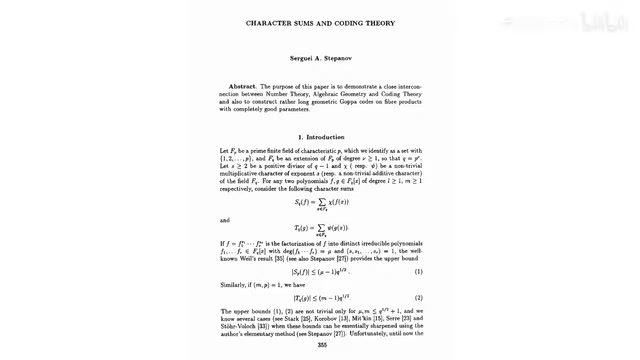
The timeline is astonishing: work began October 6, eight hurdles were cleared in a single day on November 15, and on November 16 he wrote the three letters GRH representing the Generalized Riemann Hypothesis—only 41 days in total. Alpöge says he set the direction, but the real breakthrough step was suggested by Claude: over function fields, mathematicians had previously proven a corresponding version of the Riemann Hypothesis, but integers cannot be "spherically truncated," blocking the path for decades (see figure below). Claude suggested switching to the theta lift, converting automorphic forms between different symmetry groups, each conversion transmitting a multiplicity for the integers. The key parameter was also set by Claude: the length of the lift chain was set to √x, and the error bound given by the Riemann Hypothesis is exactly on the order of √x. Alpöge's exact words: "That alone is enough to knock a colleague off their chair."
The Lean Theorem Prover and Formal Verification
Lean is an interactive theorem prover and programming language based on dependent type theory. In Lean, mathematical propositions are written as types, and proofs are terms of those types. The compiler checks line by line whether the proof term is type-correct, ensuring that every step strictly follows logical rules. Mathlib is a large mathematical knowledge base built on Lean, containing tens of thousands of definitions and theorems. Formal verification means translating an entire proof into machine-checkable code; any logical leap or unproven lemma will be rejected. Thus, the 17 million lines of Lean code are not just a proof but a complete logical record that can be independently verified by machine.
Machine Verification: From Code Compilation to Five Independent Kernels
On November 21, Lean FRO and the Mathlib Initiative issued a joint statement: "We are completely convinced that Alpöge's proof of the Riemann Hypothesis is correct." The statement addressed one by one the four criteria proposed by Imperial College London mathematician Kevin Buzzard: whether the problem was copied correctly, whether the code compiles, whether it proves this very problem, and whether the kernel itself could be wrong. Dozens of people worldwide each compiled the 175,000 modules with zero errors and identical hash values for the exported files; the community wrote separate files importing only the Riemann Hypothesis proposition and compared using two independent tools, confirming no substitution; finally, the compiled results were exported as a 61.6 GB pure data file, stripped of source code, and handed to multiple independent kernels for cross-checking: NanoDoc, written in Rust, ran 80 threads for 27 minutes 42 seconds and accepted everything; Conleach, with 64 threads, reviewed 1,468,000 declarations in 3 minutes 15 seconds with zero rejections; the Lean kernel and official checker also had zero rejections. The five core theorems depend only on three standard axioms.
An intriguing detail: Conleach, which reviewed everything in 3 minutes 15 seconds, was also written by Claude. MIT mathematician Andrew Sutherland's verification log states "the entire verification suite was run with Claude Code"—Claude wrote the proof, Claude wrote the checker, and Claude ran the audit. This alone is indeed unnerving (see figure below), but the conclusion is not from a single source: Conleach comes with its own formal proof based on set theory, the Lean team also translated it into a Rust version and used tools to prove the two versions logically equivalent, and with the official kernel and NanoDoc, several checkers with different implementation paths gave the same answer on the same offline file. To fool this gate, one would have to simultaneously fool several differently designed yet mutually constraining systems. Buzzard's assessment is accurate: "Cheating code that exploits an unknown vulnerability would have to exploit unknown vulnerabilities in multiple independent systems at once to get through."

This proof has another beautiful byproduct: Sutherland combined it with another independently completed formalization of Robin's criterion, and without touching the ζ function, made the machine derive an inequality concerning only the sum of integer divisors—for any integer greater than 5040, the sum of all its divisors is less than e^γ·n·ln ln n (γ is the Euler–Mascheroni constant, e^γ≈1.781). In 1984, French mathematician Robin proved that this inequality is equivalent to the Riemann Hypothesis. 5040 happens to be the last number that crosses the line: the sum of its divisors is 19344, while the upper bound is 19237. Behind this problem statement that even a middle schooler can understand lies the entire Riemann Hypothesis.
Humanity's Counterattack: A 940-Page Manuscript and 8 Hours of Error-Finding
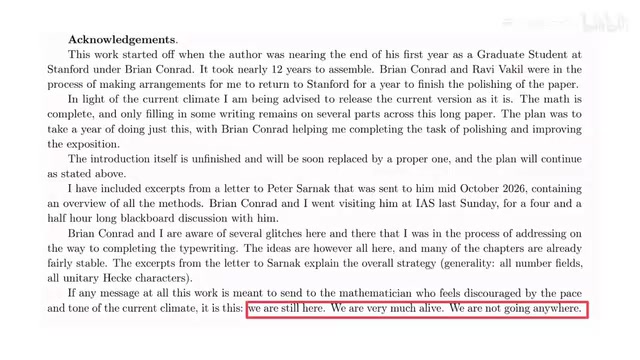
On the same day, Ravi Vakil, president of the American Mathematical Society and professor at Stanford University, posted an urgent announcement on the course webpage, publicizing Alessandro Masullo's manuscript proving the Generalized Riemann Hypothesis—940 pages, titled The Music of the Primes. The work began 12 years ago, entirely manual, without any AI. Masullo's doctoral advisor, Stanford number theorist Brian Conrad, had been advocating for a review for several months and had even spent a month in Rome helping revise the manuscript; the original plan was to polish it for another year. Alpöge's announcement disrupted the plan, and Vakil decided not to wait.
In the preface, Masullo wrote: "If this work is to convey any message to any mathematician frustrated by the rhythm and tone of the current atmosphere, it is that we are still here, we are very much alive, and we are not going anywhere." (See figure below.) These words read more like a statement. However, about 8 hours after the manuscript was publicized, Vakil updated the announcement: many people had already used different AI models to find problems in the manuscript, and he could not guarantee that the proof strategy was correct. A work of 12 years, reviewed for months by an advising advisor, had flaws found by AI within 8 hours; on the other side, 17 million lines of code that no one could understand first received machine certification. This contrast is more striking than any commentary.
The Generalized Riemann Hypothesis (GRH)
The Generalized Riemann Hypothesis is a generalization of the Riemann Hypothesis, concerning Dirichlet L-functions. Dirichlet L-functions are a class of complex functions related to modular characters, whose zero distribution also controls the distribution of primes in arithmetic progressions. GRH asserts that the nontrivial zeros of all these L-functions also lie on the critical line Re(s)=1/2. Since Dirichlet L-functions include the Riemann ζ function as a special case, GRH is stronger than the original Riemann Hypothesis and harder to prove. Alpöge claims to have proven GRH, and Masullo's manuscript also targets the generalized version, making the comparison of the two works more direct.
The Third Proof: GPT's 6-Page Paper and the Weil Conjecture
Another day later, a paper of less than 6 pages appeared. OpenAI's GPT gave a new proof of the Riemann Hypothesis over finite fields—the Weil Conjecture. In 1974, Pierre Deligne used Lefschetz numbers, the Kazhdan–Margulis theorem, and other modern mathematical treasures to write two monumental works totaling over 150 pages, earning the Fields Medal. The new proof's core derivation is less than 6 pages, and the only core estimate used is the Cauchy–Schwarz inequality, which undergraduates learn. The inspiration came from an inconspicuous annotation in the corner of page 23 of Alpöge's notes. Humans were almost entirely uninvolved in the process: Opus first wrote the annotation into a research proposition, GPT produced the complete proof, Opus checked it line by line and wrote the initial draft, and finally another model cut off all history records and started a double-blind review, catching a hidden bug—the initial draft's citation of the Lefschetz theorem had a discrepancy; the paper adopted the correction and reverted to Deligne's original proof as written in Katz's paper. The only thing human author Floris van Doorn did was upload the paper online under the CC0 license. Stanford mathematician Jared Lichtman commented: "We may really be approaching a critical point."
The Cost of 250,000 Pages: Why Machine Proofs Are Hard to Digest
Why did the proof balloon to 250,000 pages? One practical reason is misaligned incentives: today's reasoning model training almost exclusively focuses on whether the reasoning goes through—whether the answer is correct, whether it compiles—not on conciseness or insight. A model with unlimited stamina that does not look at a map will, as long as it can feel its way along the wall to the exit, write down that hundred-thousand-step route word for word. The 250,000 pages likely contain a great deal of scaffolding and trial-and-error waste. Alpöge himself believes the proof should be greatly simplifiable, perhaps even the core idea can be stated in a few sentences.
This differs from the Four Color Theorem in 1976: at that time humans fully understood the proof idea; only the computation was delegated to machine exhaustion (see figure below). This time, the derivation path itself has never been walked by humans. Alpöge admits that he has not yet mastered the vast mathematics surrounding this proof. The value of mathematics has never been merely to check a box after a conjecture, but to grow new concepts, methods, and bridges during the proof process. If that mass cannot be unpacked by anyone, its help to downstream physics, engineering, materials, and drug discovery is very limited—few companies dare to put a black-box conclusion they do not understand at all into production, because you do not know its applicable boundaries or whether moving the conditions will cause collapse.

The Calm of the Mathematical Community: Milestone or Black Box?
The mathematical community's attitude is far calmer than public opinion. 2010 Fields Medalist Ngô Bảo Châu publicly acknowledged the proof but believed that those rushing to declare "the end of mathematical research" may be wrong; AI will instead make mathematics more prosperous and democratic. He said that future competitiveness in mathematics will no longer depend mainly on whether one can build complex proof chains, but on whether one can ask good questions, observe, and explore. Fields Medalist James Maynard said that if fully verified it would clearly be a milestone in mathematical history, and he leans toward believing it is ultimately correct, but also stated plainly: "Right now this is just a pile of code that no one understands; it will take mathematicians a long time to digest it." Terence Tao's judgment is similar: at first glance the proof seems to deploy the full power of the Langlands program and modern developments in arithmetic geometry; digesting it will take considerable time, though fortunately there is at least one human author to communicate with. Buzzard put it more bluntly: "Right now we don't even know why this theorem holds."
The Clay Mathematics Institute website still marks it "unsolved." This is not slow reaction but rules: a proof must be published in a qualified peer-reviewed journal, pass at least two years, and gain general acceptance by the global mathematical community before entering prize deliberation. Moreover, this verification covers the Riemann Hypothesis and the generalized version for all Dirichlet L-functions; Dedekind ζ functions, Hecke L-functions, and more general automorphic L-functions are not included. Alpöge says extending the Riemann Hypothesis is the next goal.
Conclusion: The Ability to Catch the Answer
Humans have long relied on things they do not understand: mathematicians can directly use theorems proven by predecessors, engineers can call verified libraries, and the classification of finite simple groups spans over 10,000 pages across hundreds of papers; the entire verification took decades, yet the mathematical community as a whole digested it. Knowledge grows this way; each time we extend trust one link outward, the world we construct becomes a little larger.
At the end of his statement, Alpöge wrote: the first thing after reaching the summit is to understand the argument, simplify it, make more people understand it, and write it out properly. He said the Riemann Hypothesis was a lamp from his student days; the lamp going out is a bit sad, but what he has seen over the past month convinces him that something even greater in science is just dawning. Machines can already place answers on the table before we understand them. The next question is not whether it can do it, but whether we have the ability to catch it. If we cannot catch it, it is just a string of correct symbols; if we can, it will become mathematics.
One-line Summary
AI and humans each produced a proof of the Riemann Hypothesis within 48 hours; machine verification passed but humans struggle to digest it, and the mathematical community faces challenges of trust and understanding.
Paragraph Summary
The article reports that the Riemann Hypothesis was challenged twice within 48 hours: Anthropic mathematician Alpöge and Claude generated 17 million lines of Lean code in 41 days to complete a formal proof, which passed cross-verification by five independent kernels, but the entire process relied heavily on AI; on the same day, human mathematician Masullo's 940-page purely manual proof was publicized and had problems found by AI within 8 hours. Subsequently, GPT proved the Weil Conjecture with a paper of less than 6 pages, with almost no human involvement. The mathematical community acknowledges the milestone significance but stresses that digestion will take time, and the Clay Institute still marks it unsolved. The article explores the inflation of machine proofs, misaligned incentives, and humanity's ability to catch the answer.
Related articles

ChatGPT Plus Subscription Pitfall Guide: Go/Plus/Pro Tier Comparison and Quick Activation
A complete ChatGPT Plus subscription guide based on a Bilibili tutorial: from registering an account, comparing Go/Plus/Pro tiers, to the practical steps for quickly completing your subscription.

GPT-6.2 Sol/Astra Released! A Step-by-Step ChatGPT Plus Subscription Guide and Tier Comparison
GPT-6.2 Sol/Astra is out—here's a ChatGPT Plus subscription guide: register an account, compare Go/Plus/Pro tiers, and subscribe in a minute.

Comparing Three Channels for Subscribing to GPT Plus in China: Is Website Top-Up the Easiest?
How to subscribe to GPT Plus in China? This article compares website top-up, credit card, and mobile top-up channels—process, cost, and risk—with steps and tips to help you choose wisely.