U.S. Department of Defense Data Breach: Personal Information of Millions of Service Members Stolen

The U.S. DoD suffered a months-long APT intrusion, exposing millions of service members' data and revealing systemic government security failures.
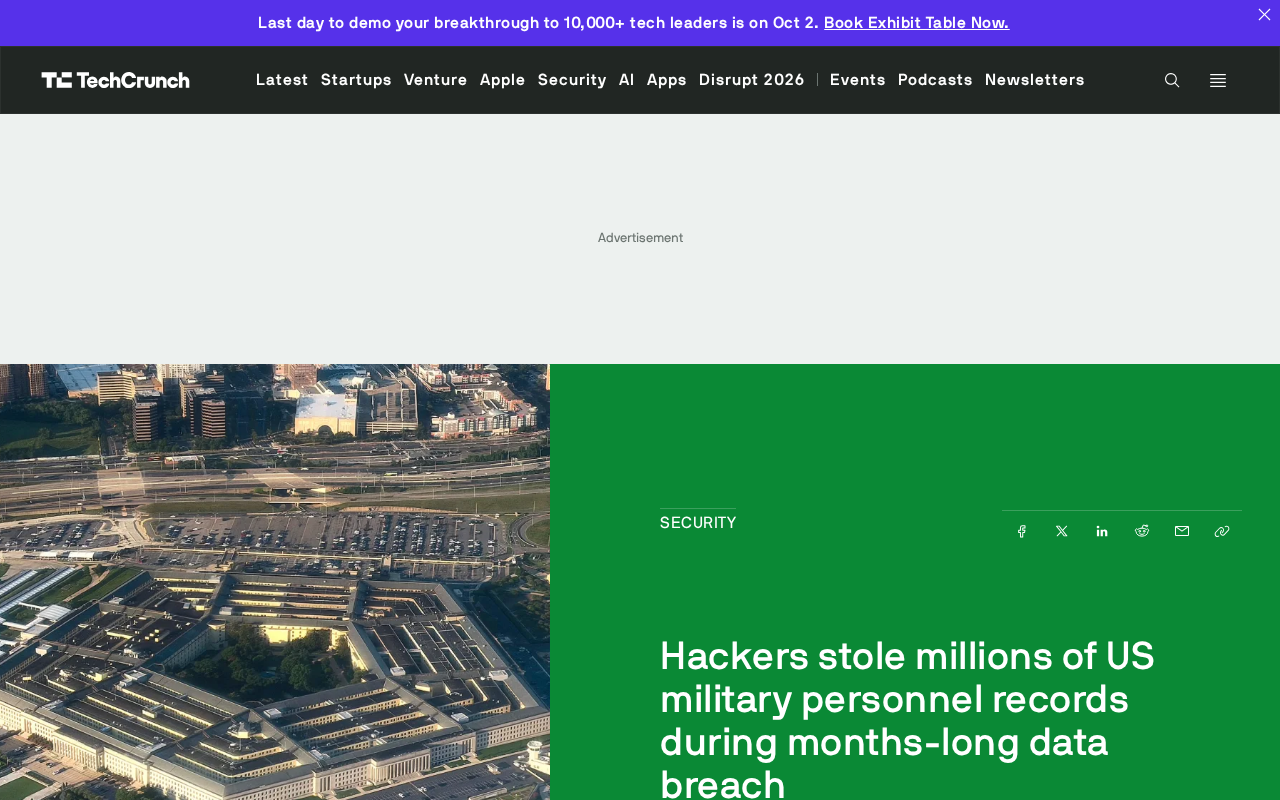
The U.S. Department of Defense recently notified millions of active-duty and retired service members that their personal information was stolen in a data breach spanning several months. Rather than a single explosive attack, this was a case of long-term, stealthy infiltration — highly covert and deeply damaging. Military identity data, due to its national security implications, can be exploited for identity theft, targeted phishing, and social engineering attacks. The incident also exposed structural weaknesses in government agencies' threat detection, access controls, and incident notification timeliness. Affected personnel should immediately enable multi-factor authentication, stay alert to official impersonation scams, and consider placing a credit freeze as a proactive defense measure.
Overview
The U.S. Department of Defense (DoD) recently notified millions of active-duty and retired service members that their personal information was stolen during a data breach that persisted over several months. The incident has once again thrust the question of cybersecurity defenses at large government agencies into the spotlight.
According to disclosures, this was not a one-time attack but rather the result of attackers maintaining long-term access and gradually exfiltrating data over months. This kind of prolonged, stealthy intrusion typically signals that the attacker possesses advanced technical capabilities and a clear objective — and it also reveals significant blind spots in the victim organization's threat detection and incident response capabilities.
Why Long-Term Persistence Is So Dangerous
Unlike ransomware attacks that detonate quickly, data theft campaigns that unfold over months are far harder to detect — and far more destructive. Attackers have ample time to move laterally through the network, escalate privileges, and selectively exfiltrate high-value data. By the time an organization detects the anomaly, sensitive information may have already been systematically stolen in bulk.
For military personnel, personal information carries far greater value than typical civilian data. Names, identity credentials, service records, and similar details — once in the hands of adversaries or criminal organizations — can be weaponized for identity theft, targeted phishing, or even social engineering attacks against specific individuals. When the people involved have national security backgrounds, the potential fallout is amplified considerably.
This type of attack pattern is known in cybersecurity as an APT (Advanced Persistent Threat). APT attacks are typically carried out by state-sponsored hacker groups or highly organized criminal syndicates. Their defining characteristic is being "low, slow, and stealthy" — operating with minimal network noise, an unhurried infiltration pace, and highly covert lateral movement to evade traditional security detection. Attackers typically gain an initial foothold through spear-phishing emails or supply chain vulnerabilities, then quietly establish multiple backdoor channels over an extended period inside the network. Even if one entry point is sealed off, the attack continues uninterrupted. Traditional signature-based antivirus tools or firewall rules are nearly useless against these threats; defenders must rely on more proactive measures such as behavioral analysis, Endpoint Detection and Response (EDR), and network traffic anomaly analysis. The SolarWinds supply chain attack on the U.S. government in 2020 is a landmark case of this type of APT intrusion — it also went undetected for months.
The Structural Security Weaknesses of Government Agencies
In recent years, government agencies have become prime targets for cyberattacks. They hold vast troves of sensitive data, yet are frequently hampered by legacy systems, cumbersome procurement processes, and fragmented security governance. Attackers have taken direct aim at these structural vulnerabilities.
This DoD incident exposed several common shortcomings: insufficient threat detection capabilities that allowed the intrusion to go unnoticed for an extended period; possible gaps in data classification and access controls that enabled attackers to reach large-scale sensitive records; and delays in incident notification — affected individuals often receive word long after their data has already been stolen.
The Principle of Least Privilege is one of the core security standards implicitly violated in this incident. This principle requires that every user, program, or service within a system be granted only the minimum level of access necessary to perform its function — thereby limiting how much data an attacker can reach after gaining initial access. However, government agencies frequently suffer from "privilege creep" due to aging system architectures and the accumulated complexity of permission management over time. Common issues include failure to revoke access when employees leave and service accounts being granted excessive permissions. Once an attacker breaches the perimeter using a low-privilege account, they can progressively expand their reach through privilege escalation techniques, gaining access to vast amounts of sensitive records. This is the structural root cause behind why millions of records were stolen in bulk in this incident.
Steps Affected Personnel Should Take
For active-duty and retired service members who have received a notification, taking protective action promptly is critical:
- Strengthen account security: Enable multi-factor authentication on important accounts and change any passwords that may be linked to the compromised information.
- Watch for targeted phishing: Attackers may use the stolen information to impersonate official agencies in fraudulent communications. Treat any message requesting sensitive information with extreme caution.
- Monitor for credit and identity anomalies: Watch for suspicious activity in credit reports and financial accounts. Consider placing a credit freeze if necessary.
- Follow official guidance: Adhere to any remediation measures and identity protection services provided by the Department of Defense.
A Credit Freeze is one of the most effective proactive defenses against identity information theft, though it remains relatively unfamiliar to many outside the U.S. context. In the United States, by filing a credit freeze request with the three major credit bureaus — Equifax, Experian, and TransUnion — you can prevent anyone from opening new lines of credit or loans in your name, even if a fraudster already has your complete Social Security Number (SSN) and other identifying information. The freeze is free, can be lifted at any time, and does not affect the normal use of existing accounts. For the military personnel affected in this breach — given the high-value nature of their identity information — proactively placing a credit freeze should be prioritized over relying solely on credit monitoring services. The latter can only alert you after fraud has already occurred, rather than blocking it in advance.
Broader Implications
This incident is not an isolated case — it is a reflection of the overall cybersecurity posture across the entire public sector. It serves as a reminder to all types of organizations that data protection cannot remain at the compliance checkbox level; it requires building continuous threat monitoring, least-privilege access controls, and rapid incident response capabilities.
For ordinary individuals, the most practical lesson is this: once personal information is handed over to a third-party institution, its security is partly beyond your own control. In this context, proactive identity protection and security awareness matter more than ever.
Note: Due to limited information in the original reporting, specific details such as the exact scale of the breach, the identity of the attackers, and the precise methods of intrusion are still pending further official disclosure.
Related articles

WorkBuddy Step-by-Step Tutorial: Get an Automated Workflow Running in Half an Hour
A step-by-step breakdown of the WorkBuddy automated workflow: why most people only use it as a chat app, how the 27-anchor course and 12 templates help beginners get up and running in half an hour, plus notes on usage boundaries.

The Truth About Free Claude Code: Three Legitimate Paths and One Scam
Is free Claude Code possible? We break down the real cost of Pro and Max (with exchange rates and taxes), how community free methods work and their privacy trade-offs, plus fake installers and phishing traps—and three legitimate free paths.
Codex Cloud Mode Explained: Environment Setup and Use Cases
This article explains how Codex cloud mode works, environment setup steps, and use cases, including how to create environments, connect GitHub repositories, set scheduled tasks, and compare cloud vs. local mode.