U.S. Driver's License Data Breach: A Severely Underestimated National Security Crisis
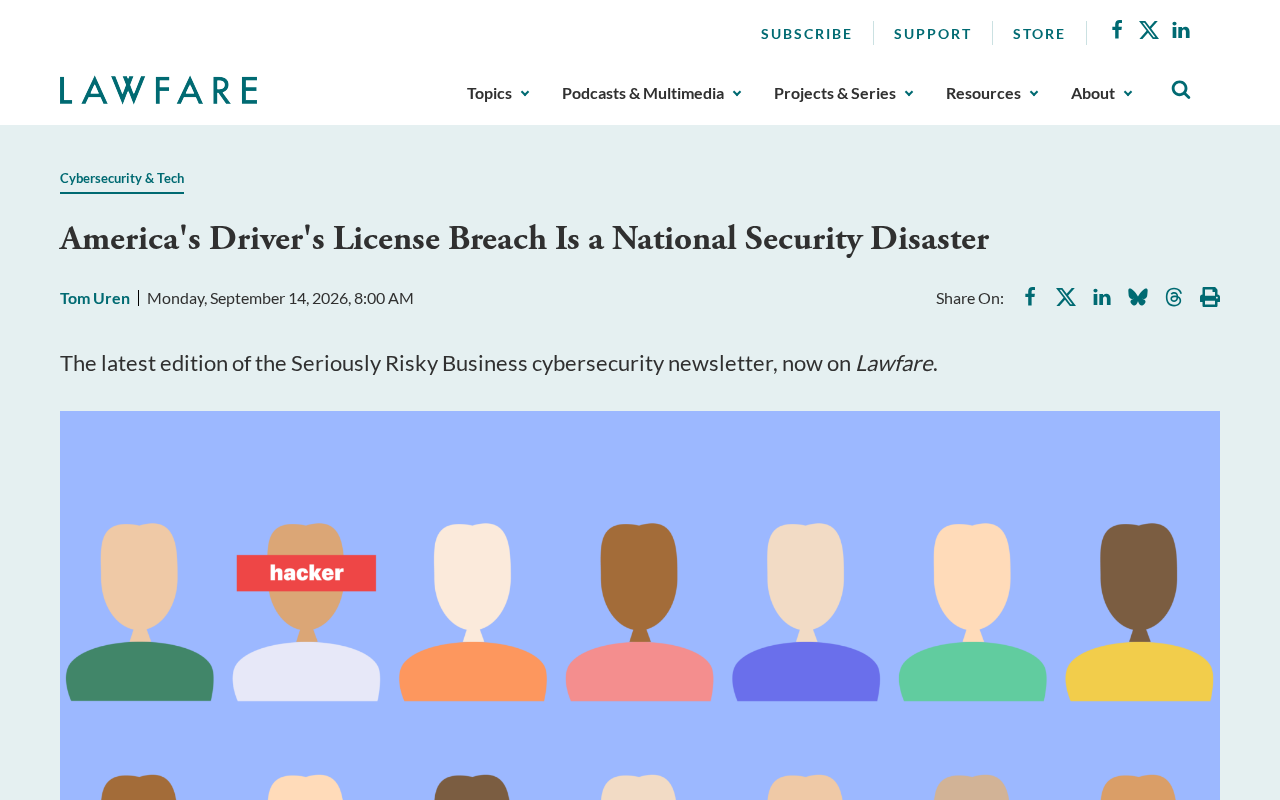
Mass U.S. driver's license breaches are a national security threat due to their irreversibility and intelligence aggregation value.
Security researchers have labeled the U.S. driver's license breach a "national security disaster" for three key reasons: the data carries near-permanent identity attributes (name, address, photo, signature), effectively serves as a national ID, and cannot be "reset" once compromised. At millions of records in scale, hostile intelligence agencies can build citizen dossiers for identity forgery, targeted social engineering, and cross-referencing with datasets like OPM records. Fragmented DMV governance and data brokers further blur accountability. The article argues that response must shift from remediation to prevention, focusing on cryptographic dynamic verification, restricting data brokers, and exploring decentralized digital identity solutions.
A large-scale breach of U.S. driver's license data is being characterized by security researchers as a "national security disaster." The issue has recently sparked discussion on legal and security policy platforms such as Lawfare, and garnered over 250 upvotes and more than 150 comments on Hacker News — reflecting intense concern from both the technical and policy communities.
Why a Driver's License Breach Is More Dangerous Than Ordinary Data Breaches
A stolen credit card can be cancelled and reissued. A compromised password can be reset. But the identity information encoded in a driver's license — name, date of birth, home address, license number, photo, and even signature — is essentially bound to a person for life. Once this data enters the black market, victims cannot "reset" their identity the way they would replace a bank card.
In practice, the driver's license functions as a de facto national ID in the United States. It is used for airport security checks, bank account openings, alcohol purchases, voter registration verification, and countless other scenarios. When this data is systematically compromised, attackers gain not just a personal profile, but a "master key" capable of impersonating U.S. citizens and bypassing multiple layers of identity verification.
From Personal Privacy to National Security
The core logic behind elevating driver's license breaches to a "national security" issue lies in the potential for large-scale misuse. When a breach involves millions or even tens of millions of records, hostile foreign intelligence agencies can use this data to build a comprehensive dossier database on U.S. citizens.
This type of data can be exploited for:
- Identity forgery and infiltration: Creating credible synthetic identities for spies or agents;
- Precision social engineering attacks: Launching targeted phishing campaigns against government employees, military personnel, and critical infrastructure workers;
- Financial and benefits fraud: Fraudulently claiming tax refunds, unemployment benefits, or healthcare assistance at scale;
- Long-term intelligence accumulation: Cross-referencing with other breached datasets (such as medical or credit records) to build deep profiles on specific individuals.
It's worth noting that intelligence value rarely manifests in a single event — it emerges from the aggregation of data across multiple datasets. The lesson from the Office of Personnel Management (OPM) breach, which exposed security clearance background files, already demonstrated that seemingly disparate identity data, once assembled, can pose a structural threat to national security.
The 2015 OPM data breach remains the most illustrative case to date. It involved records on approximately 21.8 million individuals who had undergone federal security clearances, including fingerprints, family member information, mental health history, and financial details. The U.S. intelligence community widely believes this data was obtained by Chinese intelligence agencies and could be used to identify American intelligence officers overseas, map social networks, and cultivate informants through blackmail or direct contact. This case reveals the core threat logic of "data aggregation attacks": the value of a single dataset is often underestimated, but once cross-referenced with other sources — such as driver's licenses, medical records, or social media — it can generate highly actionable intelligence profiles. Because driver's license data includes photos and physical addresses, it holds unique value in constructing credible "layered identities," which is precisely why this breach has been characterized as a national security event.
Institutional Weaknesses: Who Is Guarding This Data
The U.S. driver's license system is managed in a decentralized manner by individual state Departments of Motor Vehicles (DMVs), with no unified federal-level security standards. This fragmented governance means that any weak link in a single state can become a breach point for the entire system.
Decentralized architecture was supposed to offer resilience — the idea being that data couldn't all be stolen at once. But in practice, third-party data brokers, contractors, and various identity verification services have aggregated what were once isolated datasets, creating new centralized points of risk. As data flows through outsourcing chains, it gets copied, cached, and resold, leaving security accountability dangerously diffuse.
Irreversible Harm
The most troubling aspect of driver's license breaches is their irreversibility. Governments can notify victims and offer credit monitoring services, but they cannot claw back data that has already spread — nor can they reissue entirely new identity credentials to tens of millions of people.
This reality demands a fundamental shift in strategy: from reactive remediation toward proactive defense and reducing the value of exposed data:
- Moving identity verification away from "knowing a static number" toward cryptography-based dynamic authentication;
- Strictly limiting data brokers' ability to collect, retain, and resell identity information;
- Establishing stronger accountability mechanisms for third-party data handlers;
- Exploring decentralized, selective-disclosure digital identity solutions that eliminate the need to expose all personal information at once.
Decentralized Identity (DID) is one of the leading technical approaches for addressing the risks of static identity data exposure. Its core concept is to allow users to cryptographically hold their own identity credentials and selectively disclose only the attributes required in a given verification context — for example, proving "age is 21 or older" without revealing a full date of birth — rather than submitting a fixed document containing all personal information. The W3C has standardized the "Verifiable Credentials" specification, and the EU's eIDAS 2.0 framework is also advancing similar architectures. By contrast, the current driver's license system requires presenting all data fields at once, and recipients (such as liquor retailers or car rental companies) often retain far more information than their business actually requires — this is the institutional root cause of breach risks continuously propagating downstream.
Implications for Ordinary Users and Policymakers
For individuals, options in the short term are relatively limited: stay alert to scams that use driver's license information as bait, freeze credit reports, and enable multi-factor authentication. But fundamental change must come from the institutional level.
For policymakers, this incident is a wake-up call — the security of identity infrastructure should not be treated as a mere privacy compliance matter, but must be incorporated into the national security strategic framework. When identity data becomes raw material for adversarial intelligence operations, protecting it is equivalent to protecting the nation's security perimeter.
The true lesson of this breach may be this: in the digital age, identity is infrastructure — and the vulnerability of infrastructure has never been purely a technical problem.
Related articles

Letting AI Build AI Tools: A 7-Day, 31-Commit Bootstrapping Post-Mortem
An engineer ran a fully autonomous AI-builds-AI pipeline for 7 days, 31 commits, with a 1-in-6 success rate. This post-mortem covers 5 failure types, 11 structural rules, and how every mistake became a permanent immunity gate.
Building an AI-Powered E-Commerce Business from Scratch: A Real-World Account of Multi-Agent Architecture for Print-on-Demand
A blogger builds a print-on-demand e-commerce company from scratch using AI agents — documenting specialized Agent profiles, GPT-5.6 vs Claude Fable multi-model orchestration, and reusable skill accumulation.

AI Agent Earns $10K in One Week: 3 Key Upgrades Explained
A blogger shares how he earned $10K in a week with an AI Agent — not by adding more skills, but through verification, approval gates, and subagents to raise trust and enable true automation.