Uber Data Reveals: AI Agent Ride Booking Is Still a False Demand?

Only 4 AI agent ride-booking orders in Uber's busiest week, revealing commercialization bottlenecks in ecosystem and trust.
Uber disclosed that in its busiest week only 4 orders platform-wide were completed by AI agents, sharply contrasting with optimistic industry expectations. The article analyzes that ride booking involves real payment, location authorization, and account security; platforms lack identity and authorization mechanisms designed for agents; existing user interaction is already short enough; and platforms lack incentives to open agent ordering. This shows that AI agent implementation depends on scenario selection and platform ecosystem cooperation, and high-frequency, short-process, high-trust consumer transactions are hard for agents to penetrate in the short term.
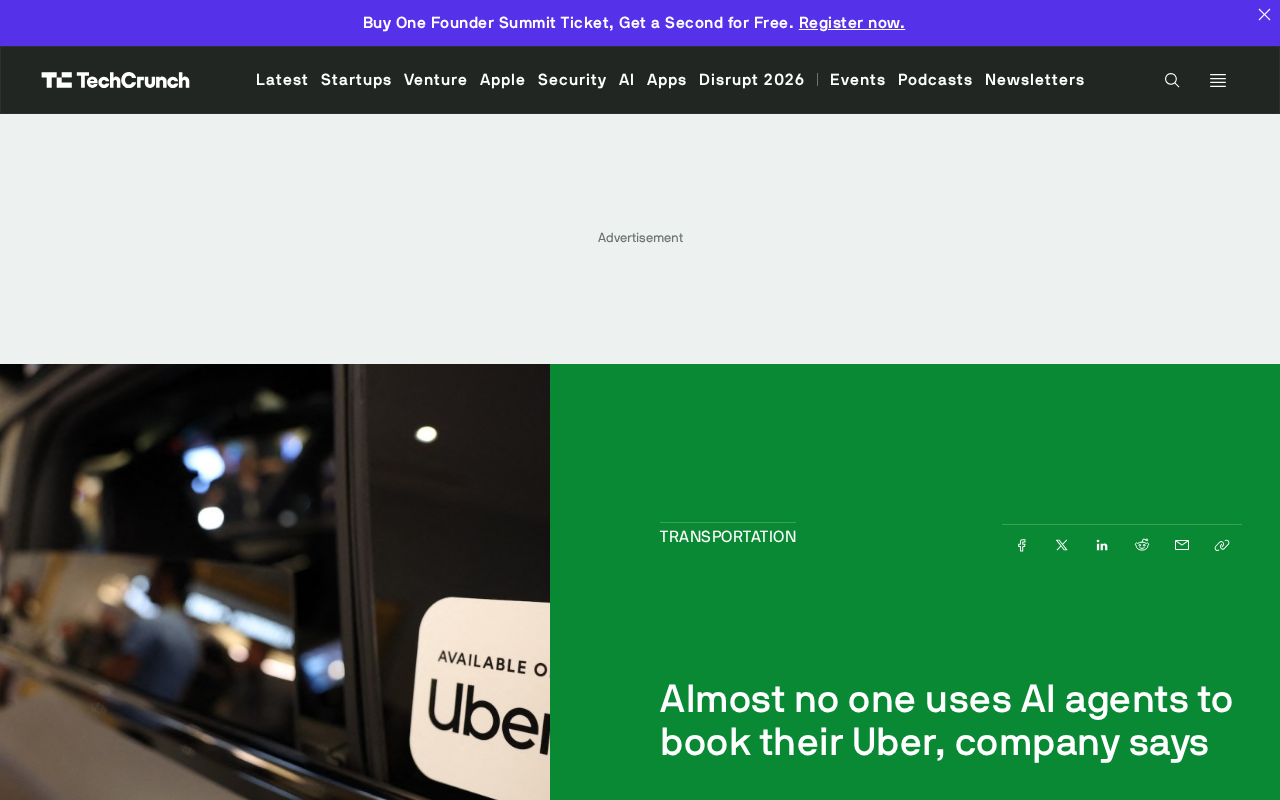
Uber disclosed that in its busiest week of the most recent quarter, only 4 orders were completed through AI agents. This figure comes from official company disclosure and stands in stark contrast to the heated industry discussion around the commercialization of AI agents.
An Imagination Punctured by Data
For some time, AI agents have been portrayed as the core entry point for the next generation of human-computer interaction—users need only give a single natural language instruction, and the agent can automatically open apps, compare prices, place orders, and complete payments. Ride booking, because of its standardized process and mature APIs, is often listed as one of the scenarios most likely to be implemented first.
Uber's data pours cold water on this expectation. In the busiest week, only 4 people across the entire platform completed a ride booking through an AI agent. This magnitude can no longer be called "early adoption"; it is closer to occasional testing behavior.
This data point is noteworthy because it comes from proactive disclosure on the supply side, rather than third-party estimation. The platform holds the complete order chain and can distinguish human operations from agent calls, so this figure has relatively high credibility.
AI agents are fundamentally different from traditional chatbots or API calls. Chatbots typically only generate text responses, while API calls are fixed logic pre-written by developers; AI agents, by contrast, have the ability to plan autonomously, invoke tools, and execute multi-step operations, and can complete a goal without step-by-step human intervention. A typical architecture includes a large language model as the reasoning core, tool invocation interfaces (such as browser control and app operation), memory modules, and a security sandbox. For this reason, agents can theoretically simulate human clicking, filling, and confirmation behavior in apps. But the autonomy of agents also brings difficult problems around authorization, auditing, and responsibility attribution, especially in scenarios involving real fund transactions, where platforms often require traceable identity authentication and risk control mechanisms, while existing agent technologies have not yet formed standardized solutions in these areas.
Why Agent Ride Booking Doesn't Work
Payment and Identity Barriers
Ride booking is not information querying but a high-trust transaction involving real payment, location authorization, and account security. Letting an AI agent complete a charge on behalf of a user requires solving a series of problems such as authorization boundaries, responsibility attribution, and exception handling. Mainstream platforms currently do not have identity and authorization mechanisms designed specifically for "agent ordering."
In the payment field, agent ordering involves the issue of "authorization boundaries": is the permission granted by the user to the agent one-time, limited, or continuous? Can the agent make decisions on its own when encountering price changes, payment failures, or trip anomalies? Currently, mainstream payment networks and platforms generally adopt authentication systems based on human accounts (such as SMS verification codes, biometrics, and device fingerprints), and these mechanisms assume by default that the operating subject is a natural person and cannot be directly applied to agents. In addition, responsibility attribution is also unclear: if an agent places an erroneous order or encounters fraud, should the loss be borne by the user, the agent developer, or the platform? The industry has not yet reached a consensus. Some payment companies have begun exploring "agent payment tokens" and programmable authorization, but coverage and maturity are very limited, which is also an important technical obstacle to scaling agent ride booking.
Existing Interaction Is Already Short Enough
From the user's perspective, opening Uber, confirming the destination, and tapping to book the ride takes only a few clicks. The efficiency gain brought by AI agents in this scenario is very limited, and users lack motivation to configure agents, grant permissions, and bear additional risks.
Platform-Side Incentives Are Not Aligned
Once agents become widespread, the platform's control over the user interface and its dominance over pricing display will both be weakened. Platforms prefer to embed AI capabilities into their own apps rather than open them to external agents. This also explains why agent calls are unlikely to receive official support.
Implications for AI Agent Startups
This set of data does not mean that AI agents have no value; rather, it suggests that scenario selection is more critical than technical capability. High-frequency consumer transactions with short processes and high trust requirements are unlikely to be penetrated by agents in the short term; by contrast, information-intensive, cross-system complex tasks that require multi-step comparison are where agents are more likely to prove their value.
Another implication is that the commercialization of agents requires platform cooperation. Without platform-side authorization, interfaces, and risk control support, agents can only remain at the demonstration level. Uber's 4 orders are essentially a direct reflection of the absence of an ecosystem.
For practitioners focused on the implementation of AI applications, rather than expecting agents to overturn super apps, it is better to first find niche scenarios that platforms are willing to open up and users are willing to authorize.
One-line Summary
In Uber's busiest week, there were only 4 AI agent ride-booking orders, revealing that agent commercialization faces ecosystem and trust bottlenecks.
Paragraph Summary
Uber disclosed that in its busiest week, only 4 orders across the entire platform were completed by AI agents, in stark contrast to the industry's optimistic expectations for agent commercialization. The article argues that the ride-booking scenario involves real payment, location authorization, and account security, and existing platforms lack identity and authorization mechanisms designed for agents; at the same time, users' existing interaction is already short enough, and the efficiency gain brought by agents is limited; platforms also lack incentives to open agent ordering and prefer to embed AI capabilities in their own apps. This data shows that the implementation of AI agents depends not only on technical capability but also on scenario selection and platform ecosystem cooperation. High-frequency, short-process, high-trust consumer transactions are unlikely to be penetrated by agents in the short term.
Related articles
 Tech Frontiers
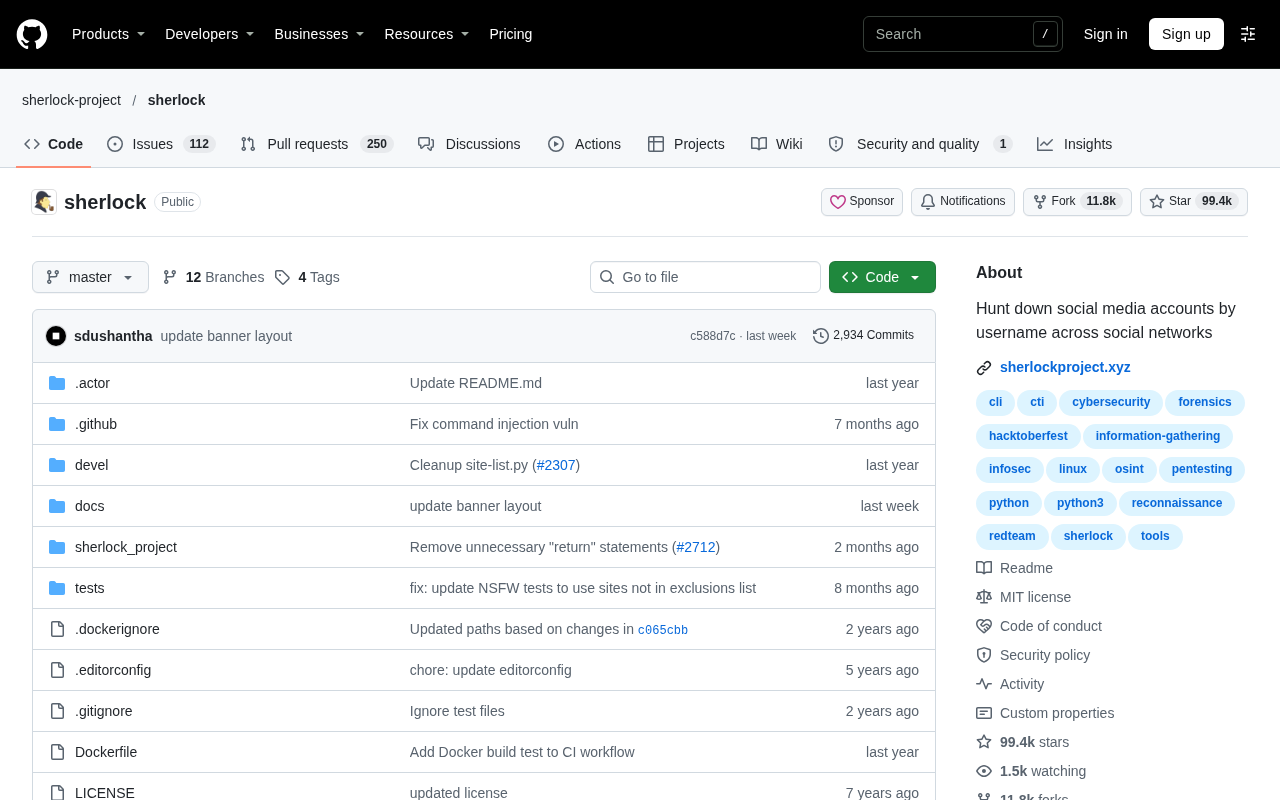
Sherlock: An Open-Source Tool for Tracking Usernames Across Social Networks
Sherlock is an open-source Python tool that tracks social accounts across networks by username. This article covers its core features, why developers love it, typical use cases, and privacy compliance considerations.
 Tech Frontiers
GitHub Daily·Nov 07: Agent-Ready and Context Compression
GitHub Trending Nov 07: meta's agent-ready design system astryx, billion-context's 5x context compression, sherlock nearing 100k stars, plus local-first localthings and bare-metal GPU orchestration nvke.
 Tech Frontiers
Buoyant Open-Sources Kinference: An Inference Control Plane for vLLM on K8s
Buoyant open-sources Kinference, an inference control plane for vLLM on Kubernetes, with declarative routing, KV-cache-aware load balancing, and per-tenant metrics—claiming 95% lower median TTFT in official benchmarks.