uBlock Origin Exposes Universal XSS Vulnerability: Element Picker as Attack Vector
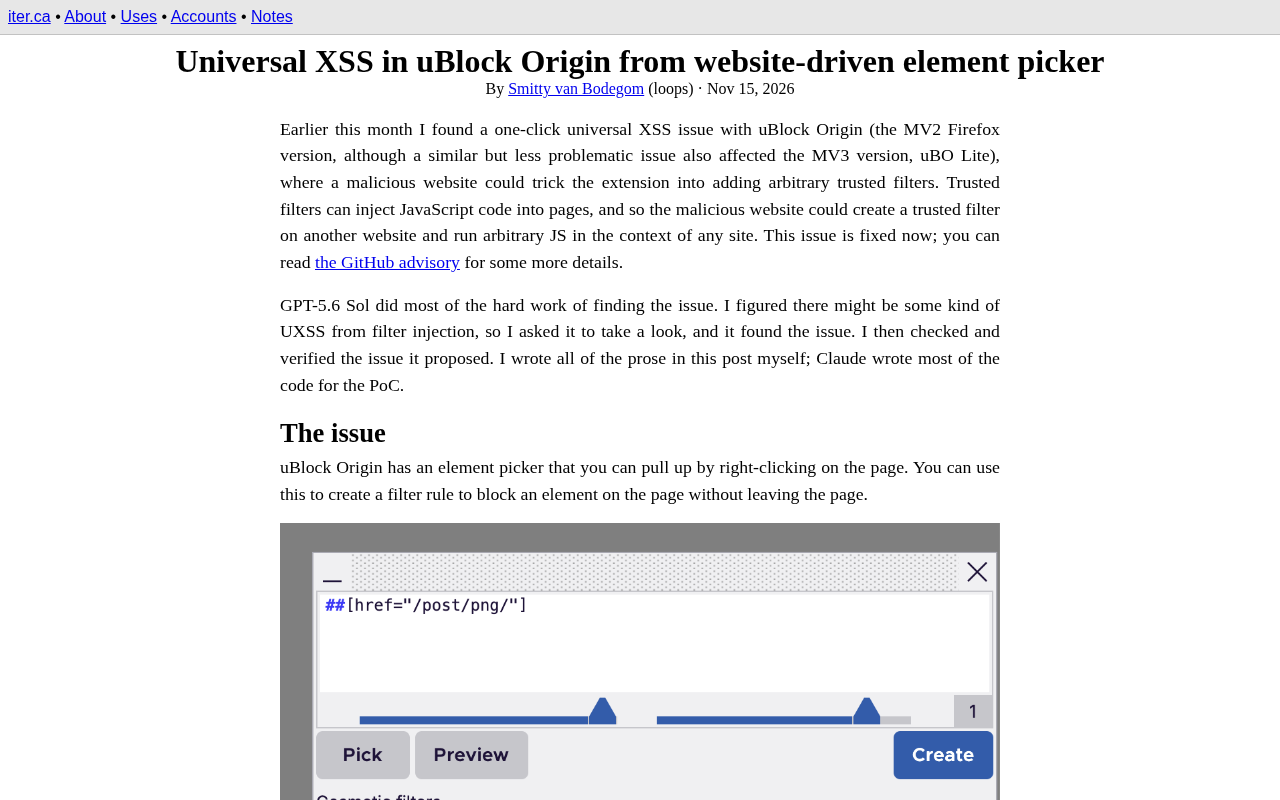
uBlock Origin's Element Picker has a Universal XSS flaw that lets websites trigger it and inject scripts.
Security researchers disclosed a Universal XSS vulnerability in uBlock Origin's Element Picker. Webpage JavaScript can programmatically trigger the picker and exploit the extension's handling logic to inject malicious payloads. Since extensions have higher privileges, attackers can bypass the same-origin policy, execute scripts on any page, and read cross-site data. The Hacker News community is divided on exploitability. Researchers have reported the issue and advise updates; developers should harden messaging channels and sandbox injected content.
An Overlooked Attack Surface: The Element Picker
uBlock Origin, the most widely used open-source ad-blocking extension, has long been a subject of security scrutiny. Recently, security researchers disclosed a Universal Cross-Site Scripting (Universal XSS) vulnerability in its Element Picker feature. According to a technical blog post on iter.ca and discussions on Hacker News (the post garnered 209 points and 51 comments), the issue stems from websites being able to actively trigger and manipulate uBlock Origin's Element Picker, thereby executing malicious scripts on arbitrary pages.
The Element Picker was originally designed as a convenient tool for users to manually block page elements. However, researchers discovered that JavaScript on a webpage can "drive" this feature in a certain way, causing it to enter selection mode without the user's knowledge. Because extensions have higher privileges than ordinary webpages, attackers can bypass the same-origin policy and achieve cross-origin script execution.
How the Vulnerability Works: Permission Boundaries Broken
The danger of Universal XSS lies in the fact that it is not limited to a single site but can affect any page the user visits. uBlock Origin's Element Picker injects UI and scripts when activated. If a website can control this activation process and inject its own content, it effectively gains the extension's execution context.
According to iter.ca's analysis, the key to the attack chain is that a website can programmatically open the picker and exploit the extension's handling logic for page elements to inject malicious payloads. Commenters on Hacker News added that the root cause of such vulnerabilities is often insufficient origin validation in the extension's messaging mechanism.
Universal XSS (UXSS) differs from ordinary XSS primarily in scope: ordinary XSS relies on an injection point in the target site itself and can only affect users of that site, whereas UXSS exploits vulnerabilities in the browser or extension itself to bypass the same-origin policy and execute scripts on arbitrary pages not controlled by the attacker. This means the attacker does not need to wait for the victim to visit a flawed website—as long as the victim has the vulnerable extension installed, any page visited can be injected. The harm of UXSS is thus amplified: the script runs under the origin of the victim page, can read that origin's cookies, localStorage, and DOM content, and can thereby hijack sessions or steal sensitive data. In the browser extension context, because extension scripts typically have higher privileges than webpages, once a webpage can influence the extension's execution logic, it effectively achieves privilege escalation through the extension.
Understanding this vulnerability also requires familiarity with browser extension messaging mechanisms. Extensions typically consist of content scripts, background pages/service workers, and popup interfaces, which communicate through channels such as chrome.runtime.sendMessage, chrome.tabs.sendMessage, or window.postMessage. These channels are not inherently trustworthy: scripts running on a webpage share the same DOM environment as content scripts, and the webpage can send forged messages to the extension via postMessage or by directly calling interfaces exposed in the page context. If the extension does not validate the sender's origin (e.g., event.source, event.origin) when receiving messages, or does not perform type and escaping checks on message content, a malicious webpage could induce the extension to perform unintended operations—such as programmatically activating the Element Picker and injecting attacker-crafted HTML.
Community Reaction and Remediation Recommendations
In the Hacker News discussion, developers debated the exploitability of the vulnerability. Some commenters argued that triggering it requires user interaction or specific configurations, limiting the actual risk; others emphasized that once exploited, Universal XSS can have far more severe consequences than ordinary XSS, because attackers can read cross-site data.
Researchers have reported the issue to the uBlock Origin project and recommend that users keep the extension updated. For ordinary users, upgrading to the latest version promptly is the most direct protective measure; for extension developers, this case serves as a reminder that any interface allowing webpages to interact with the extension must strictly validate origin and content.
Implications for the Extension Security Ecosystem
This is not the first time uBlock Origin has faced security scrutiny over its feature design, but it once again highlights the tension between convenience and security in browser extensions. Although the extension permission model isolates webpages from the browser kernel, improperly designed feature interfaces can become a stepping stone for privilege escalation.
For security researchers, features like the Element Picker that are "user-triggered" are often implicitly trusted, but this vulnerability shows that websites can also be triggers. In future extension development, hardening messaging channels and sandboxing injected content should become standard practice.
The browser extension permission model is fundamental to understanding such risks. Extensions declare a set of permissions at install time (e.g., activeTab, <all_urls>, webRequest), and once granted, they can read tab information across origins, modify page content, or intercept network requests. This design is intended to let extensions perform cross-site functions such as ad blocking and password management under user authorization, but it also means the extension's trust boundary is much broader than that of ordinary webpages. Although content scripts run in the webpage's DOM, they reside in an "isolated world" separate from the page script's JavaScript environment; however, the DOM is shared, and the page can still influence the content script's behavior by modifying DOM elements, triggering events, or sending messages. When an extension treats page-controllable data as trusted input, the protection offered by the isolated world is bypassed, creating a privilege escalation path from webpage to extension.
One-line Summary
uBlock Origin's Element Picker was found to have a Universal XSS vulnerability, allowing websites to actively trigger it and inject scripts.
Paragraph Summary
Security researchers disclosed a Universal Cross-Site Scripting (UXSS) vulnerability in uBlock Origin's Element Picker feature. Originally intended for users to manually block page elements, the picker can be programmatically triggered by webpage JavaScript, which then exploits the extension's handling logic for page elements to inject malicious payloads. Because the extension has higher privileges than ordinary webpages, attackers can bypass the same-origin policy, execute scripts on arbitrary pages, and read cross-site data. The Hacker News community is divided on exploitability: some believe user interaction is required and risk is limited, while others emphasize the severe consequences of UXSS. Researchers have reported the issue and recommend users update the extension promptly; for developers, the root cause is the lack of origin validation in messaging channels—channels should be hardened and injected content sandboxed.
Related articles

DevWorkflow 5.0: From Idea to Launch with the AI Five-Step Method
DevWorkflow 5.0 is a Claude Code plugin that uses a five-step process to take AI-assisted development from idea to launch. It asks you before every decision, preventing AI from adding tables and fields on its own, keeping docs and code consistent, and stopping merges before tests are written. Supports multiple platforms and languages, for individual developers and small teams.

How Do Hermes Agent's .md Files Work? A Breakdown of the Core Mechanism
Explaining Hermes Agent's .hermes directory mechanism: user.md stores personal info, memory.md records details worth remembering, soul.md defines the Agent's personality. Learn how these pure Markdown files keep the Agent consistent across sessions.

UN "Killer Robot" Talks Stall Again: Why Autonomous Weapons Regulation Is Hard to Break Through
UN Geneva talks on autonomous weapons ("killer robots") ended a week of consultations with little progress; delegates only agreed to "begin discussing options." This article analyzes the definitional disputes, conflicting security demands, and limits of multilateral mechanisms behind the stalemate.