UCR Archive Exposed? 52 Pigs Reveal the Truth About TSC Benchmarks
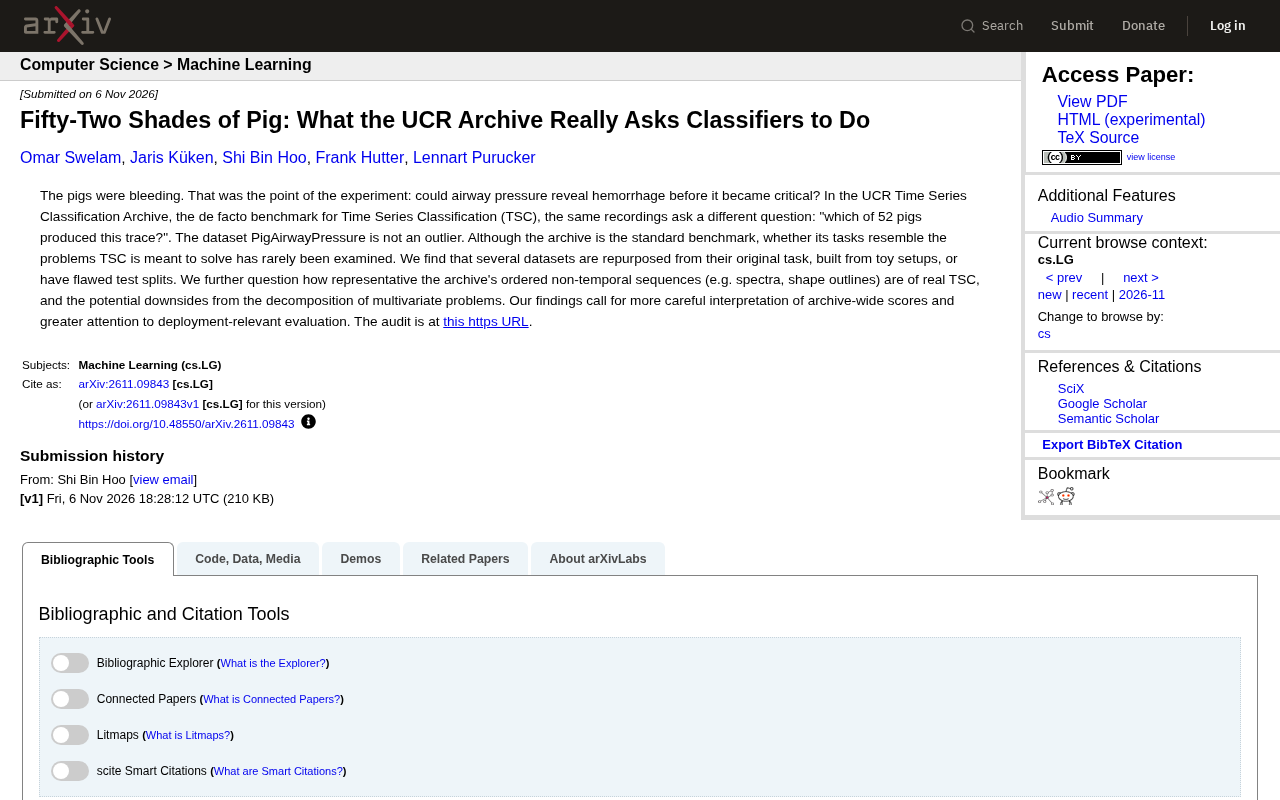
Audit reveals task semantic shifts, data heterogeneity, and split flaws in UCR Archive datasets, calling for calibration of TSC evaluation benchmarks.
An audit study of the UCR Archive, the benchmark for time series classification (TSC), found that multiple datasets suffer from task semantic shifts, heterogeneous data composition, and improper decomposition of multivariate problems. Using the PigAirwayPressure dataset as an example, the original bleeding detection task was repurposed into individual identification, causing evaluation to deviate from real objectives. The archive also contains large amounts of ordered non-temporal data (e.g., spectra, shapes) that mismatch genuine time series tasks; multivariate problems are decomposed into univariate series, losing variable interaction information; and some datasets come from toy experiments or have flawed test splits. Researchers call for more cautious interpretation of archive scores, a shift toward deployment-relevant evaluation designs, and have open-sourced the audit code.
When Benchmark Datasets Start to "Drift"
In the field of time series classification (TSC), there is one name that cannot be avoided: the UCR Archive. It is the default evaluation ground for virtually all TSC papers and is regarded as the "yardstick" for measuring model quality. But a recent audit study raises an unsettling question: is this yardstick really measuring the problems that TSC should be solving?
The study uses the PigAirwayPressure dataset as a starting point. The original experimental purpose of this data was to determine whether a pig was experiencing bleeding based on airway pressure, but in the UCR Archive, the task became "which of the 52 pigs did this curve come from." From medical warning to individual identification, the semantics of the task have fundamentally shifted. More critically, this shift is not an isolated case.
The audit team traced the provenance of multiple datasets in the UCR Archive and found three common categories of problems: first, original tasks were "repurposed" into classification tasks, making the correspondence between data and target far-fetched; second, some datasets come from toy-level experimental setups that are far removed from the complexity of real-world scenarios; third, some datasets have flawed train/test splits that may compromise the fairness of evaluation. These findings point to a core conclusion: we may have been testing the right algorithms with the wrong problems.
The UCR Archive, officially known as the UCR Time Series Classification Archive, is maintained by Professor Eamonn Keogh's team at the University of California, Riverside. Since its release in 2015, it has become the most widely used benchmark dataset collection in the field of time series classification, containing over a hundred datasets from different domains. The archive's original purpose was to provide diverse evaluation scenarios and promote algorithm comparability. However, as its influence grew, researchers gradually discovered that some datasets in the archive suffer from ambiguous labeling and unclear task definitions. This audit is a systematic investigation of these hidden issues, aiming to reveal potential biases in the task semantics of benchmark datasets rather than to deny their historical value.
The Overlooked "Non-Temporal" Series
Another point of controversy in the UCR Archive is the heterogeneity of its data composition. The archive contains a large amount of "ordered non-temporal" data that is not strictly time series, such as spectral curves and shape outlines. These data are ordered in structure, but they lack the temporal dependencies and dynamic evolution characteristics unique to time series.
Evaluating them together with genuine time series introduces a hidden problem: a model may perform well on spectral or shape data simply because it excels at capturing static morphological patterns rather than temporal modeling capability. This "capability mismatch" strips the archive's overall scores of discriminative power and makes it difficult for researchers to judge a model's generalization on real temporal tasks.
Ordered non-temporal data refers to data with sequential structure but no temporal dependency, such as spectral curves (wavelength order) and shape outlines (spatial point order). The key difference between such data and time series is that time series observations have dynamic evolutionary relationships—current values are influenced by historical values—whereas the order in ordered non-temporal data merely indicates the sequence of collection or arrangement and does not imply causal or dynamic associations. In the UCR Archive, such data is included in the TSC benchmark, which may cause model evaluation to deviate from the core goal of temporal modeling capability, because a model may achieve high scores simply by capturing static morphological features without needing to understand temporal dependencies.
The Cost of Multivariate Decomposition
The UCR Archive's handling of multivariate time series problems is also questionable. The audit points out that decomposing multivariate problems into multiple univariate series for classification simplifies the evaluation process but may lose interaction information between variables. The core challenge of real-world multivariate time series tasks—such as multi-sensor fusion for fault diagnosis—lies precisely in the synergistic relationships between variables. After decomposition, these relationships are flattened, and the evaluation results naturally struggle to reflect the model's actual deployment value.
Multivariate time series classification involves multiple variables changing over time simultaneously, often with complex interactions among them. For example, in multi-sensor fault diagnosis, readings from different sensors may be correlated and jointly reflect system status. Decomposing a multivariate problem into multiple univariate series for independent classification ignores this cross-variable synergistic information, preventing the model from learning joint patterns among variables. Although this simplification reduces computational complexity, it may mask the model's performance deficiencies on real multivariate tasks, because in actual deployment the model needs to handle dynamic interactions among variables rather than analyzing each variable in isolation.
Implications for TSC Evaluation
This audit does not aim to deny the historical contributions of the UCR Archive. As a standardized benchmark, it has greatly advanced comparable research in the TSC field. But the problem is that when the community relies excessively on the aggregate scores of a single archive, it is easy to develop a "false sense of progress": the numbers on the leaderboard keep rising, but the model's performance in real-world scenarios may not improve in tandem.
Researchers call for more cautious interpretation of archive-level scores and for a shift in attention toward evaluation designs relevant to deployment. Specifically, this means paying more attention to task semantic consistency in benchmark selection, ensuring that test sets reflect real distributions in data splitting, and preserving structural information among variables in multivariate problems. The audit code has been made public on GitHub, providing a reproducible starting point for future benchmark improvements.
Conclusion: The Yardstick Needs Calibration
The 52 pigs of PigAirwayPressure act like a mirror reflecting the awkwardness of TSC benchmarks: the data is still the same data, but the problem is no longer the same problem. For AI researchers, this audit reminds us that benchmarks are not truth but tools. Tools need regular calibration; otherwise, we may be answering the wrong questions within a seemingly rigorous system.
As the community begins to ask "what exactly does the archive make classifiers do," the evaluation culture of TSC may be entering a necessary period of reflection.
Related articles
Claude Fable 5.2 Hands-On: Top Intelligence but Absurdly Expensive
Anthropic releases Claude Fable 5.2 and Mythos 5.2, topping the Artificial Analysis intelligence leaderboard with big gains in scientific reasoning, strong game and hardware design, but max mode costs ~$26.54 per task. Hands-on game, circuit board design, and pricing advice.

1,000 AI Agents Formalize Fermat's Last Theorem in 30 Hours, Anthropic Releases New Claude Models
Anthropic releases Claude Fable 5.2 and Mythos 5.2: 1,000 agents formalize Fermat's Last Theorem in 30 hours, coding costs halved, plus hardware design and physics.

Claude Fable 5.2 Released: A Thousand AI Agents Build a Bootable OS in 8 Days
Anthropic releases Claude Fable 5.2 and Mythos 5.2—same model, two safety tiers. Demo shows 1,000 AI agents build a bootable OS in 8 days, formalize Fermat proof in 30 hours, score 64.6 beating Gemini 4 Carbon, price cut 20%.