UK Power Grid Narrowly Avoids Major Blackout, Sounding Alarm on Energy Risks in the AI Era

UK grid narrowly avoids blackout, warning of energy resilience risks amid AI compute expansion.
Based on a brief Hacker News discussion, this article reviews the UK power grid's near-miss blackout in June 2026 and its implications for AI. Although public details are limited, the author notes that high-load AI training clusters and data centers may exacerbate peak grid pressure, while the UK grid's operating margin is narrowing due to accelerating electrification and growing intermittent renewables. The tech community's lukewarm engagement reflects the marginalization of energy infrastructure discussions. The article recommends incorporating grid redundancy and demand response into AI infrastructure assessments and strengthening cross-industry collaboration between tech companies and energy operators to safeguard the digital world's physical foundation.
UK Power Grid Narrowly Avoids Major Blackout, Sounding Alarm on Energy Risks in the AI Era
A recent discussion on Hacker News reveals that the UK power grid came dangerously close to a large-scale blackout in June 2026. Although the original thread provided only a headline and limited engagement data, the event itself should serve as a wake-up call for professionals at the intersection of technology and energy: as AI compute demand continues to climb, grid fragility is becoming a hidden risk for digital infrastructure.
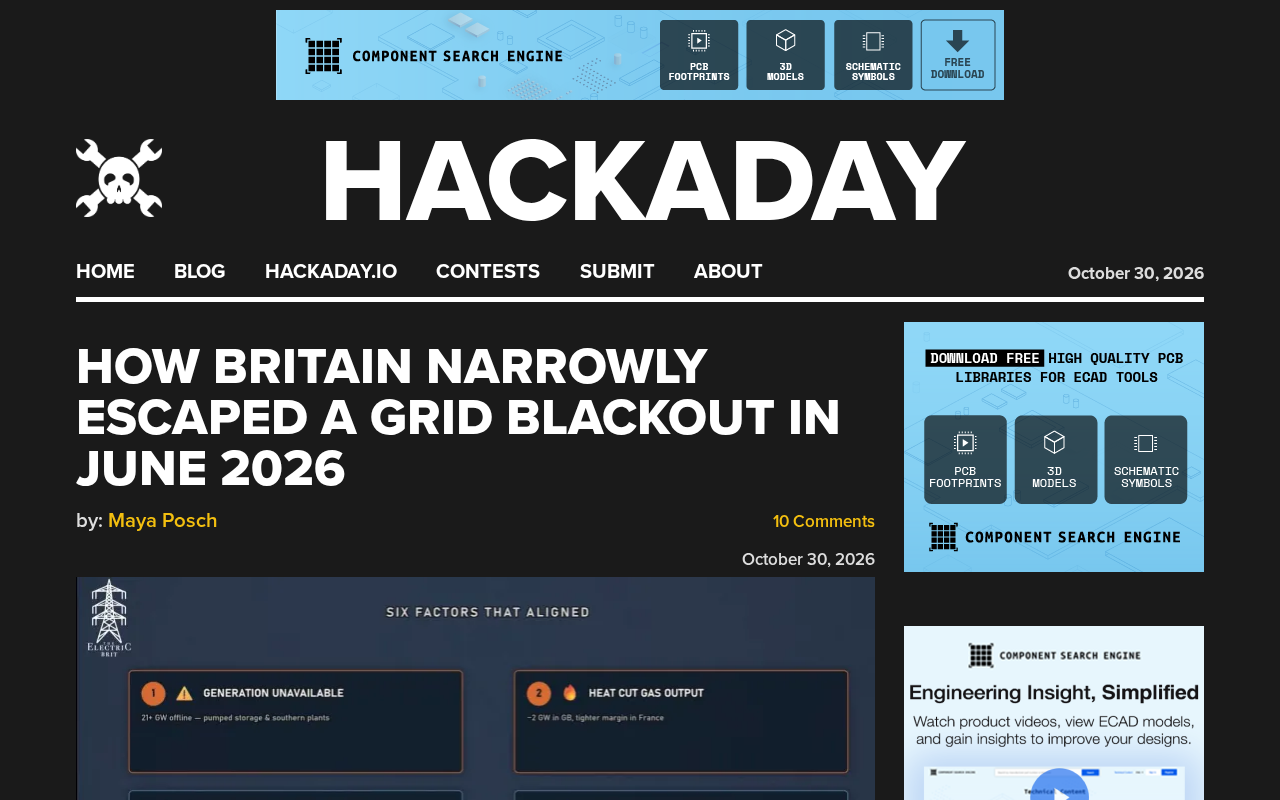
1. Event Recap: A Grid Crisis That Was "This Close"
According to information on Hacker News, the UK power grid experienced a near-blackout emergency in June 2026. The original post title explicitly states that "the UK narrowly dodged a grid blackout in June 2026," but did not disclose specific causes, scope of impact, or response details.
This scarcity of information is itself noteworthy. Grid security incidents often involve sensitive data about critical infrastructure, and public discussion typically lags behind the events themselves. The fact that a brief post on Hacker News attracted attention suggests that the tech community's sensitivity to energy system stability is increasing.
2. The Hidden Link Between AI Compute Expansion and Grid Pressure
Although the original material did not directly discuss the relationship between AI and the power grid, there is a reasonable connection between this event and current trends in the tech industry. The electricity consumption of large-scale AI training clusters and data centers has become a non-negligible variable in grid planning.
In recent years, the UK's National Grid has repeatedly warned that, with accelerating electrification and a growing share of intermittent renewable energy, the grid's operating margin is narrowing. The concentrated, high-load characteristics of AI infrastructure may further exacerbate peak pressure on local grids.
This event reminds us that the sustainable development of the AI industry depends not only on chips and algorithms but also on the resilience of the underlying energy system.
3. Tech Community Reaction and Information Gaps
The post on Hacker News received only 5 points and 2 comments, with limited discussion activity. This low engagement may reflect several realities: there is insufficient public information about the event to enable technical analysis, or grid security topics have not yet become a mainstream concern in the tech community.
Compared with the high attention given to AI model releases or chip news, discussions about energy infrastructure are clearly marginalized. This imbalance in attention allocation may be precisely the breeding ground for accumulating risk.
4. Implications for AI Infrastructure Planning
From this "near-blackout" event, several practical takeaways for the AI industry can be distilled:
- Energy resilience should be included in AI infrastructure assessments: Data center site selection and expansion plans need to more seriously consider the redundancy capacity of local power grids.
- The value of demand response mechanisms is rising: AI workloads have a degree of dispatchability; participating in grid demand response can both reduce operating costs and improve system security.
- Cross-industry collaboration urgently needs strengthening: Information sharing and joint planning between tech companies and energy operators are still at an early stage.
5. Conclusion
This close call for the UK power grid has limited public details at present, but it serves as a sufficient warning signal. At a time when the AI compute race is white-hot, energy system stability is an easily overlooked underlying variable. The tech community needs to direct more attention to the physical infrastructure that supports the digital world.
Note: This article is based on publicly available discussion information from Hacker News. The specific causes and scope of impact of the event are subject to official investigation.
Background Notes
Demand Response is a regulation mechanism in power systems: when grid supply and demand are tight, power operators use price signals or incentive measures to guide users to voluntarily reduce or shift electricity load, thereby avoiding rolling blackouts or activating high-cost peaking units. For data centers, AI training tasks typically have batch-computing characteristics, and some non-real-time inference tasks can be delayed by minutes to hours, giving them a natural capacity to participate in demand response. Tech companies can sign demand response agreements with grid operators to automatically reduce compute load during peak periods, earning economic compensation while helping the grid maintain frequency and voltage stability. As AI loads account for a growing share of total electricity consumption, the value of this flexible regulation capability will shift from a marginal supplement to a system-level necessity.
Operating Margin refers to the reserve generation and transmission capacity that a power system can still call upon beyond meeting maximum load demand, usually expressed as a percentage. When the operating margin narrows below a critical threshold, the system's ability to withstand sudden failures (such as unit trips or line overloads) declines significantly, and even a minor disturbance may trigger a cascading reaction. In recent years, the UK's National Grid has faced continuous pressure on its operating margin due to the retirement of coal-fired units, the growing share of wind and solar power, and bidirectional growth in winter heating and summer cooling loads. As a new concentrated high-density load, AI data centers—if connected without accompanying energy storage or demand response resources—will further compress already limited margin space, bringing the grid closer to the boundary of "nearly blacking out" during extreme weather or equipment failures.
Data center redundant power supply (N+1 / 2N architecture) is a common engineering practice for ensuring AI compute continuity: N+1 means configuring one additional backup power module beyond the N modules required to meet the load, while 2N means a fully duplicated configuration. However, this redundancy targets internal power distribution failures within the data center, not large-scale outages of the external grid. When the regional grid itself faces insufficient operating margin, UPS and diesel generators alone can only sustain operations for hours to days and cannot cope with prolonged supply interruptions. Therefore, AI infrastructure assessments need to incorporate external grid reliability indicators (such as SAIDI and SAIFI) into site selection models, and prioritize deploying energy storage systems or signing interruptible load agreements with grid operators in high-stress areas, forming a two-layer safeguard of "internal redundancy + external resilience."
One-line Summary
UK power grid narrowly avoids blackout, warning of energy resilience risks amid AI compute expansion.
Paragraph Summary
Based on a brief Hacker News discussion, this article reviews the near-miss large-scale blackout of the UK power grid in June 2026 and its implications for the AI industry. Although public details are limited, the author notes that the high-load characteristics of AI training clusters and data centers may exacerbate peak grid pressure, while the UK grid's operating margin is narrowing due to accelerating electrification and a growing share of intermittent renewables. The tech community's lukewarm engagement on this topic reflects the marginalization of energy infrastructure discussions. The article recommends that the AI industry incorporate grid redundancy capacity and demand response mechanisms into infrastructure assessments and strengthen cross-industry collaboration between tech companies and energy operators to safeguard the physical foundation of the digital world.
Related articles

Cloudflare Open-Sources AI Code Security Audit Tool, Hits 60K Stars
Cloudflare open-sources Security Audit, giving AI coding agents free security auditing. Three-step workflow: app mapping, multi-agent adversarial bug hunting, and three-tier classified reports—born from an internal vulnerability hunting system, with nearly 60K stars.

GPT-6 Astra's Weight-Reading Trick: Only for Small Networks, Practical Value Comes from Writing Code
GPT-6 Astra can read network weights directly, but without tools it is limited to small networks of ~170K weights. Fixing QUEN 3.5 0.8b's reasoning loop required Python and 50 batches; game identification took nearly an hour. This article maps the capability's boundaries and two security reminders.

GPT-6 Astra Rewrites Qwen Weights: 7.9% to 48.1% — Did It Learn Math or Just Learn to Stop?
MIT researchers used GPT-6 Astra to edit Qwen's weights directly, raising math scores from 7.9% to 48.1% with no training. But reproductions show the gain mainly comes from fixing loops and teaching the model to stop, not new math ability.