Ultrahuman Brings Biological Age Model to UAE, Smart Rings Enter Clinical Validation Phase

Ultrahuman partners with Abu Dhabi to roll out and clinically validate its biological age model across the UAE, pushing smart rings toward health assessment.
Ultrahuman has announced a two-year collaboration with Abu Dhabi to roll out its biological age model across the UAE while advancing research and clinical validation. This marks a shift in smart ring competition from data tracking like sleep and heart rate toward more interpretable physiological age assessment. The article analyzes Ultrahuman's strategic pivot, noting that clinical validation is key to broad acceptance of the biological age model, involving three major challenges: data quality, individual differences, and interpretability. The UAE was chosen for its flexible regulation and heavy health tech investment. If validation succeeds, it could push competitors like Oura and Samsung to follow suit.
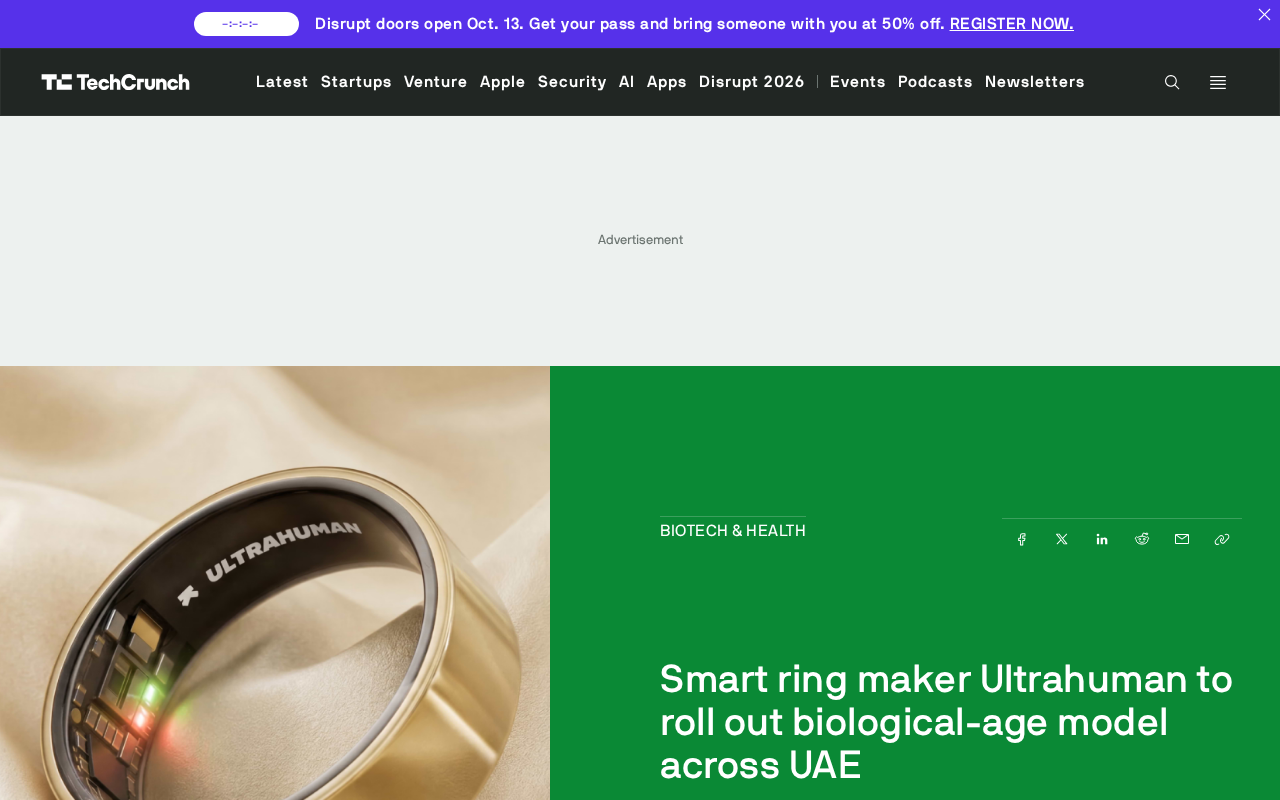
Smart ring maker Ultrahuman has announced a two-year collaboration with Abu Dhabi to roll out its biological age model across the UAE, while simultaneously advancing research and clinical validation. This signals that the competition in smart rings is shifting from traditional metrics like sleep and heart rate toward a more interpretable "physiological age" framework.
From Data Tracking to Clinical Validation: Ultrahuman's Strategic Pivot
Over the past few years, the core selling point of wearables has been "tracking" — steps, heart rate variability, blood oxygen, sleep stages. But this data alone doesn't directly answer the question users care about most: is my body getting better or worse?
Ultrahuman's biological age model attempts to provide a more concrete answer. It uses long-term physiological signals collected by the wearable to estimate the user's bodily function relative to their age peers. Once users accept this number, it becomes a far stronger behavioral driver than "last night's sleep score: 82."
The key to this Abu Dhabi partnership isn't the product launch — it's clinical validation. Ultrahuman has made it clear that the next two years will be dedicated to research and clinical validation, which suggests the biological age model still needs rigorous scientific backing rather than being purely a marketing concept.
Biological age is a metric that measures the actual state of an individual's bodily function, as distinct from chronological age calculated by birth date. It is typically estimated through a combination of biomarkers such as DNA methylation levels, metabolic indicators, cardiorespiratory fitness, and inflammatory factors. If a person's biological age is lower than their actual age, it generally means their bodily function is better than the average for their age group.
Estimating biological age on consumer-grade wearables typically relies on long-term signals such as heart rate variability, resting heart rate, sleep architecture, and activity levels, which are then compared against population baseline models. Compared to lab-based measurements using blood or genetic methylation, the precision and dimensionality are limited — which is why clinical validation is particularly critical.
Why the UAE?
Choosing the UAE as the base for rolling out and validating the biological age model is no accident.
Abu Dhabi has significantly increased its investment in health tech and longevity research in recent years, possessing both the infrastructure and policy willingness to conduct large-scale population health data collection and clinical research. For Ultrahuman, landing first in a market with relatively flexible regulation and a willingness to provide test scenarios for health innovation allows for faster accumulation of real-world data.
Moreover, UAE users have high acceptance of premium health consumer products, and the penetration potential of smart rings in this market cannot be overlooked.
The UAE has positioned the health and longevity industry as one of its national strategic directions in recent years. Abu Dhabi hosts institutions focused on health data and precision medicine, and has introduced sandboxes and incentive policies for health tech companies, allowing real-world research under relatively flexible regulation.
For wearable manufacturers, such markets offer a triple advantage: first, rapid access to large-scale, diverse user physiological data; second, policy support for advancing health claims and clinical research in parallel; third, high acceptance of new-form devices like smart rings among premium consumer groups. Ultrahuman's choice of the UAE as the pioneering validation base for its biological age model is precisely due to these conditions.
Biological Age: The Next Competitive Battleground for Wearables
Biological age is not a concept invented by Ultrahuman. In recent years, multiple health tech companies and research institutions have attempted to estimate physiological age using different combinations of biomarkers, including DNA methylation, metabolic indicators, and cardiorespiratory function.
But integrating biological age into consumer-grade wearables presents entirely different challenges:
- Data quality: Smart rings capture limited signal dimensions — whether they can support reliable biological age estimation needs verification
- Individual differences: Baseline differences across populations are enormous — whether a single model can apply across ethnicities and regions is a core question
- Interpretability: When users see "your biological age is 3 years older than your actual age," they need clear actionable advice — otherwise it only creates anxiety
Ultrahuman's two-year research plan with Abu Dhabi is precisely a response to these issues. If clinical validation can demonstrate the model's reliability and intervenability, it will open new value space for the entire smart ring category.
DNA methylation is one of the most recognized molecular markers for estimating biological age in the scientific community. It refers to epigenetic modifications where methyl groups are added to DNA molecules, thereby affecting gene expression. As age increases, methylation patterns at specific gene loci change in a regular manner, and researchers use this to construct "epigenetic clocks" (such as the Horvath clock and GrimAge) that can predict physiological age and health risks with reasonable accuracy.
However, DNA methylation testing requires blood or saliva samples and laboratory analysis, and cannot be directly measured by a smart ring. Wearables can only collect physiological signals like heart rate, HRV, body temperature, and activity, then indirectly estimate biological age through statistical models — their reliability and interpretability are far inferior to laboratory clocks, which is precisely why Ultrahuman needs clinical validation.
Impact on the Industry
If Ultrahuman's biological age model passes clinical validation and scales across the UAE, it could have several effects:
First, it could push competitors to follow suit. Smart ring players like Oura and Samsung may accelerate R&D or partnerships for similar features.
Second, it could change user expectations for wearables. Shifting from a "tracking tool" to a "health assessment tool" will affect user stickiness and willingness to pay differently.
Third, it could provide a reference for regulators. As a health claim, biological age may face stricter compliance requirements in the future, and those who validate first will hold an advantage.
Ultrahuman's move is essentially betting on a direction: the next phase of wearable competition isn't about the number of sensors, but about whether data can be translated into clinically meaningful health conclusions. Whether the biological age model can withstand two years of clinical research will determine the success or failure of this bet.
One-line Summary
Ultrahuman partners with Abu Dhabi to roll out and clinically validate its biological age model across the UAE, pushing smart rings toward health assessment.
Paragraph Summary
Ultrahuman has announced a two-year collaboration with Abu Dhabi to roll out its biological age model across the UAE while advancing research and clinical validation. This marks a shift in smart ring competition from data tracking like sleep and heart rate toward more interpretable physiological age assessment. The article analyzes Ultrahuman's strategic pivot, noting that clinical validation is key to broad acceptance of the biological age model, involving three major challenges: data quality, individual differences, and interpretability. The UAE was chosen for its flexible regulation, heavy health tech investment, and high user acceptance. If validation succeeds, it could push competitors like Oura and Samsung to follow suit and reshape the industry's value proposition for wearables.
Related articles

Amphibious Transforming Drone: Beyond 100x Power Savings, What Are the Real Needs?
Is the amphibious transforming drone just a gimmick? Starting from the 100x power difference of the M4 Morphobot, explore real application scenarios and thesis topic ideas, analyzing boundary conditions where pure drones and pure ground robots both fail.

Warhound Raises $200 Million: Genetically Engineered "War Dogs" Paired with Anduril Gear
Warhound raises $200M, backed by Ben Lamm and Palmer Luckey, to genetically engineer dogs for military and law enforcement use and equip them with Anduril gear. This article analyzes its technology direction, funding logic, and ethical controversy.

Claude API Comes to Google Cloud: IAM Integration and SDK Access Guide
Anthropic hosts the full Claude API on Google Cloud with IAM-controlled permissions and unified billing. This guide covers the Vertex AI and Anthropic-hosted entry points, IAM role configuration, and SDK access.