UMAMI: A Multimodal Dietary Decision-Making Benchmark Dataset Released

The UMAMI benchmark systematically evaluates multimodal dietary decisions using independently collected images, nutrition, and intake records.
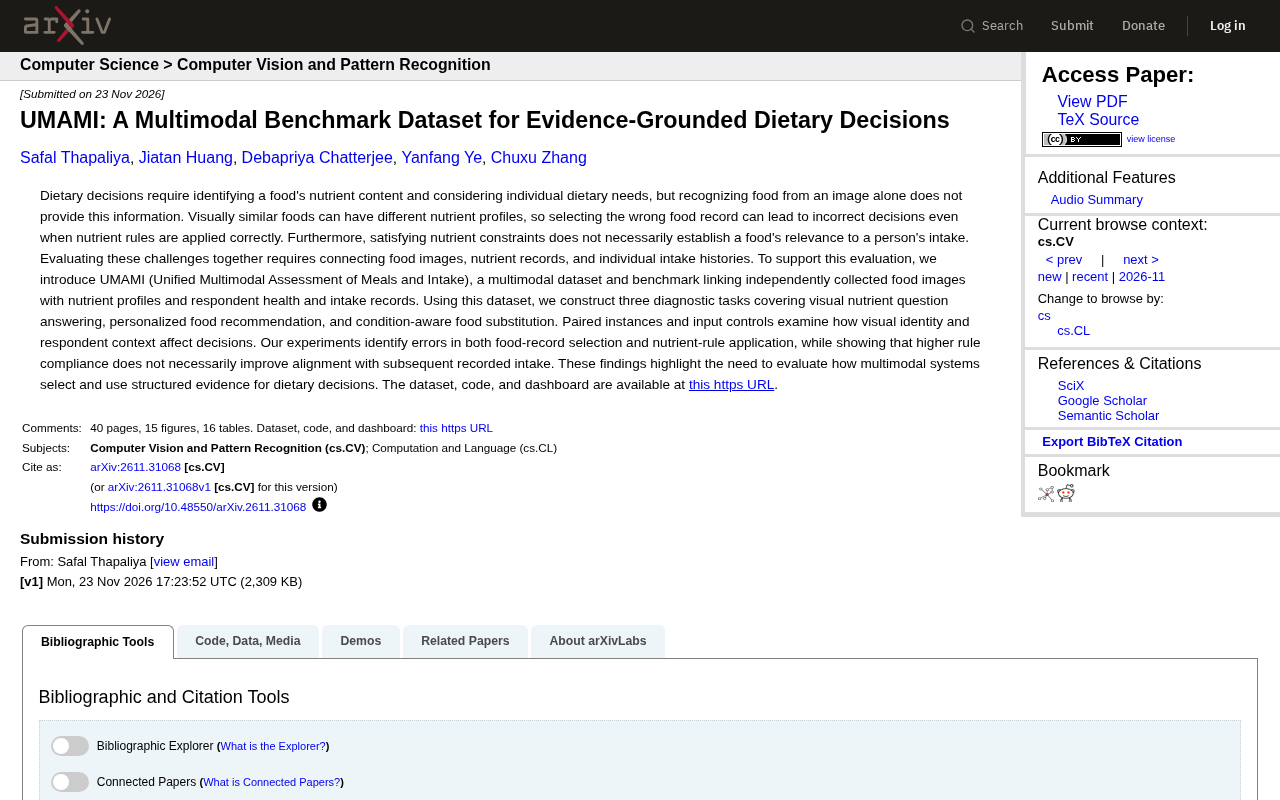
UMAMI is an evaluation dataset and benchmark for multimodal dietary decision-making that links independently collected food images, nutritional information, and respondent intake records into a unified framework. It designs three diagnostic tasks—visual nutrition QA, personalized food recommendation, and condition-aware food substitution—and reveals two error types: food record selection errors and nutritional rule application errors.
Food recognition is not the same as nutritional judgment. An image can tell you "what" is on the plate, but it struggles to say how nutritious it is—let alone whether it suits a specific person. To address this gap, researchers have introduced the UMAMI dataset and benchmark, which aims to connect food images, nutritional profiles, and personal intake records to systematically evaluate how multimodal systems perform in dietary decision-making.
Why Food Images Alone Are Not Enough
The paper highlights an easily overlooked problem: visually similar foods can have vastly different nutritional compositions. If a system selects the wrong food record, even perfectly correct application of nutritional rules will still lead to incorrect decisions. This means errors in multimodal dietary systems can originate from more than one source—they may stem from misidentifying the food, or from misapplying the rules.
A further challenge lies in personalization. Meeting nutritional constraints does not mean the food is relevant to someone's actual intake history. To evaluate all these aspects together, images, nutritional data, and individual intake records must be placed within a single evaluation framework. UMAMI (Unified Multimodal Assessment of Meals and Intake) was built precisely for this purpose.
Visually similar foods with different nutrition are a common pitfall in food recognition. For example, white rice and brown rice look similar but differ several-fold in dietary fiber content; different cooking methods (deep-frying, steaming, braising) can significantly alter the energy and fat content of the same ingredient. Therefore, food labels obtained from image classification alone cannot be directly converted into reliable nutritional estimates—systems also need portion estimation, cooking-method inference, and nutritional database lookups.
Dataset Composition and Three Diagnostic Tasks
UMAMI's distinguishing feature is that it links independently collected data: food images, nutritional information, and respondent health and intake records are gathered separately and then associated. This design allows evaluation to more faithfully reflect system performance under heterogeneous evidence, rather than scoring high on manually aligned, clean data.
Based on this dataset, the researchers constructed three diagnostic tasks:
- Visual Nutrition QA: Answering nutrition-related questions from images, testing the ability to combine visual recognition with nutritional knowledge.
- Personalized Food Recommendation: Providing recommendations based on individual health and intake context, rather than generic answers.
- Condition-Aware Food Substitution: Finding suitable substitute foods under specific health conditions, testing understanding of constraints.
The task design also introduces paired instances and input controls to separately examine the influence of visual identity and respondent context on decisions. This controlled-variable evaluation approach can pinpoint exactly which stage fails, far better than a single accuracy metric.
Visual Nutrition QA is a subdirection of multimodal visual question answering, requiring models to answer nutrition-related questions (such as "approximately how much protein does this dish contain?") based on understanding image content. The difficulty lies in the fact that models must not only recognize food categories but also align visual information with external nutritional knowledge bases and make reasonable inferences about portion size and cooking method.
Condition-aware Food Substitution refers to recommending substitute foods with similar nutritional function under given health constraints (e.g., low sodium, low sugar, allergen avoidance). This task requires systems to simultaneously understand constraints, food nutritional properties, and individual preferences—a concentrated expression of constraint reasoning in multimodal dietary decision-making.
Two Types of Errors Revealed by Experiments
Experiments identified two distinct types of errors: food record selection errors and nutritional rule application errors. The former corresponds to the visual recognition stage, the latter to the rule reasoning stage, and both often coexist in real systems.
A more notable finding is that higher rule compliance does not necessarily lead to better alignment with subsequently recorded intake. In other words, a system can "strictly follow the rules" yet still produce results disconnected from the user's actual dietary behavior. This suggests evaluation should look beyond constraint satisfaction rates to whether decisions truly align with individual intake history.
These findings point to a core conclusion: the evaluation focus of multimodal dietary systems should shift from "can it recognize food" to "how does it select and use structured evidence." The dataset, code, and visualization dashboard are publicly available on the project homepage for researchers to reproduce and extend.
Rule compliance refers to the degree to which system outputs satisfy predefined nutritional constraints, while intake alignment measures the consistency between recommendations and users' actual dietary records. The two are not equivalent: a system can fully satisfy the rule "daily sodium intake not exceeding a threshold" while recommending foods the user would never eat. This tension between metrics shows that a single constraint satisfaction rate is insufficient to reflect a system's real-world usability.
Implications for Multimodal Application Development
UMAMI's value extends beyond being just a dataset. It provides an evaluation paradigm: separate visual input, structured knowledge, and individual context, apply controls to each, then observe system performance under combined conditions. For teams building health and dietary AI applications, this means pre-launch evaluation needs to cover both the record selection and rule application pipelines—not just test image classification accuracy.
At the same time, personalized recommendation systems should incorporate intake history as an alignment objective, rather than treating nutritional constraints as the sole optimization direction. The gap between rule compliance and real behavior is precisely the most underestimated risk point when bringing products to market.
One-line Summary
The UMAMI benchmark systematically evaluates multimodal dietary decision-making using independently collected images, nutrition data, and intake records.
Paragraph Summary
UMAMI is an evaluation dataset and benchmark for multimodal dietary decision-making. It links independently collected food images, nutritional information, and respondent health and intake records into a unified framework, and designs three diagnostic tasks: visual nutrition QA, personalized food recommendation, and condition-aware food substitution. The research notes that visually similar foods can differ vastly in nutrition, and that system errors can stem from both food record selection errors and nutritional rule application errors. Experiments further find that higher rule compliance does not necessarily lead to better alignment with users' actual intake records, suggesting evaluation should shift from "can it recognize food" to "how does it select and use structured evidence."
Related articles

A 19-Year-Old's Rental Horror Story: Ceiling Collapse, Bug Infestation, and the Lessons It Taught Me
At 19, my first off-campus rental brought bug infestations, no heat, a collapsed ceiling, and a ruined laptop with no renter's insurance. Here are the hard-won lessons for first-time student renters.

Veda Nurse's Cranial Nerve Exam: Why ASMR Role-Play Is Going Viral
Bilibili creator Veda's cranial nerve exam ASMR video goes viral, blending humor and sensory triggers through nurse role-play. This article analyzes its unique appeal and the audience psychology behind ASMR role-play.

LG Cinebeam AI Review: 120-Inch Giant Screen + 3000 Lumens, a New Choice for the Living Room Theater
LG Cinebeam AI projector review: 3000 ANSI lumens, 4K, 100 inches from about 8 cm and 120 inches from about 18 cm. Built-in webOS, AI Concierge voice recommendations, AI Sound Pro 11.1.2 virtual surround, and Game Optimizer—positioned for fixed living room installation, complementing the portable Cinebeam S.