Unclickbait: One-Click Replacement of YouTube Clickbait Thumbnails

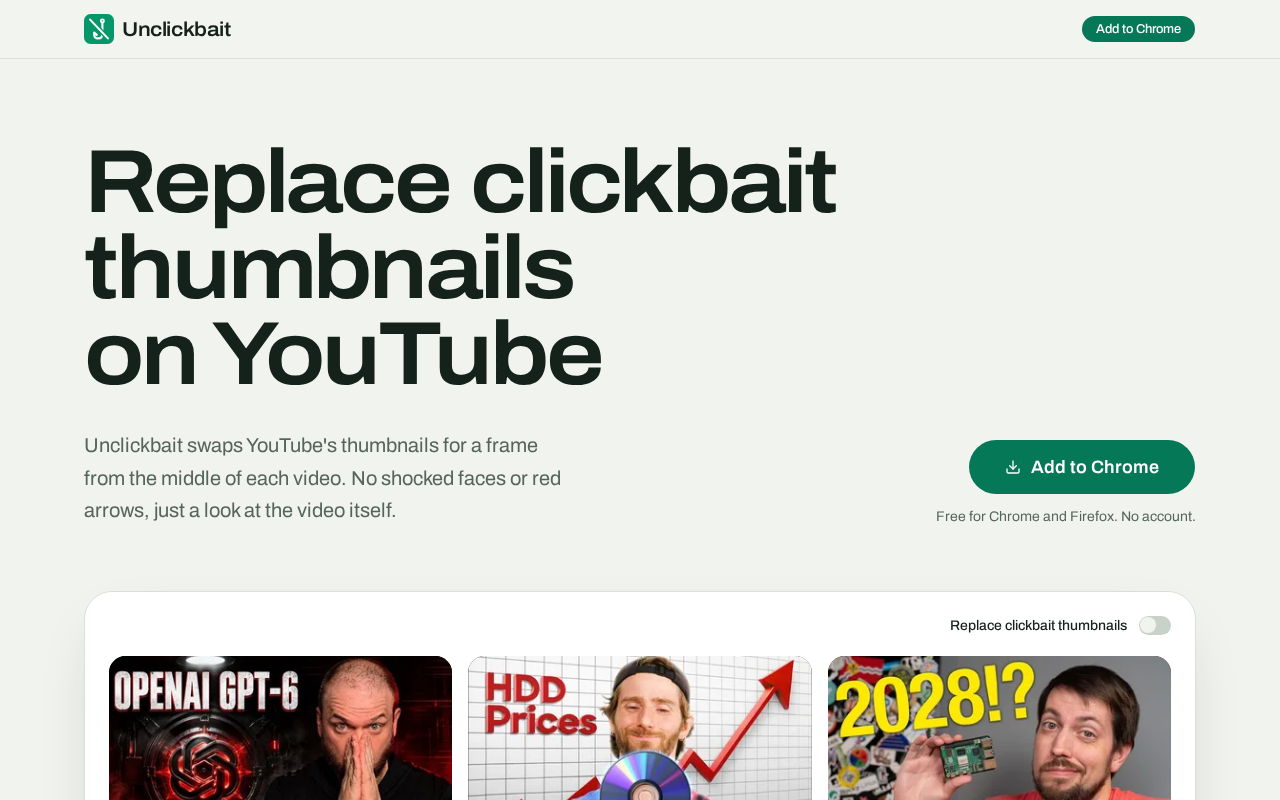
Unclickbait is an early-stage tool that aims to replace YouTube clickbait thumbnails with the video's real first frame.
Unclickbait is an early-stage project posted in Hacker News' Show HN section, aiming to replace exaggerated, misleading clickbait thumbnails on YouTube with first-frame images closer to the video's real content. The article analyzes the background: YouTube's recommendation algorithm favors high click-through rates, pushing creators toward exaggerated thumbnails and increasing users' information-filtering costs. Unclickbait intervenes at the display layer without changing the video content itself. Currently, the project has low engagement, and technical details, platform support, and replacement logic are undisclosed. The article notes that such tools face open questions around replacement stability, page performance impact, and user control granularity, while page-parsing approaches carry high maintenance costs when the platform frontend changes. Overall, the project has a clear direction but still needs real-world validation.
In the Show HN section of Hacker News, a project called "Unclickbait" has sparked a small discussion. Its goal is straightforward: replace those exaggerated, misleading clickbait thumbnails on YouTube so users can see a first-frame image that's closer to the video's actual content.
Why We Need an "Anti-Clickbait" Tool
YouTube's recommendation algorithm has long favored high-click-through content, and thumbnails are one of the most direct factors influencing click-through rates. As a result, many creators lean toward using exaggerated expressions, red-circle arrows, giant text, or even images unrelated to the content to grab attention. For viewers, this increases information noise and makes it harder to judge whether a video is worth clicking on.
Unclickbait's approach isn't to block videos but to intervene at the display layer: replacing heavily packaged covers with frames from the video itself, so users can make the "click or not" decision based on more truthful information.
Clickbait is a content strategy that lures users into clicking through exaggerated, misleading, or emotionally charged titles and thumbnails. In the YouTube ecosystem, thumbnails are the first visual element users perceive while browsing, and their design directly affects click-through rate (CTR). Platform recommendation algorithms typically treat CTR as an important signal, creating an incentive loop: high CTR brings more recommendations, and more recommendations bring even higher CTR. Therefore, creators have strong motivation to use red-circle arrows, exaggerated expressions, giant text, and similar tactics to boost CTR, even when these elements are only weakly related to the video's actual content. The long-term consequences of clickbait are declining user trust and rising decision costs—users must spend more effort judging whether a video is worth watching.
The Project's Current Status
According to the Hacker News post page, the project was published in "Show HN" format and received 7 upvotes and 3 comments. The low discussion volume suggests it's still in an early stage and has yet to undergo large-scale user validation. The original material doesn't disclose specific technical implementation details, supported browser platforms, or replacement logic (such as whether it uses the video's first frame or allows users to manually select a frame).
Open Questions Worth Watching
For tools like this, several key questions determine their practicality: whether the replaced thumbnails can be reliably obtained, whether they affect page load performance, and whether users can toggle the feature on or off for individual channels or videos. None of these are answered in the available information and would require hands-on experience to judge.
Show HN is a section of the Hacker News community for showcasing new work by individuals or teams. Posters typically include a project link and a brief description, and community members can upvote, comment, and ask questions. Discussion volume on Show HN often correlates with a project's innovativeness, completeness, and usability, but low engagement doesn't directly equate to poor quality—many early projects receive only a handful of responses when launched. For Unclickbait, 7 upvotes and 3 comments indicate it hasn't yet entered the mainstream spotlight, but small-scale discussions like this can sometimes provide developers with valuable early user feedback.
The Potential Value and Limitations of Such Tools
From a product perspective, Unclickbait hits a real pain point. Demand for "give me back the real cover" has long existed among users, but it also faces inherent limitations: replacing thumbnails doesn't change the video content itself, and clickbait videos may still retain viewers through their content structure. At the same time, if the replacement logic is too aggressive, it could unfairly affect creators who use thumbnails legitimately to convey information.
Another practical issue is that such tools typically rely on parsing or injecting into YouTube pages, and any adjustment to the platform's frontend raises maintenance costs. For independent developer projects, continuous updates are a harder challenge than the initial feature.
Page injection and parsing is a common technical approach used by browser extensions or user scripts. For single-page applications (SPAs) like YouTube, page content is loaded dynamically via JavaScript, and URL changes don't necessarily trigger a full page refresh. Tools typically need to listen for DOM changes (e.g., using MutationObserver) to locate and replace image sources after thumbnail elements render. The fragility of this approach lies in the fact that any adjustment to the platform's frontend code—such as class name changes, DOM structure reorganization, or changes to image lazy-loading strategies—can cause selectors to fail, preventing the tool from correctly identifying or replacing thumbnails. Therefore, tools relying on page injection need to continuously track platform updates, resulting in high maintenance costs—a common challenge for independent developer projects.
Summary
Unclickbait is a small tool with a clear direction, attempting to return some control over thumbnail selection to viewers. Currently, public information is limited, and both popularity and discussion volume are at an early stage; whether it's worth using long-term requires more real-world feedback. For users tired of clickbait covers, it offers a new option worth watching.
Related articles

AI Writes Your Code—Do You Still Need to Learn Git? Five Reasons
AI coding agents handle Git operations automatically—is it still necessary to learn Git? Five reasons: team communication, reviewing agent PRs, monitoring code changes, fallback when AI goes down, and the joy of learning—plus how the focus of learning Git is shifting in the agent era.

Anthropic Reportedly Prices IPO at $83 Per Share, Valuing Company at $1.5 Trillion
Anthropic reportedly prices IPO at $83 per share, above the expected range, with a fully diluted valuation of $1.5 trillion. This article analyzes the signal significance of the pricing and its impact on the AI industry's financing environment.

Open-Source Code Hosting Platform Codeberg Suffers Outage, Sparking Debate in Developer Community
Open-source code hosting platform Codeberg.org suffered an outage, sparking Hacker News debate over nonprofit platform stability and open-source infrastructure dependency risks.