Understanding AI Large Language Models from Scratch: Concepts, Technical Evolution, and Opportunities for Everyone
From rule-based systems to generative AI — a clear map of core AI concepts and where to start.
This article systematically maps the hierarchy of AI concepts: AI is the broad field, machine learning a key subset, deep learning a critical branch, and large models with generative AI the latest products of deep learning after the Transformer breakthrough. Using Deep Blue and AlphaGo as historical anchors, it explains the shift from rule-driven to data-driven AI, covers supervised learning, reinforcement learning, and the Transformer attention mechanism, and closes with practical advice: for most developers and everyday users, the optimal path is applying existing large models to real business contexts — not training from scratch — with Agent development as the most promising near-term direction.
Many people new to AI share the same confusion: what exactly is the relationship between artificial intelligence, machine learning, deep learning, large models, and generative AI? Some assume AI is just ChatGPT. Others think large models represent the entirety of AI. Still others treat machine learning, deep learning, and large models as completely separate technologies. In reality, a clear line of development connects all of them. Understanding that line is the foundation for learning large model application development.
This article is based on a beginner's series on large models by Bilibili creator Jinze. It traces the complete evolution of AI from rule-driven systems to generative AI, and explores how everyday people can enter this field.
What Is Artificial Intelligence, Really
AI research is concerned with giving computers and machines capabilities similar to human learning, understanding, reasoning, and action. Two keywords stand out here: "machine" — the subject of study is not humans themselves, but computer programs, software systems, or robots — and "intelligence."
What counts as "intelligence" varies widely depending on who you ask. By the science-fiction standard — machines with autonomous consciousness, independent thought, even superiority over humans — current technology still falls well short. But from a more practical perspective, if a machine can complete tasks that previously required a human, it can be considered to possess some degree of intelligence. The voice assistant on your phone understands commands. Navigation software plans routes. Both fall under the umbrella of artificial intelligence.
So AI is not a specific product — it's an entire technical field, spanning computer science, mathematics, statistics, linguistics, and even neuroscience. With that in mind, instead of debating whether AI will surpass humanity, it's more useful to ask: "Can AI help me solve real problems?"
From Deep Blue to AlphaGo: Two Pivotal Moments
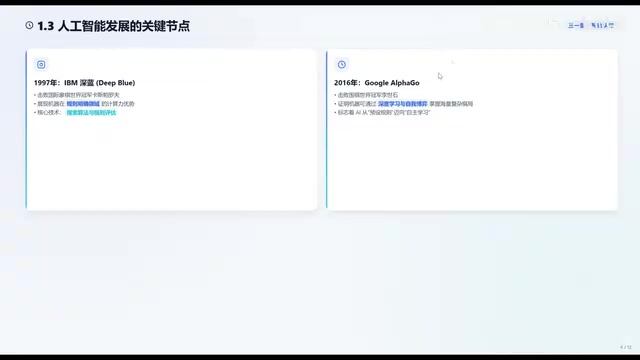
Two landmark events stand out in the history of AI. In 1997, IBM's Deep Blue defeated chess world champion Garry Kasparov. In 2016, AlphaGo defeated Go world champion Lee Sedol. Each represents a distinct phase in AI's development.
Deep Blue's significance was in proving that, in domains with clear rules, machines can surpass humans through sheer computational power. But its underlying approach is nothing like today's large models. It relied primarily on search algorithms — analyzing enormous numbers of possible board positions in advance, then selecting moves with higher win probability according to preset evaluation rules. This worked for chess because every possible move and its consequences could be defined in advance by a program.
The problem is that many real-world tasks have no clear rules. Deciding whether an image contains a cat, or analyzing the sentiment of an article — these are nearly impossible to solve with hand-written rules. The core logic of traditional AI was "humans give the machine the rules, the machine computes by those rules." Real-world problems, however, can't be exhaustively enumerated. That's precisely what drove AI into its next phase.
Machine Learning: Teaching Machines to Learn from Data
The idea behind machine learning is to stop telling machines all the answers, and instead let them discover hidden patterns on their own through large amounts of data. Take cat-versus-dog recognition. The traditional approach would tell the computer "cats have pointy ears, dogs have larger bodies" — but in practice, variations in angle and lighting make it impossible to write complete rules. Machine learning takes a different approach: feed the machine massive amounts of data and let it generalize on its own.
There are three classic paradigms in machine learning:
Supervised Learning
Provide the machine with data that has ground-truth labels. Like a student working through practice problems, each image is tagged as "cat" or "dog," and the machine continuously learns the relationship between images and labels until it can make predictions on new images. Spam email detection and financial risk systems rely heavily on this approach.
Unsupervised Learning
Data has no labels — the machine finds patterns by itself. Given a large dataset of user ages, browsing habits, and purchase histories, the model discovers on its own which users behave similarly and might belong to the same group. Large model training draws on this idea too: feed the model massive text, design tasks that ask it to predict missing content, and let it learn language patterns through repeated prediction and adjustment.
Reinforcement Learning
Behavior is refined through trial and error and feedback — similar to how a child learns to walk: fall down, adjust, take a successful step, receive positive reinforcement. The machine earns reward or penalty scores after completing actions, gradually learning which behaviors best achieve the goal.
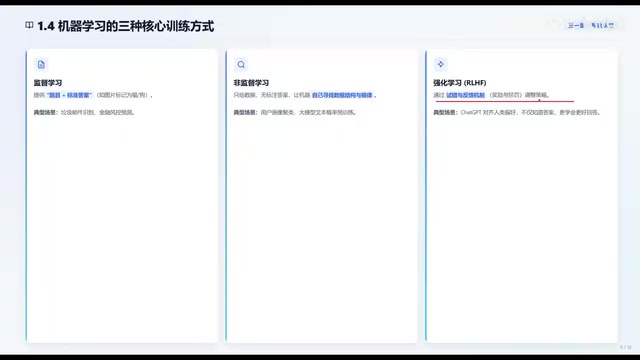
After completing its basic training, ChatGPT underwent further optimization of response quality through human feedback — what's commonly known as RLHF (Reinforcement Learning from Human Feedback). Although the model had absorbed enormous knowledge, it didn't necessarily know what kind of answer would best meet user needs or be safest to give. Simply put, RLHF teaches a model not just to know the answer, but to know how to answer better.
A closer look at RLHF: The process typically involves three stages. First, the pretrained model is fine-tuned with supervised learning to give it basic conversational ability. Second, human annotators rank several of the model's responses to train a "reward model" that predicts human preferences. Third, a reinforcement learning algorithm (such as PPO) uses the reward model's scores as a signal to continuously adjust the large model's output strategy. This pipeline is what allowed ChatGPT to take a major leap in conversational experience over early GPT-3 — evolving from "knowing the right answer" to "knowing how to give an answer that's helpful, safe, and well-received."
Deep Learning and the Transformer Architecture
As tasks grew more complex — image recognition, speech understanding, natural language processing — the sheer volume of information involved pushed traditional machine learning to its limits. Deep learning emerged as a critical branch of machine learning, with neural networks at its core.
A neural network is a computational model inspired by the way neurons connect in the human brain. It links large numbers of computational nodes, processing information through multiple layers. In image recognition, for instance, the first layer learns edges and colors, the second learns shapes and structure, and the third learns how objects are composed. "Deep" refers to the number of layers — the more layers, the richer the hierarchy of features the network can learn. Early deep learning struggled with information loss as signals passed through many layers, but innovations like residual connections — which let information skip over certain layers and be added directly to later outputs — became a cornerstone of modern deep learning.
In 2017, eight researchers at Google published a paper titled Attention Is All You Need, introducing the Transformer architecture. The challenge with language is that the same word can mean different things in different contexts, and language carries enormous amounts of implicit information. "This project is really tough" might mean the technology is complex, the execution is difficult, or it might simply be an emotional expression. A machine that can't understand context can't truly understand language.
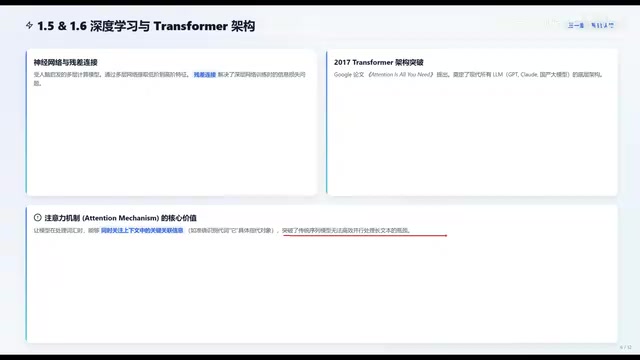
The core of Transformer is the attention mechanism. Take the sentence "Apple released a new phone, and it has been well received by many users." Humans immediately understand that "it" refers to the new phone. The attention mechanism lets a model, when processing any given word, simultaneously attend to related information elsewhere in the context to establish accurate semantic connections. Crucially, compared to traditional recurrent neural networks (RNNs), which tend to "forget" earlier content when processing long texts, Transformer can analyze multiple parts of a text simultaneously — making it possible to handle longer, more complex information. GPT, Claude, and many Chinese large models are all built on the Transformer architecture or improved variants of it.
A closer look at residual connections: Proposed by Microsoft Research in 2015, the core idea is to add "shortcut paths" between network layers, allowing the input signal to bypass several layers and be added directly to the output of later layers. This solved the vanishing gradient problem in deep neural network training — the deeper the network, the weaker the error signal becomes as it propagates backward, making layers near the input nearly impossible to train effectively. Residual connections enabled networks to be stacked hundreds or even thousands of layers deep, directly contributing to the success of architectures like ResNet, and laying the engineering foundation for stable training of Transformers at massive scale.
Generative AI: From Judgment to Creation
Looking back at AI's progression — from rules, to machine learning, to deep learning, to Transformer — one shift stands out clearly. Earlier AI was largely about classification and judgment: is this email spam? Does this image contain a cat? The great breakthrough of recent generative AI is creating content from nothing.
Old AI answered "what is this thing?" Today's large models go further: "based on your requirements, I'll create something new" — generating articles, code, images, and more. Getting a computer to write an essay used to be extremely difficult, because writing requires understanding a topic, organizing structure, and choosing how to express ideas. Today's large models can produce complete content from a simple prompt.
ChatGPT's explosive rise was no accident. Three factors converged: the accumulation of data at scale, a leap in computing power (GPU clusters, for instance), and the architectural breakthrough of the 2017 Transformer paper. Together, these triggered a qualitative leap in model capability.
Where Do Ordinary People Fit In
Large models are lowering the barrier to getting things done and improving the efficiency of human-computer collaboration. For developers, AI can assist with code generation, reading, and analysis. For operations and marketing staff, it can help organize information and generate content. For enterprises, an internal knowledge base can be turned into an intelligent assistant.
A realistic assessment: large models are currently best suited not to fully replacing jobs, but to acting as highly efficient assistants that handle large volumes of repetitive work — freeing people to focus on goal-setting, judgment, decision-making, and creative work.
The positioning for everyday users and developers should be clear. Training a large model from scratch requires resources that are far beyond the reach of most people. The more realistic path is to leverage the general capabilities of existing large models and apply them to specific business contexts — building an enterprise internal knowledge base, for example, or developing an Agent to replace repetitive tasks. Just as most people don't need to understand how a car engine works after the automobile was invented — they just need to learn to drive to improve how they get around.
Leading Large Models and Future Directions
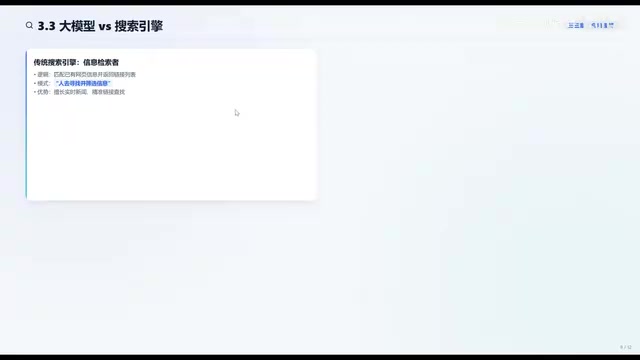
Internationally, OpenAI's GPT series has the widest influence, covering text generation, code assistance, knowledge Q&A, and data analysis. Claude places greater emphasis on long-document analysis and logical reasoning, and is especially popular among developers. Google's Gemini is a multimodal model capable of handling text, images, audio, and video. In China, Alibaba's Qwen (open source), Baidu's ERNIE series, and DeepSeek have all performed impressively.
There is no absolute standard for choosing a large model — it depends on task type, usage environment, and goals. For learning, organizing information, or assisting with writing, general office-oriented models work well. For software development, Claude or Gemini are strong options. Enterprise scenarios require weighing data security, support for private deployment, cost controllability, and ease of system integration.
Several directions are shaping the future: continued improvement in models' reasoning, coding, and multimodal capabilities; the rise of domain-specific models tailored to industries like finance, law, and healthcare; and Agents, which may well become the dominant application form in the next few years. Unlike a model that merely answers questions, an Agent understands goals (perception), makes plans (planning), and calls tools to execute tasks — completing an intelligent loop. Ask it to analyze a company's sales performance, and it can automatically read the data, analyze trends, generate a report, and offer recommendations.
Agents vs. chat models — the key difference: A chat model operates on a "single question, single answer" basis. An Agent operates on "goal-driven, multi-step execution." An Agent typically consists of a perception module (reading inputs and environmental state), a planning module (breaking a goal into subtasks), a memory module (storing intermediate results and conversation history), and a tool-calling module (browser, code interpreter, database interfaces, etc.). Popular frameworks like LangChain, AutoGen, and Alibaba's Qwen-Agent are all working to standardize this architecture. Developers can use these frameworks to connect a large model's language understanding capabilities to specific business systems — without retraining the model from scratch. This is the direction the article recommends that everyday developers focus on most closely.
Related articles
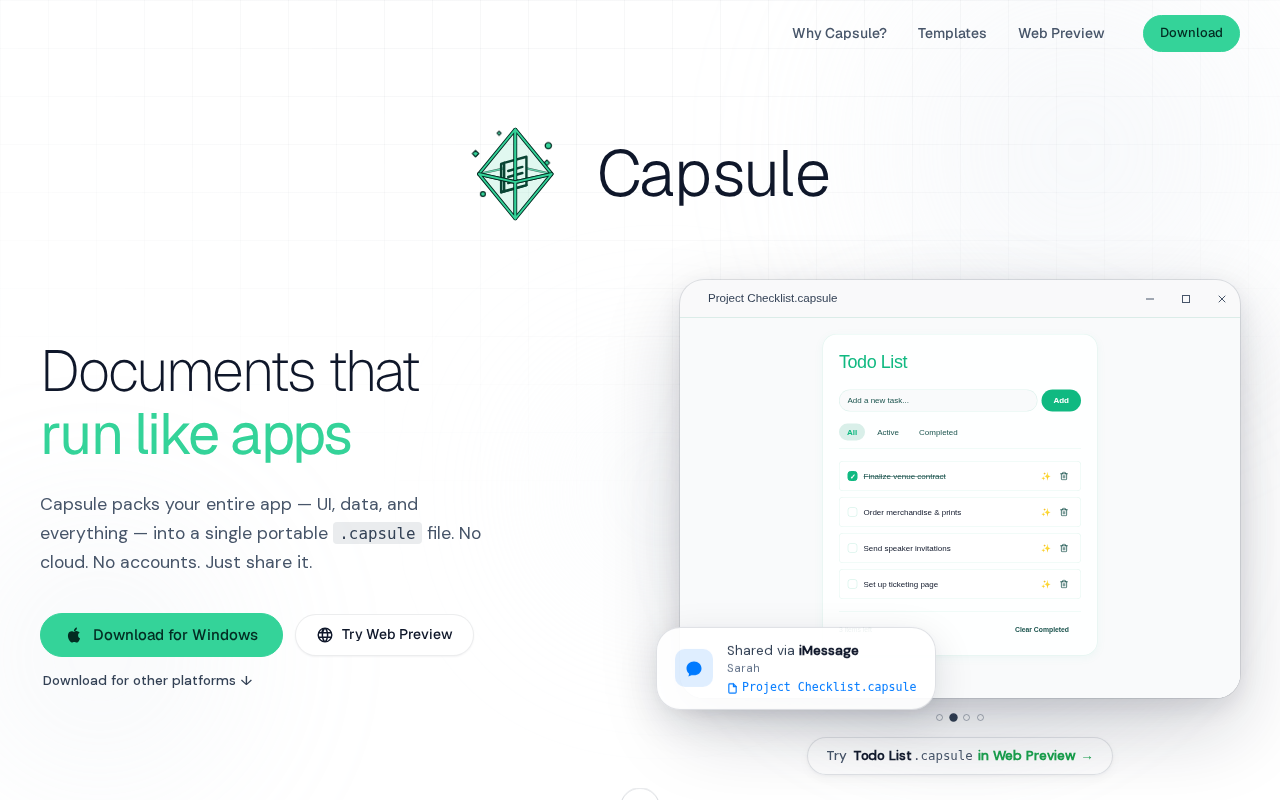
Capsule: Pack Web Apps and Data into a Single SQLite File
Capsule is a Rust/Tauri 2.0 tool that packs HTML web apps and data into a single SQLite file — privacy-first, local storage, portable sharing, with AI support.
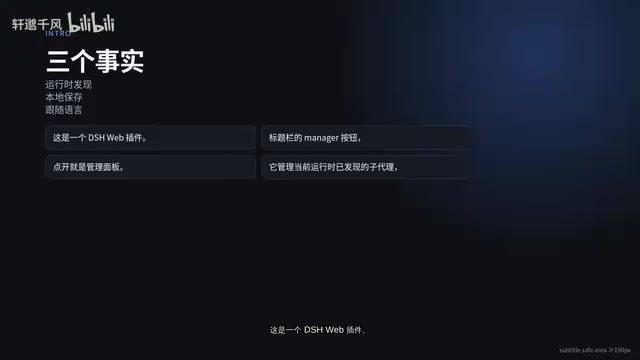
DSH-SUBAGENT-UI Plugin: The Ultimate Sub-Agent Manager for DeepSeek Harness
DSH-SUBAGENT-UI is a DeepSeek Harness browser plugin offering sub-agent overview, search, local categorization, and completion snapshots — install with one command.
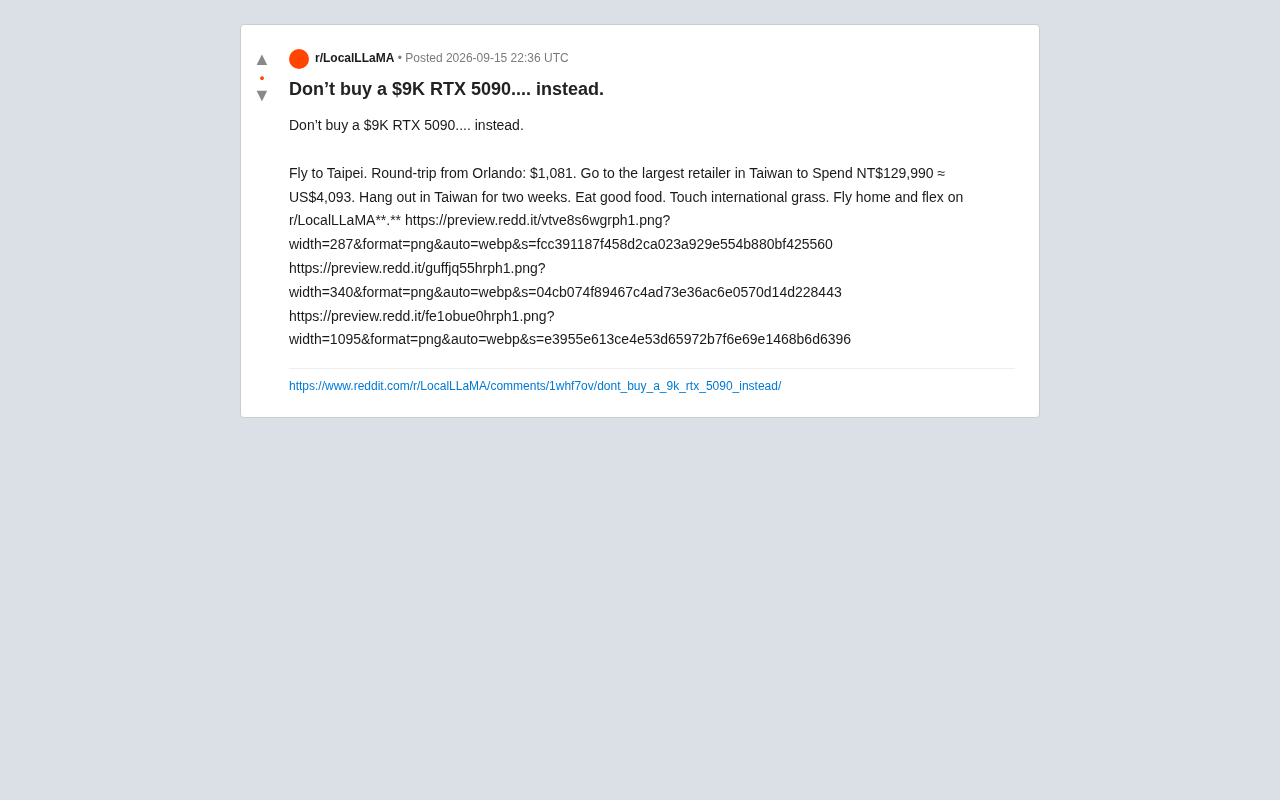
RTX 5090 Scalped for $9,000 in the US? Flying to Taipei to Buy One Might Actually Be Cheaper
RTX 5090 scalped for $9,000 in the US — a Reddit user did the math and found flying to Taipei to buy one is actually cheaper. A look at the real supply-demand crisis behind the joke.