Unpacking LoCoMo Score Fluctuations: The Impact of Memory Context, Answer Prompts, and Judges

LoCoMo scores are significantly affected by judges and prompts; Becos's advantage depends on model capability.
A study systematically evaluated the impact of evaluation configurations on LoCoMo benchmark scores, finding that changing only the judge can cause 7.2-point fluctuations and changing the answer prompt can cause 9.3-point differences. After controlling for these variables, the team memory system Becos significantly outperformed the full-conversation baseline on gpt-4o-mini (79.7 vs. 73.0) but lost its advantage on gpt-4.1-mini (83.2 vs. 83.1). Becos uses contexts with 90% fewer characters, but its configuration was developed on LoCoMo without a held-out set. Blind human checks show reliability when judges agree, but the primary judge's errors disadvantage Becos. The study emphasizes the importance of transparently reporting evaluation configurations and releases all answers and scripts to promote reproducible research.
Introduction
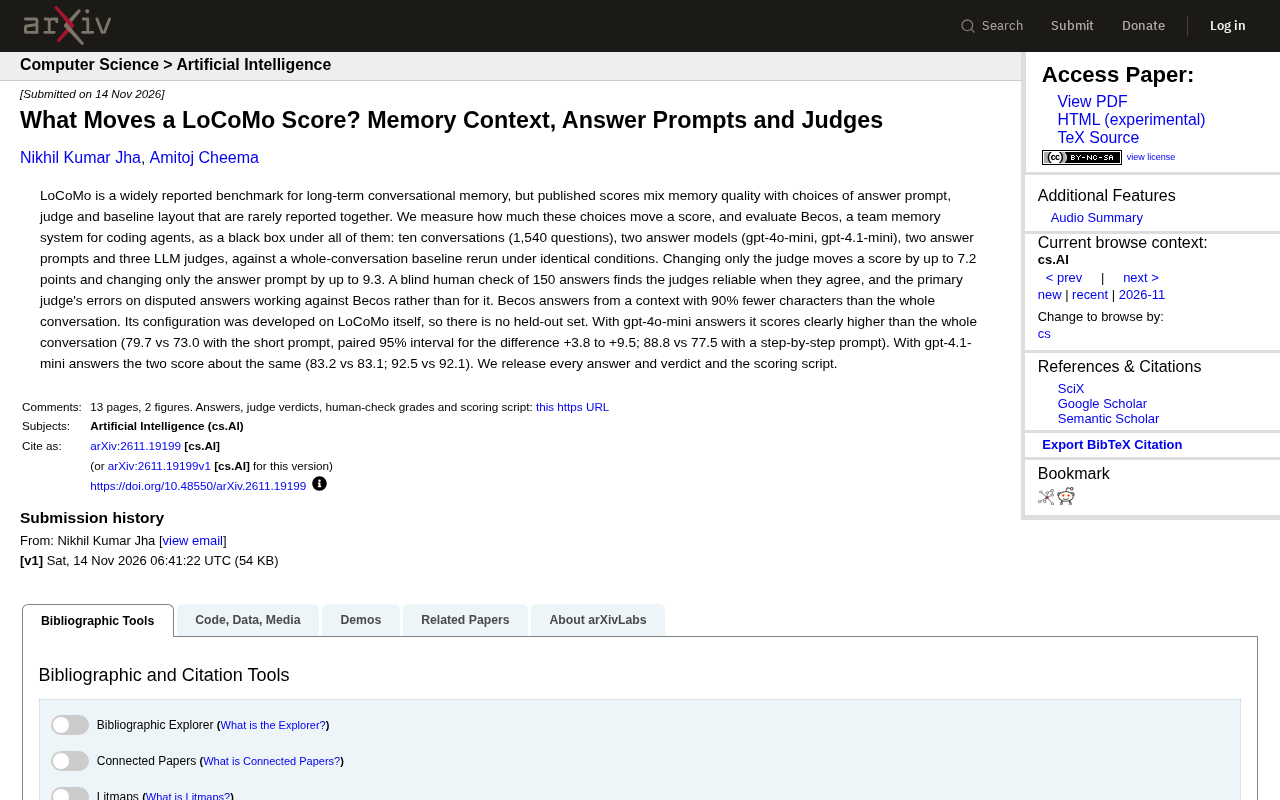
LoCoMo is a commonly used benchmark for evaluating long-term conversational memory, but published scores often blend memory quality, answer prompts, judge models, and baseline settings—factors that are rarely reported together. A new study systematically measures the impact of these choices on scores and evaluates Becos, a team memory system for coding agents, in a black-box manner.
LoCoMo Benchmark (Long-term Conversation Memory) is a widely used dataset for evaluating conversational memory systems. It contains multiple long dialogues and questions generated based on the dialogue content, designed to test a model's ability to retain and retrieve long-range contextual information. Evaluation typically involves generating answers and having them judged by an LLM, but different studies vary in answer prompts, judge models, and baseline settings, making scores difficult to compare directly.
Experimental Design: Rigorous Evaluation Under Multivariate Control
The research team conducted controlled experiments on the LoCoMo benchmark using 10 dialogues (1,540 questions in total). They compared two answer models (gpt-4o-mini and gpt-4.1-mini), two answer prompts (short prompt and step-by-step prompt), and three LLM judges. They also compared Becos against a "full-conversation" baseline re-run under identical conditions.
This multivariate design allows researchers to isolate the independent effect of each factor on the final score, rather than reporting only a single composite score as is typically done.
Multivariate Controlled Experiment is an experimental design method that manipulates multiple independent variables simultaneously while controlling others to isolate the independent effect of each factor on the dependent variable. In this study, researchers independently varied the answer model, answer prompt, and judge, thereby quantifying each factor's contribution to the LoCoMo score and avoiding confounding effects.
Key Findings: Judges and Prompts Alone Can Swing Scores
Results show that merely changing the judge can cause score fluctuations of up to 7.2 points, while merely changing the answer prompt can produce differences of up to 9.3 points. This means that when comparing different memory systems, without reporting these settings, score differences may stem entirely from evaluation configuration rather than the systems themselves.
Furthermore, a blind human check of 150 answers found that results are reliable when judges agree; on disputed answers, the primary judge's errors tend to disadvantage Becos rather than favor it. This suggests possible systematic bias in automated judging.
Becos Performance: Context Efficiency and Model Dependence
Becos is a team memory system for coding agents. In the experiments, it generated answers from contexts with 90% fewer characters than the full conversation. Notably, Becos's configuration was developed on LoCoMo itself, so there is no held-out set, which may lead to some degree of overfitting.
When using gpt-4o-mini as the answer model, Becos significantly outperformed the full-conversation baseline: scoring 79.7 vs. 73.0 under the short prompt (paired 95% confidence interval +3.8 to +9.5), and 88.8 vs. 77.5 under the step-by-step prompt. However, with gpt-4.1-mini, the scores were similar: 83.2 vs. 83.1 (short prompt) and 92.5 vs. 92.1 (step-by-step prompt). This indicates that Becos's advantage depends on the answer model's capability and disappears with stronger models.
Context Efficiency refers to the ratio of contextual information utilized by a system when generating answers to its performance. Becos uses contexts with 90% fewer characters than the full conversation yet can match or exceed the full-conversation baseline's performance on some models, indicating its memory mechanism efficiently extracts key information. However, this efficiency advantage may be influenced by the answer model's capability, with differences not significant on stronger models.
Implications for Benchmark Evaluation
This study highlights the importance of transparently disclosing evaluation configurations when reporting LoCoMo scores. Different judges, prompts, and baseline settings can cause score differences of several percentage points—enough to change rankings between systems. The research team released all answers, judging results, and scoring scripts to promote reproducible research.
For memory system developers, this means being more cautious in interpreting published scores and controlling for these variables in their own evaluations. Meanwhile, the Becos case shows that advantages observed on weaker models may not generalize to stronger models, so evaluations should cover multiple model configurations.
Judge Bias refers to systematic tendencies exhibited by automated judge models during scoring, which may stem from training data, prompt design, or inherent model preferences. In this study, blind human checks found that the primary judge's errors often disadvantage Becos, suggesting that automated judging may introduce asymmetric errors that affect the fairness of system comparisons.
Conclusion
LoCoMo score fluctuations reflect not only the quality of memory systems but are also deeply influenced by evaluation methodology. This study provides a transparent evaluation framework and reminds the community to pay attention to judge bias and prompt design. As memory systems grow increasingly important in AI applications, establishing more robust evaluation standards will become crucial.
One-line Summary
LoCoMo scores are significantly affected by judges and prompts; Becos's advantage depends on model capability.
Paragraph Summary
A study systematically evaluated the impact of evaluation configurations on LoCoMo benchmark scores, finding that merely changing the judge can cause score fluctuations of 7.2 points and changing the answer prompt can cause 9.3 points. After controlling for these variables, the team memory system Becos significantly outperformed the full-conversation baseline on gpt-4o-mini (79.7 vs. 73.0) but lost its advantage on gpt-4.1-mini (83.2 vs. 83.1). Becos uses contexts with 90% fewer characters, but its configuration was developed on LoCoMo without a held-out set. Blind human checks show reliability when judges agree, but the primary judge's errors disadvantage Becos. The study emphasizes the importance of transparently reporting evaluation configurations and releases all answers and scripts to promote reproducible research.
Related articles

ChatGPT Plus Subscription Pitfall Guide: Go/Plus/Pro Tier Comparison and Quick Activation
A complete ChatGPT Plus subscription guide based on a Bilibili tutorial: from registering an account, comparing Go/Plus/Pro tiers, to the practical steps for quickly completing your subscription.

GPT-6.2 Sol/Astra Released! A Step-by-Step ChatGPT Plus Subscription Guide and Tier Comparison
GPT-6.2 Sol/Astra is out—here's a ChatGPT Plus subscription guide: register an account, compare Go/Plus/Pro tiers, and subscribe in a minute.

Comparing Three Channels for Subscribing to GPT Plus in China: Is Website Top-Up the Easiest?
How to subscribe to GPT Plus in China? This article compares website top-up, credit card, and mobile top-up channels—process, cost, and risk—with steps and tips to help you choose wisely.