Unreal Engine Synthetic Data Generation: A Practical Guide to Domain Randomization for Training Datasets
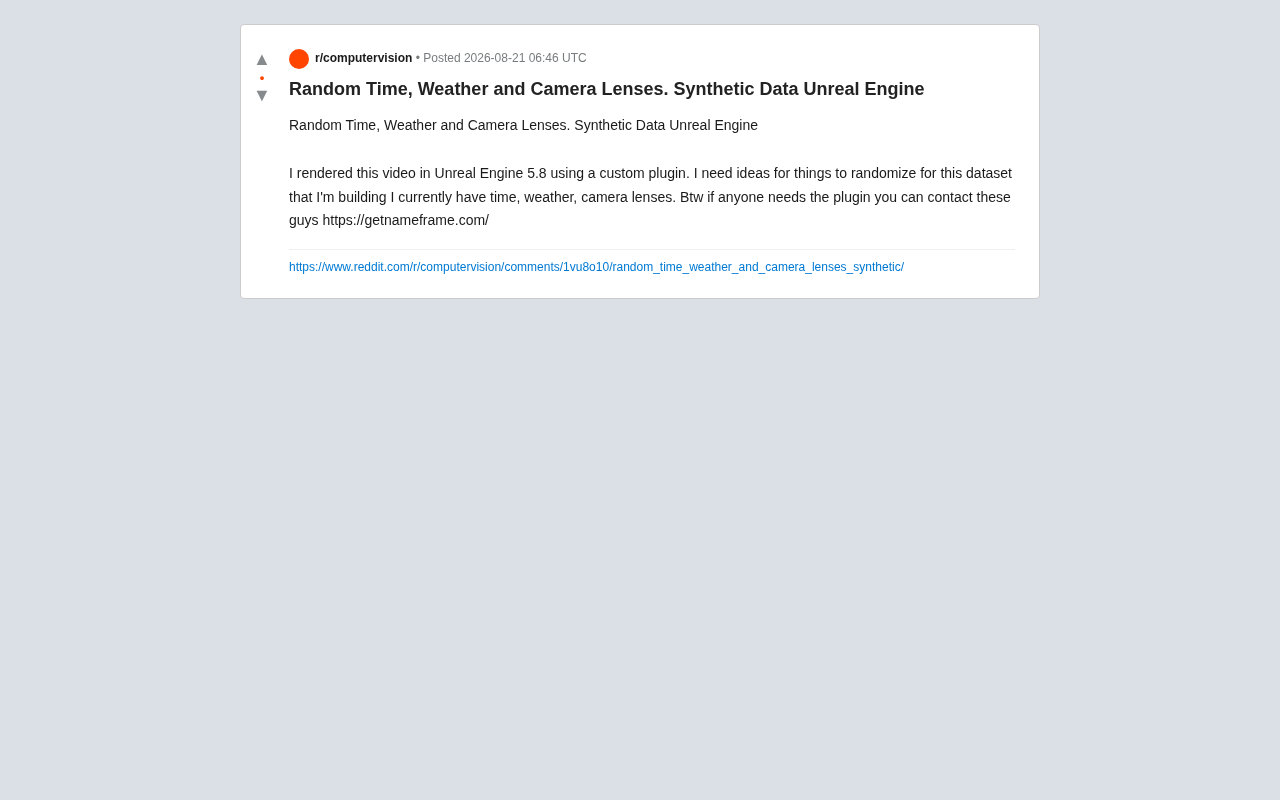
Using UE5.8 domain randomization to generate diverse synthetic training data for computer vision
A developer shared his Unreal Engine 5.8 project that uses domain randomization across time, weather, and camera parameters to batch-generate synthetic training datasets. By systematically randomizing scene elements, the approach produces diverse, automatically annotated data at near-zero cost while addressing the Sim-to-Real gap challenge in AI training.
Introduction: Why Synthetic Data Matters
In AI fields like computer vision and autonomous driving, high-quality, precisely annotated training data remains a scarce resource. Collecting real-world data is not only costly but also faces challenges such as privacy protection and the difficulty of reproducing extreme scenarios. This is why synthetic data has become a focal point for the industry in recent years.
Synthetic data refers to data artificially created through algorithms, simulations, or generative models, rather than directly collected from the real world. In the deep learning era, large-scale datasets like ImageNet drove breakthroughs in computer vision, but annotation costs were extremely high—ImageNet's 14 million images required tens of thousands of hours of manual annotation. More critically, safety-critical fields like autonomous driving require large amounts of rare scenario data (such as pedestrians crossing in rainy nights), which are difficult to systematically collect in the real world. OpenAI's 2017 robotics research demonstrated that through sufficient domain randomization training in simulated environments, robotic arms could directly transfer to real-world task completion, marking synthetic data's evolution from auxiliary tool to core productivity driver. Currently, leading autonomous driving companies like Waymo and Tesla extensively use simulation data to supplement real datasets, building what's known as a "hybrid data training paradigm."
Recently, a developer shared on Reddit his synthetic data rendering project based on Unreal Engine 5.8. Using a custom plugin, he can randomize parameters like time, weather, and camera lenses in rendered scenes to batch-generate image datasets for machine learning training. This post sparked heated community discussion about "how to build richer synthetic datasets."
Project Core: Batch-Generating Randomized Training Data with Unreal Engine
Unreal Engine, developed by Epic Games, was initially designed for game production, but its real-time ray tracing, physics simulation, and scene editing capabilities make it an ideal platform for synthetic data generation. UE 5.8's Nanite virtualized geometry technology can render billions of polygons without frame rate loss, while the Lumen global illumination system provides cinematic-quality real-time lighting effects, significantly enhancing the realism of synthetic images. Compared to traditional offline renderers (like Blender Cycles), UE's real-time capabilities accelerate iteration by orders of magnitude. More importantly, UE provides complete Python APIs and plugin systems that allow programmatic control of every scene parameter—the foundation for batch training data generation. Companies like NVIDIA and Microsoft have also built specialized simulation platforms based on UE (such as NVIDIA Omniverse) for autonomous driving and robotics training.
Three Major Randomization Dimensions Already Implemented
According to the developer, he has currently implemented randomization across three key dimensions:
- Time: Simulates lighting changes throughout different times of day, from dawn to dusk to night, with corresponding variations in light angle and color temperature.
- Weather: Covers various meteorological conditions including sunny, cloudy, rain, snow, and fog, directly affecting visibility and material appearance.
- Camera Lenses: Simulates lens effects with different focal lengths, apertures, and even distortion characteristics, making datasets more representative of real imaging device diversity.
The combination of these three dimensions can produce massive differentiated samples at extremely low marginal cost. Compared to real-world photography, Unreal Engine's greatest advantage is that all annotation information (such as object bounding boxes, semantic segmentation masks, depth maps) can be automatically and precisely exported by the engine, completely eliminating the manual annotation bottleneck.
In simulation environments like Unreal Engine, annotation information can be directly exported through the engine's internal data structures—a revolutionary advantage of synthetic data over real data. The engine precisely knows each object's 3D position, category, and pose, enabling zero-cost generation of multiple annotation types including 2D bounding boxes, pixel-level semantic segmentation masks, instance segmentation, depth maps, surface normals, and optical flow. For real data, pixel-level annotation costs can reach several to tens of dollars per image, while physical information like depth maps is nearly impossible to annotate manually and requires expensive sensors like LiDAR. This "annotation-as-generation" characteristic allows researchers to customize annotation types for specific tasks, such as generating precise object pose quaternions for 6D pose estimation tasks or complete temporal trajectory annotations for motion prediction tasks.
Plugins and Toolchain Used
The project uses a custom plugin from getnameframe.com, and the developer indicates that interested users can contact them directly. The value of such plugins lies in packaging Unreal Engine's powerful real-time rendering capabilities into automated pipelines for data production, eliminating the need for researchers to write rendering scripts from scratch.
Domain Randomization Expansion: What Other Dimensions Can Be Randomized
The original poster solicited community suggestions for "what other parameters are worth randomizing." This is actually the core proposition of building high-quality synthetic datasets—the richer and more realistic the randomization dimensions, the stronger the trained model's generalization capability. Drawing from industry practices, the following dimension categories warrant consideration:
Scene and Object Level
- Material and Texture Randomization: Randomly replace object surface materials, colors, and wear levels to enhance model robustness to appearance variations.
- Object Position and Pose: Randomly place target objects, covering various orientations, occlusions, and stacking situations.
- Background Environment Switching: Switch between different scene backgrounds (urban, rural, indoor) to prevent model overfitting to fixed backgrounds.
Camera and Viewpoint Level
- Camera Height and Angle: Simulate viewpoints of surveillance or vehicle-mounted cameras at different installation positions.
- Motion Blur and Exposure: Add varying degrees of motion blur, overexposure, or underexposure to approximate real capture imperfections.
- Image Noise and Compression Artifacts: Simulate sensor noise, JPEG compression artifacts, and other real imaging degradation phenomena.
Lighting and Post-Processing Level
- Multi-Light Source Configuration: Randomize the number, color, and intensity of artificial light sources.
- Reflections and Shadows: Adjust reflectivity and shadow hardness to enrich lighting diversity.
This systematic randomization strategy essentially implements the famous Domain Randomization method in computer vision—by introducing extensive random variations during training, it narrows the "domain gap" between synthetic and real data, keeping model performance stable in real scenarios.
Domain randomization is a transfer learning strategy proposed and validated by institutions like OpenAI and Google in 2017-2018, with the core idea of "compensating for lack of realism with randomization diversity." Its theoretical foundation stems from statistical learning theory: if the training data distribution is broad enough (i.e., covers a sufficiently large variation space), then real data will likely fall within this broad distribution's coverage range, enabling model generalization to real scenarios. Mathematically, this equates to uniform or biased sampling in parameter space, making the support set of training distribution P_train contain the real data distribution P_real. In practice, randomization must balance two objectives: variation range must be large enough to cover real scenarios, while not being so random as to generate physically unreasonable samples (like floating cars). Successful cases include OpenAI's robotic arm trained purely on simulation data achieving over 90% success rate in the real world, and Waymo improving rare scenario detection recall by over 30% through simulation data.
Value and Challenges of Synthetic Data
Core Advantages
The appeal of synthetic data lies in its controllability, scalability, and zero annotation cost. Developers can precisely control the scene composition of each frame, easily generate rare scenarios that are extremely difficult to collect in the real world (such as nighttime accident scenes in heavy rain), and automatically obtain pixel-perfect annotations. This is particularly critical for fields like autonomous driving, robotics, and security that are extremely sensitive to edge cases.
Sim-to-Real Gap: A Challenge That Must Be Faced
However, synthetic data is not a panacea. The core challenge remains the Sim-to-Real Gap—no matter how realistic the rendering, distribution differences between synthetic images and real photographs that cannot be completely eliminated still exist. This is precisely why "more randomization dimensions are better"—a sufficiently broad randomization range can ensure real data falls within the training distribution's coverage.
The Sim-to-Real Gap refers to systematic distribution differences between data generated in simulation environments and data collected from the real world, representing the core bottleneck in synthetic data applications. Factors causing this gap operate at multiple levels: (1) Rendering level—even ray tracing struggles to perfectly simulate real optical phenomena like lens flare, sensor noise patterns, and atmospheric scattering; (2) Physics level—simulated rigid body dynamics, cloth deformation, and fluid effects contain approximation errors compared to reality; (3) Semantic level—object placement and interaction patterns in simulated scenes may lack the statistical regularities of the real world (e.g., vehicles in real parking lots tend to park in orderly fashion rather than completely randomly). Research shows that even visually indistinguishable synthetic images may still have detectable differences in frequency domain features and texture statistics compared to real images. Therefore, narrowing the Sim-to-Real Gap requires multiple approaches: improving rendering realism, increasing randomization dimensions, introducing real data for mixed training, and using transfer learning techniques like domain adaptation.
Additionally, how to validate synthetic dataset quality and balance, avoiding imbalanced frequencies of certain parameter combinations, is also an aspect of data engineering that requires continuous refinement.
Conclusion
This Reddit developer's project is a vivid illustration of Unreal Engine's application in AI data production. As real-time rendering technology matures, game engines are increasingly becoming important production platforms for synthetic data. Starting from the three dimensions of time, weather, and lenses, then gradually expanding to materials, poses, noise, and more, a comprehensive domain randomization pipeline can produce training data at extremely low cost that rivals or even surpasses real-world collection.
For developers exploring synthetic data, this case provides a clear starting point: first build an automated rendering pipeline, then continuously expand randomization dimensions, letting data diversity drive model capability improvement.
Key Takeaways
Related articles
Fable 5.1 Cracks 373-Year-Old Cipher: AI Reasoning Achieves Real-World Breakthrough
AI evaluation firm Vals AI claims its Fable 5.1 model cracked the 373-year-old Cyphral Distich cipher. An in-depth analysis of the technical significance, historical cipher-breaking challenges, and LLM reasoning capabilities.
Stanford AI Course: Three Feedback Mechanisms That Enable Agents to Self-Evolve
Deep dive into Stanford's AI Agents Lecture 4: how ReAct, RLEF execution feedback, and Constitutional AI self-critique create three feedback loops driving LLM agent self-evolution.
CGI: The First Open-Source GPU Compute Pricing Index, Making Compute Pricing Transparent
Computable GPU Index (CGI) is the first open-source GPU compute pricing index, denominated in USD per GPU-hour, calculated from a fixed provider panel with mathematical rigor and full verifiability. This article analyzes CGI's core features, the importance of compute pricing indices, and the potential for compute financialization.