Unsloth New Release: Qwen-Image-2.1 Image Generation and Custom Agent Skills

Unsloth v0.1.812-beta adds image generation and reusable Agent Skills, evolving into a full local AI workbench.
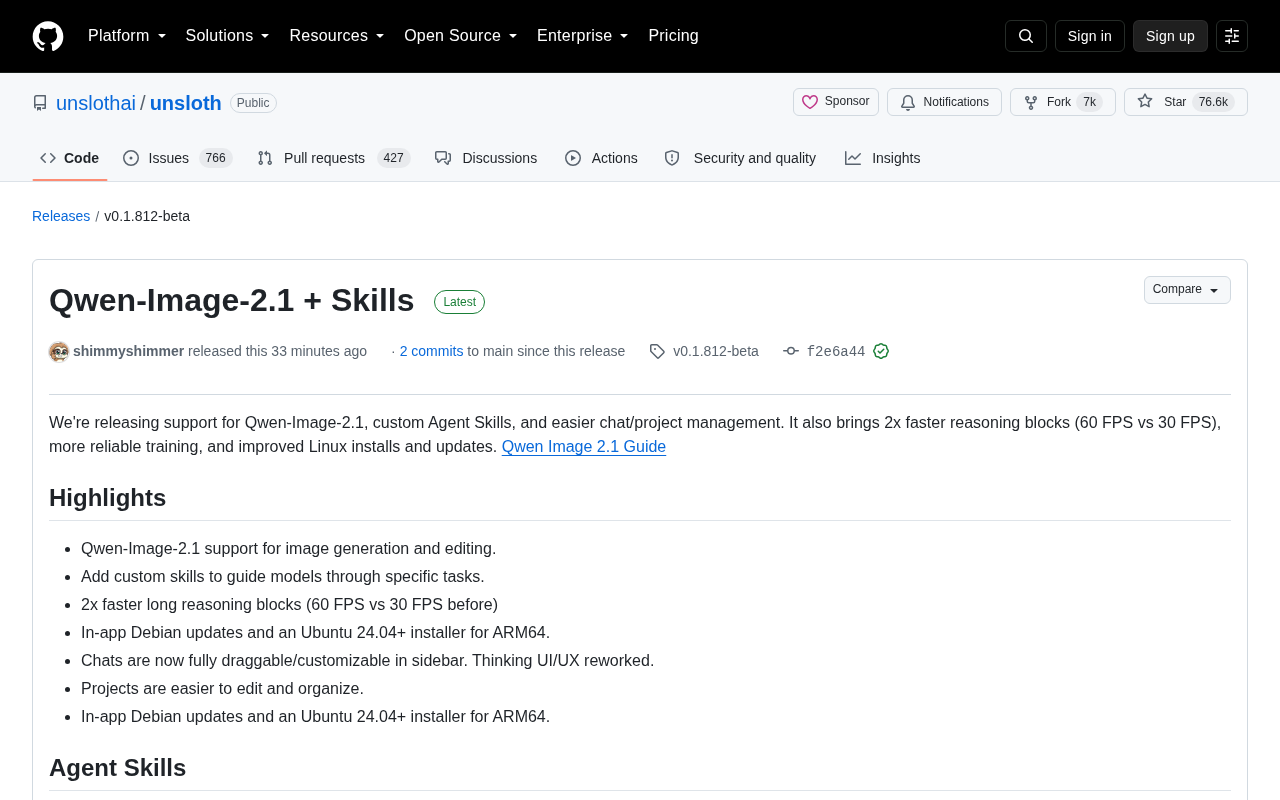
Unsloth v0.1.812-beta delivers three major upgrades: Qwen-Image-2.1 image generation and editing support brings multimodal capabilities into the local workflow; a custom Agent Skills system with Claude Code `.agents` directory compatibility enables zero-cost skill migration; and reasoning block rendering jumps from 30 to 60 FPS for a smoother experience. Training resumption reliability, dataset edge-case handling, and model export cleanliness are also improved, alongside Debian in-app updates, native ARM64 packages, and an AMD ROCm Docker image on Linux.
Open-source fine-tuning tool Unsloth has released version v0.1.812-beta, introducing support for the Qwen-Image-2.1 image model, a customizable Agent Skills system, and a range of improvements to inference speed, training stability, and the Linux deployment experience. As a project with over 76,000 GitHub stars, Unsloth has long been known for efficient fine-tuning — and this update signals a clear evolution toward a more complete local AI workbench.
Qwen-Image-2.1: Bringing Image Generation into Your Workflow
The most notable addition in this release is support for Qwen-Image-2.1, covering both image generation and image editing. This means Unsloth Studio is no longer limited to fine-tuning and inference for text-based language models — multimodal image capabilities are now integrated into the same local environment.
For developers who want to handle everything from model training to content generation locally, this unified design reduces the overhead of switching between different tools. Official documentation for Qwen Image 2.1 is also available to help users get started with image-related tasks quickly.
Thanks to underlying optimizations, vision models can now also "see" images returned by MCP tools. In multi-image conversations, the system provides decoded pixel data directly rather than forwarding raw base64 strings — a detail that makes image-text interactions significantly more stable.
Agent Skills: Guide the Model Your Way
Another core feature is the custom Agent Skills system. Users can add custom skills to guide the model through specific tasks and quickly invoke a skill during chat using the @ symbol.
The compatibility design is worth noting: Unsloth allows direct reuse of existing skills from Claude Code and the .agents directory. For users who have already built up skill configurations in the Claude ecosystem, this is essentially zero migration cost — existing assets can be brought directly into the local environment.
Skill management is also abstracted as a dedicated layer, allowing users to view, edit, and organize their skill library in one place. This approach aligns with the industry-wide trend toward "reusable capability modules," turning prompt engineering from scattered chat snippets into manageable, versioned assets.
Agent Skills are essentially structured prompt templates or tool-call specifications that consolidate what used to be scattered instructions — role definitions, task descriptions, output formats — into reusable modules. Compared to piling text into a system prompt, modular skills offer clear advantages: version control, shareability, and on-demand composition. Claude Code's .agents directory is a local skill storage convention defined by Anthropic for Claude, where each skill file typically contains three fields: name, description, and instructions. Unsloth's direct compatibility with this format means users don't need to learn a new DSL or rewrite existing configurations, significantly lowering the friction of migrating from cloud-based models to local open-source ones.
Inference and UI: Thinking at 60 FPS
On the performance side, rendering speed for long reasoning blocks has doubled — from 30 FPS to 60 FPS. For scenarios that require displaying a model's complete chain of thought, smoother scrolling and updates translate directly into a better interactive experience.
UI-level changes are equally dense. Conversations in the sidebar can now be freely reordered by dragging, pinned to the top, or moved into a project. The Thinking UI/UX has been redesigned for a cleaner, more modern look, and long code responses now stream more smoothly while maintaining syntax highlighting.
Project management is also more flexible: users can now directly edit project names, instructions, and associated folders from the Projects page, and sort by last-updated timestamp. These seemingly minor improvements add up to a noticeably smoother day-to-day experience.
"Reasoning blocks" refer to the visible internal thought process that some large language models generate before producing a final answer — common in models like DeepSeekAd-R1, Qwen-QwQ, and Claude 3.7 Sonnet with "extended thinking" enabled. When answering complex questions, these models progressively unfold their reasoning chain, and the thinking text is often far longer than the final answer, requiring the frontend to continuously stream-render large volumes of tokens. Boosting the rendering frame rate from 30 FPS to 60 FPS reduces visual stuttering during the wait, and also allows developers to observe the unfolding thought chain in near real-time when debugging model reasoning behavior.
Training and Export: More Reliable Resume Behavior
For users whose primary use case is fine-tuning, training-related fixes are especially important. The new version makes training resumption and dataset preparation more reliable: Hugging Face datasets now work correctly in recipes, past training runs can be resumed, and the estimated time remaining after resumption now displays the correct value.
Several edge cases in dataset processing have also been resolved — columns are correctly mapped to their corresponding roles, selected splits and subsets are strictly respected, and rows that cannot be formatted by the chat template are discarded with a user notification. These improvements reduce the likelihood of mid-training failures caused by data issues.
Exports are also cleaner: when uploading a model to the Hub, files left over from previous exports are excluded, so only the current export's contents are pushed — preventing repositories from being cluttered with stale files.
Linux and Hardware: A Much Improved Deployment Experience
This release puts significant effort into Linux desktop distribution. Debian installations now support in-app updates, and a native .deb package for ARM64 is available, giving ARM-architecture Linux users a first-class experience.
On the hardware side, an AMD ROCm Docker image with Unsloth Studio and JupyterLab is now available. For hosts with mixed NVIDIA and AMD GPUs, a path to request the ROCm torch stack is also provided. When the ROCm build cannot run, the system falls back to a Vulkan-based sd.cpp build, making the error handling more robust.
For storage management, users can now view disk space used by various caches in settings and clear them with one click. Chats can also reuse already-downloaded models rather than pulling a second copy, which is a real saving in both local disk space and bandwidth.
ROCm (Radeon Open Compute) is AMD's open-source parallel computing platform for its GPUs, positioned as the AMD equivalent of NVIDIA's CUDA ecosystem. While ROCm's software ecosystem and community support have historically lagged behind CUDA, its viability for AI training and inference is rapidly improving as AMD Instinct data center GPUs gain wider adoption. Vulkan is a cross-platform graphics and compute API maintained by the Khronos Group; inference frameworks like llama.cpp use it through sd.cpp or Vulkan backends for general-purpose GPU compute, covering a broader range of hardware beyond ROCm and CUDA — including integrated graphics and some mobile GPUs. Unsloth's automatic fallback to a Vulkan backend when ROCm is unavailable gives the toolchain better resilience in heterogeneous hardware environments.
Summary
Looking at this release as a whole, Unsloth is clearly evolving from a fine-tuning-focused library into a unified local AI workbench that covers training, inference, image generation, and skill management. The addition of Qwen-Image-2.1 expands its modality coverage, while compatibility with Claude Code's Agent Skills demonstrates respect for developers' existing workflows. For teams that prioritize locality, controllability, and cost efficiency, this kind of continuously iterated open-source tool is well worth keeping on the radar.
Related articles

Amphibious Transforming Drone: Beyond 100x Power Savings, What Are the Real Needs?
Is the amphibious transforming drone just a gimmick? Starting from the 100x power difference of the M4 Morphobot, explore real application scenarios and thesis topic ideas, analyzing boundary conditions where pure drones and pure ground robots both fail.

Warhound Raises $200 Million: Genetically Engineered "War Dogs" Paired with Anduril Gear
Warhound raises $200M, backed by Ben Lamm and Palmer Luckey, to genetically engineer dogs for military and law enforcement use and equip them with Anduril gear. This article analyzes its technology direction, funding logic, and ethical controversy.

Claude API Comes to Google Cloud: IAM Integration and SDK Access Guide
Anthropic hosts the full Claude API on Google Cloud with IAM-controlled permissions and unified billing. This guide covers the Vertex AI and Anthropic-hosted entry points, IAM role configuration, and SDK access.