Unsloth New Release: Run Qwen-Image-2.1 Locally with Custom Agent Skills

Unsloth v0.1.814-beta brings local Qwen-Image-2.1 support, Agent Skills, and major Linux/AMD hardware improvements.
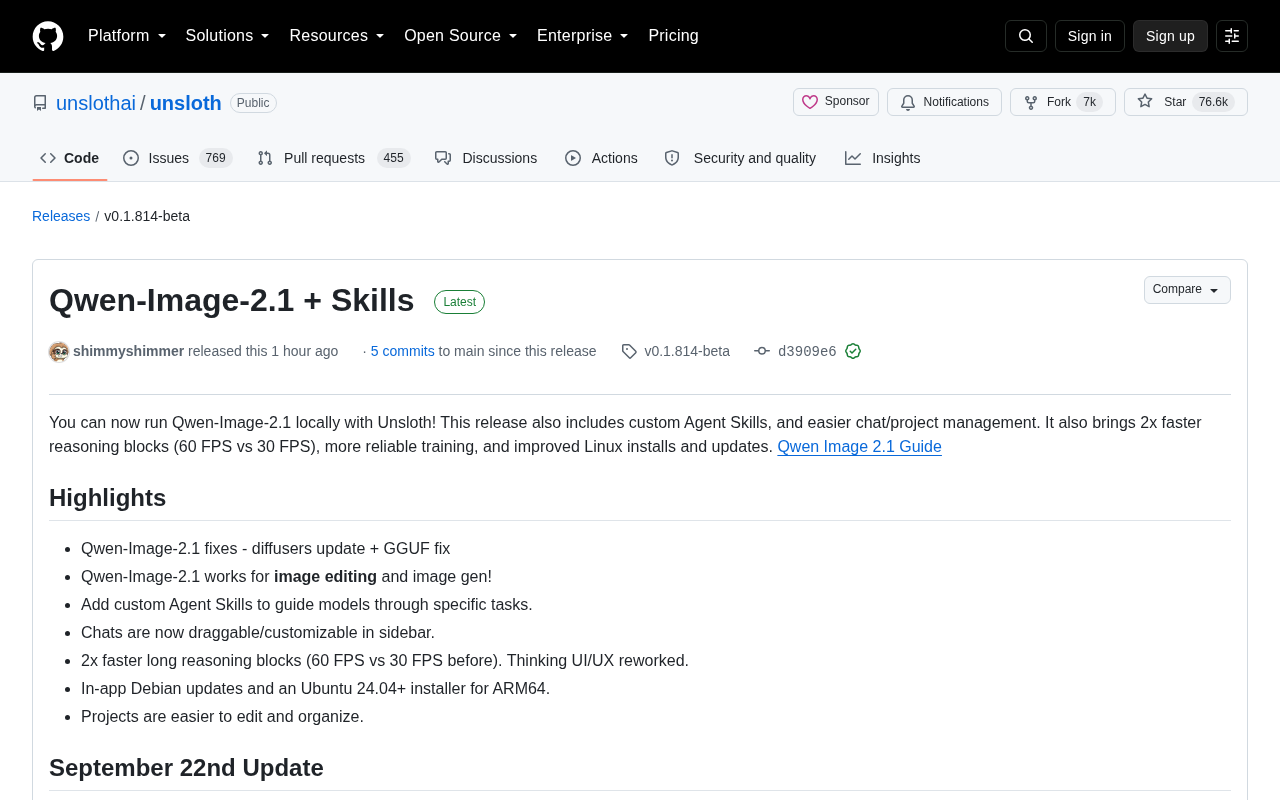
Unsloth v0.1.814-beta delivers two major updates: local Qwen-Image-2.1 support with Q4_K_M GGUF quantization for consumer GPUs, plus custom Agent Skills compatible with Claude Code configs and invokable via `@`. Inference rendering doubles to 60 FPS, streaming output is smoother, and Linux support is greatly expanded with native ARM64 packages, AMD ROCm Docker images, and WSL2 DXG GPU access. Training resume, dataset handling, and cache management have also been systematically improved.
The open-source tool Unsloth has released version v0.1.814-beta, with the most notable updates being local support for the Qwen-Image-2.1 image model and the introduction of a custom Agent Skills mechanism. This project, which has earned 76,000 stars on GitHub, has long been known for its efficient fine-tuning and local deployment capabilities. This update brings meaningful improvements across image generation, inference speed, and Linux support.
Qwen-Image-2.1 Runs Locally: Both Image Generation and Editing Supported
The centerpiece of this release is full support for Qwen-Image-2.1. Users can now perform both image generation and image editing locally, without relying on cloud-based inference. This is a significant development for developers and creators who care about data privacy or want to run image models offline.
In the September 22 update, the team fixed several critical issues: a broken diffusers update, the inability to load GGUF files for Qwen-Image, and a change to the default GGUF precision from F16/BF16 to Q4_K_M. This adjustment lowers the VRAM threshold, allowing more consumer-grade GPUs to run the model smoothly. The team also fixed diffusion black artifact issues on both A100 and consumer GPUs, improving the stability of generated images.
Qwen-Image-2.1 is a multimodal image generation and editing model developed by Alibaba's Tongyi team, representing the visual generation branch of the Qwen series. Unlike Qwen-VL and similar models focused on image understanding, the Qwen-Image series specializes in image generation and editing tasks, built on a Diffusion Model architecture. GGUF (GPT-Generated Unified Format) is a quantized model format introduced by the llama.cpp project that compresses model weights into various precision levels — for example, Q4_K_M represents 4-bit quantization, which reduces VRAM usage by roughly 75% compared to F16 (16-bit float), enabling models that previously required 24GB+ VRAM to run on 8–12GB consumer GPUs. Switching the default GGUF precision from F16/BF16 to Q4_K_M is precisely aimed at making the model accessible to a broader range of hardware users, trading some image quality for practical usability.
Agent Skills: Expanding What Models Can Do
The newly introduced Agent Skills is an important capability for agentic workflows. Users can add custom Skills to guide models in completing specific tasks, and can reuse existing skill configurations from Claude Code and .agents folders.
In practice, managing Skills is quite intuitive — users can centrally manage them in settings and quickly invoke them during chat using the @ symbol. This design lowers the barrier to extending agent capabilities, allowing local models to handle structured, reusable tasks just like commercial AI tools. For users looking to build a local AI assistant, this is a direction worth watching.
Agent Skills as a concept originates from the modular encapsulation of tool use in AI Agent workflows. In mainstream AI toolchains, a "Skill" typically refers to a predefined instruction set or tool-call template that tells the model what to do under specific trigger conditions — for example, "commit code to Git" or "parse and summarize a PDF." Unsloth's Skills implementation is compatible with Claude Code's .agents configuration files, meaning users don't need to build prompts and toolchains from scratch — they can directly reuse existing commercial tool configurations. The @ symbol invocation pattern draws from the widely validated shortcut-trigger paradigm in tools like Slack and GitHub Copilot, reducing the learning curve.
Interaction and Performance: Inference Speed Doubles
On the experience side, this update includes extensive polish to chat and project management. Chat history in the sidebar now supports drag-to-reorder, pinning, and moving to projects, while project names, descriptions, and folders can be edited directly from the Projects page.
The most tangible performance improvement is long reasoning block rendering speed doubling to 60 FPS (up from 30 FPS), along with a redesigned Thinking UI/UX that looks more modern and clean. Long code responses stream more smoothly while preserving syntax highlighting. These refinements may not be as headline-grabbing as new model support, but their cumulative impact on the day-to-day user experience is hard to overlook.
More Robust Models, Training, and Storage
On the model and storage front, vision models can now recognize images returned by MCP tools; other accounts can connect to local model servers with owner permission; and chats can reuse already-downloaded models to avoid redundant downloads. Settings now include a cache usage viewer and cleanup tool for easier disk management.
Training improvements are equally solid: training resume and dataset preparation are more reliable, Hugging Face datasets can now be used in recipes, past training runs can be correctly resumed with accurate time-remaining estimates, and previously error-prone areas like dataset column mapping and split/subset selection have been fixed. Model uploads to Hub now automatically exclude redundant files from earlier exports.
Significantly Improved Linux and Hardware Support
This update makes notable strides in Linux desktop distribution: Debian installs now support in-app updates, and a native ARM64 .deb package is now available. The team has also released an AMD ROCm Docker image with Unsloth Studio and JupyterLab, where the ROCm image can access the GPU via WSL2's DXG bridge rather than relying solely on /dev/kfd.
For multi-hardware environments, the team addressed a number of edge cases — such as providing a way to request the ROCm torch stack on mixed NVIDIA + AMD hosts, correctly identifying unified memory APU VRAM as shared host memory, and falling back to a Vulkan-based sd.cpp build when ROCm is unavailable. Accessibility has also improved, with larger font sizes getting more display room and contrast settings making buttons and menus easier to identify.
AMD ROCm (Radeon Open Compute) is AMD's open-source software platform for GPU general-purpose computing, positioning itself as the counterpart to NVIDIA's CUDA ecosystem. ROCm allows deep learning frameworks like PyTorch and TensorFlow to run on AMD GPUs, but has historically had weak support outside native Linux environments. The WSL2 DXG bridge approach mentioned by Unsloth refers to accessing the GPU through the DirectX Graphics kernel bridge layer built into Windows Subsystem for Linux 2, without relying on the traditional /dev/kfd (Kernel Fusion Driver) device node — which is typically unavailable in WSL2. This approach allows Windows users to leverage AMD GPU acceleration inside WSL2, marking a significant step forward in ROCm's Windows support. Vulkan, used as a fallback, is a cross-platform graphics and compute API that provides limited GPU compute capability via sd.cpp when ROCm is unavailable.
Overall Takeaway
This release continues Unsloth's characteristically pragmatic style — introducing two heavyweight features in local Qwen-Image-2.1 support and Agent Skills, while also fixing a wide range of issues involving training resume, cache management, and cross-platform deployment. For developers who rely on local AI workflows — especially those using AMD/ARM hardware or looking to run image models locally — this update delivers genuinely usable capability upgrades.
Related articles

OpenAI Codex CLI Practical Guide: The Open-Source AI Coding Agent in Your Terminal
OpenAI Codex CLI is an open-source AI coding agent that runs in your terminal. This guide covers its 2025 launch, 2026 desktop app, ChatGPT merger, and a three-step setup and workflow.

AI for Beginners Course Review: ChatGPT, Gemini, and AI Agents in Practice
A hands-on review of a complete beginner AI course covering ChatGPT, Gemini, Notebook LM, Manus, and DeepSeq, with 18,000-record dataset analysis, AI agent website building, and LLM principles and limits.

How Do AI Agents Autonomously Complete Complex Tasks? The ReAct Framework Explained
What's the core difference between an AI Agent and a chatbot? Using competitive research as an example, this article breaks down the ReAct framework's three-step loop of reasoning, acting, and observing, explaining how Agents autonomously decompose tasks, call tools, spot data gaps, and dynamically adjust plans to ultimately deliver complete results.