Unsloth v0.1.47-beta Released: 2x Faster LLM Fine-Tuning with 70% Less VRAM

Unsloth v0.1.47-beta brings continued optimizations to the popular 2x-faster, 70%-less-VRAM LLM fine-tuning framework.
Unsloth has released v0.1.47-beta of its open-source LLM fine-tuning framework, which uses hand-written CUDA kernels and optimized LoRA/QLoRA implementations to deliver 2x faster training and ~70% VRAM reduction for models like Llama, Mistral, and Qwen. This beta update focuses on the `_utils.py` module for compatibility and stability improvements.
Unsloth Quietly Releases v0.1.47-beta
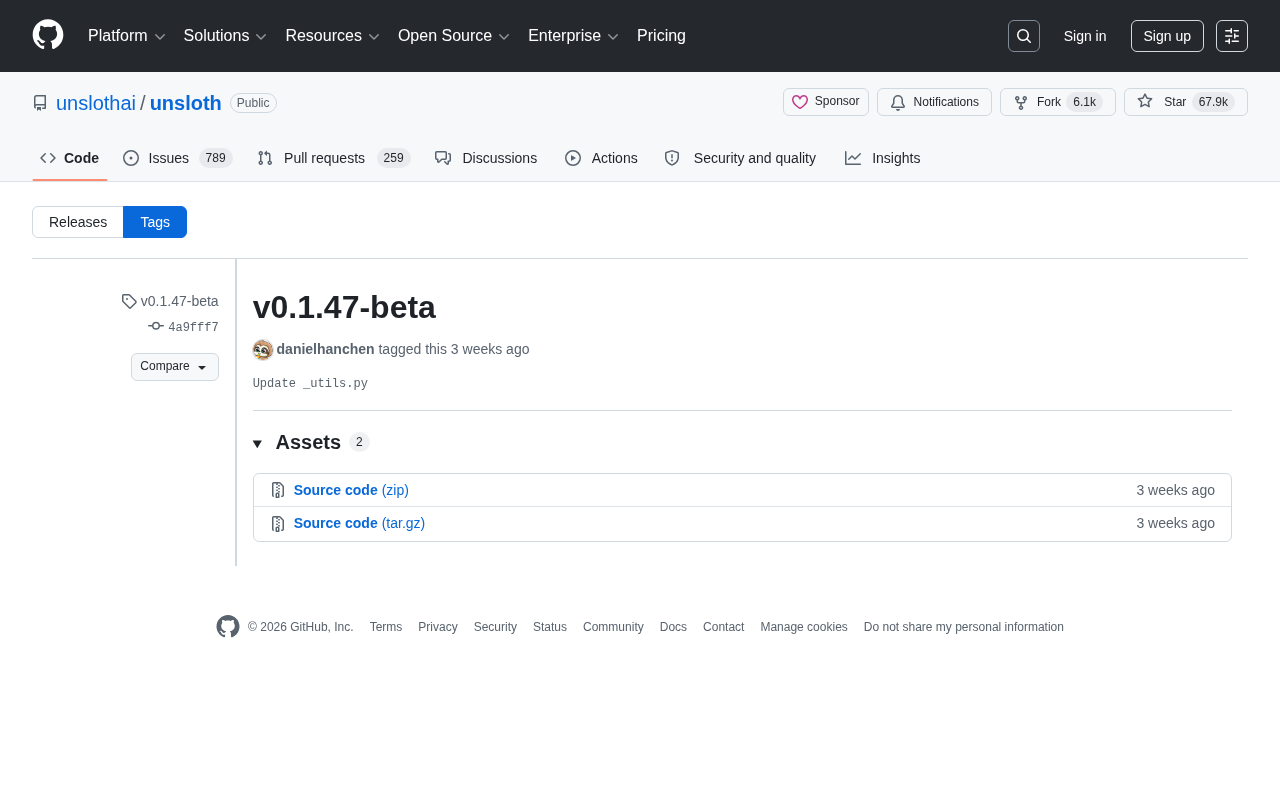
The open-source LLM fine-tuning framework Unsloth has released v0.1.47-beta. As one of the most-watched projects on GitHub, Unsloth has accumulated 67,900 Stars and over 6,100 forks, making it one of the most active tools in the efficient LLM fine-tuning space.
This beta was released by core maintainer danielhanchen on June 18, with updates focused on the _utils.py utility module — part of ongoing optimization and stability improvements.
What Is Unsloth and Why Does It Matter?
Unsloth is an open-source framework dedicated to accelerating large language model (LLM) fine-tuning. Its core advantage: dramatically reducing VRAM usage and speeding up training — without any loss in model accuracy.
According to official benchmarks, Unsloth delivers 2x or greater fine-tuning speedups for popular models like Llama, Mistral, Gemma, and Qwen, while cutting VRAM usage by roughly 70%. This means developers can now fine-tune models on consumer GPUs (like a single RTX 4090 or a free Colab T4) that previously required multi-GPU clusters.
The Technical Foundation: Hand-Written CUDA Kernels
Unsloth's performance gains stem from deep customization of low-level GPU instructions. CUDA (Compute Unified Device Architecture) is NVIDIA's parallel computing platform, and "hand-written CUDA kernels" means bypassing the generic implementations in frameworks like PyTorch to write highly optimized GPU instructions in CUDA C++ — targeting specific operations like attention mechanisms and matrix multiplications.
One of Unsloth's core techniques is an enhanced implementation of Flash Attention: by redesigning memory access patterns, intermediate results that would normally require repeated reads and writes to HBM (High Bandwidth Memory) are kept in the faster on-chip SRAM instead, breaking through bandwidth bottlenecks. Unsloth also employs gradient checkpointing and smart activation recomputation — rather than storing all intermediate activations during the forward pass, it recomputes them on demand during backpropagation, trading compute for memory. This is the technical path behind the "2x speed, 70% less VRAM" headline.
Lowering the Barrier to Fine-Tuning
LLM fine-tuning has long been resource-intensive, with high compute costs locking out individual developers and small teams. Unsloth breaks down this barrier through deep optimization of CUDA kernels, attention mechanisms, and quantization techniques — making parameter-efficient methods like LoRA/QLoRA genuinely accessible at lower cost.
LoRA (Low-Rank Adaptation), introduced by Microsoft Research, approximates weight updates by injecting low-rank decomposition matrices without modifying original model weights, compressing trainable parameters from billions down to millions. QLoRA builds on this with 4-bit NormalFloat quantization, storing the base model at 4-bit precision and cutting VRAM requirements to roughly one quarter. For a 65B-parameter LLaMA model, full fine-tuning requires 780GB+ of VRAM, while QLoRA needs only ~48GB — feasible on a single A100. Unsloth rewrites the underlying implementations of both methods, maintaining numerical equivalence while significantly improving computational efficiency, turning consumer-hardware fine-tuning from theory into practice.
What's in v0.1.47-beta?
This beta release centers on updates to the internal _utils.py utility file. While detailed release notes aren't yet available, based on Unsloth's typical iteration patterns, such updates generally cover:
Compatibility and Stability Fixes
_utils.py houses common utility functions including model loading, dependency detection, and environment adaptation. Updates here typically fix compatibility issues in specific environments or add support for newly released model architectures and library versions.
Keeping Up with the Upstream Ecosystem
Unsloth's tech stack depends heavily on several core upstream projects: PyTorch for tensor computation and automatic differentiation; HuggingFace Transformers for model architecture definitions and weight loading; PEFT (Parameter-Efficient Fine-Tuning) for standard LoRA adapter interfaces; TRL (Transformer Reinforcement Learning) for SFT, RLHF, and other training paradigms; and vLLM for high-throughput inference serving.
Any version update in these libraries can introduce API changes, data format adjustments, or behavioral differences that require Unsloth to adapt promptly. With new model architectures like Qwen2.5, Gemma3, and Llama 3.x releasing frequently, model loading and weight-mapping logic needs continuous updates — which is exactly why utility modules like _utils.py iterate so frequently, and why Unsloth's beta releases help active users stay current with the fast-moving open-source model ecosystem.
How to Think About Using the Beta
It's worth noting that beta releases are primarily aimed at developers willing to test early and provide feedback. For production environments or stability-sensitive use cases, the recommendation is to stick with official stable releases and upgrade after changes are thoroughly validated.
For researchers and developers who want to stay on the cutting edge, the beta is an effective way to preview new features and contribute to the community. You can install a specific version directly via pip or pull the corresponding tag from GitHub for local testing.
Small Steps, Continuous Evolution
Unsloth v0.1.47-beta is a typical small-step iteration — but it's precisely this kind of relentless incremental improvement that has built its leading position in the open-source fine-tuning tools space. Nearly 68,000 Stars reflect the community's strong demand for efficient, low-cost LLM fine-tuning solutions.
As the open-source LLM ecosystem continues to flourish, tools like Unsloth that genuinely lower technical barriers will play an increasingly critical role in democratizing AI. Developers following this project should keep an eye out for the upcoming stable release.
Key Takeaways
Related articles

Workbuddy for Absolute Beginners: How a Desktop AI Agent Fits Into Real Workflows
A beginner's guide to the Workbuddy desktop AI agent: installation, claiming credits, file management, and building automated workflows—compared with CodeX for fit and cost, helping professionals shift from AI question-askers to AI managers.

OpenAI's New Agent Stack: Computer Use, Decisions API, and Ultra-Fast Workflows
OpenAI Dev Day unveiled a new agent stack: Computer Use outperforms humans, Decisions API delivers ultra-low-latency classification via Luna, Agents API opens the same Computer Use capabilities, and GPT-6.1 Sol costs only one-seventh of Astra. Core updates, benchmark data, and developer insights.

Liang Wenfeng Open-Sources DeepInfo Inference Framework, Takes On U.S. Ban
DeepSeek open-sources its DeepInfo inference framework after its models, featuring GPU/CPU cross-pipelining, small-model prediction with large-model verification, and full Huawei Ascend and NVIDIA chip support—facing the U.S. federal ban head-on. This article analyzes its significance for AI deployment and open-source strategy.