US Government Agencies Hit by Cyberattacks in November 2026: Air Force, FBI, CIA, and Treasury
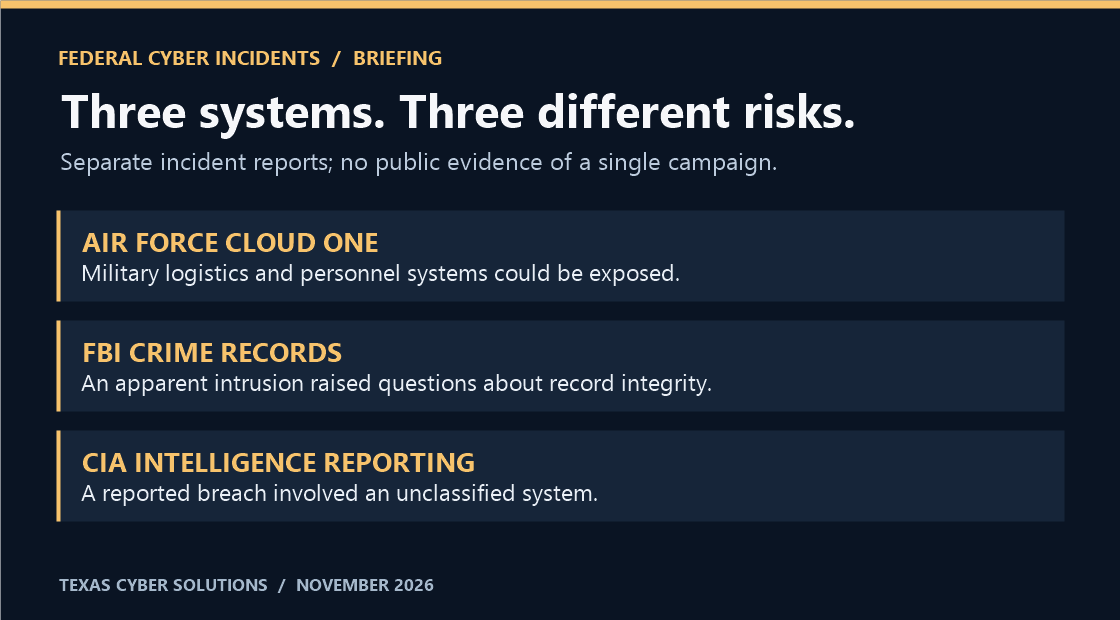
In November 2026, the US Air Force, FBI, CIA, and Treasury were reported hit by cyberattacks; this article outlines the significance, possible pathways, and defensive implications.
Based on a Hacker News discussion thread, the article reports that multiple US government agencies—including the Air Force, FBI, CIA, and Treasury—suffered cyberattacks in November 2026. The original information contains only a title and minimal engagement data, lacking attack methods, scope, and attribution. The author analyzes the sensitivity of each agency's data and infers likely pathways such as supply chain compromise, credential theft, and VPN exploitation, emphasizing caution on attribution until official investigations are released and highlighting three takeaways: cross-agency threat intelligence sharing, routine supply chain audits, and vigilance toward public fatigue over government cyberattack news.
A discussion thread on Hacker News has drawn attention in security circles: in November 2026, multiple US government agencies—including the Air Force, FBI, CIA, and Treasury—were reported to have suffered cyberattacks. The post itself contains limited information (only 13 points and 2 comments), but the list of agencies involved is enough to convey the gravity of the matter—from military intelligence to the core of finance, it covers almost every key node of the US national security apparatus.
What the Four Named Agencies Signify
Air Force: Potential Exposure of Operational and Logistics Data
If Air Force systems are penetrated, attackers could reach operational planning, logistics scheduling, and even contractor networks. Military institutions have long been prime targets for APT (Advanced Persistent Threat) groups, and such attacks typically aim at long-term persistence and intelligence theft rather than short-term disruption.
APT (Advanced Persistent Threat) refers to long-term, covert cyber intrusion campaigns conducted by state-backed or state-sponsored attack organizations. Unlike criminal groups pursuing short-term financial gain, APT groups typically aim at intelligence theft, strategic prepositioning, and long-term persistence, with attack cycles lasting months or even years. Their typical characteristics include: using zero-day vulnerabilities or custom malware, establishing initial footholds through supply chains or phishing emails, employing Living-off-the-Land techniques to evade detection, and conducting slow lateral movement and privilege escalation within target networks. Military institutions are prime targets precisely because operational planning, weapons system parameters, and logistics scheduling data carry extremely high strategic intelligence value.
FBI and CIA: Two Ends of the Intelligence Chain
The FBI focuses on domestic law enforcement and counterintelligence, while the CIA is responsible for foreign intelligence. The simultaneous appearance of both on one attack list suggests attackers may be attempting to piece together internal and external intelligence views—or at least conducting broad, opportunistic scanning.
Treasury: A Sensitive Hub for the Economy and Payment Systems
Treasury systems are tied to federal payments, sanctions enforcement, and financial regulatory data. Historically, attacks on financial institutions have often been linked to financial fraud, data extortion, or geopolitical pressure.
Possible Attack Pathways (Inferences Based on Public Discussion)
Although the Hacker News comment section is brief, incidents of this kind typically point to several common pathways: supply chain compromise (through third-party contractors or software vendors), credential theft and lateral movement, and exploitation of vulnerabilities in VPN/remote access infrastructure. Government agencies have a vast and dispersed attack surface, and any weak link can become a breach point.
It should be emphasized that the original post did not disclose specific attack methods, scope of impact, or attribution conclusions. Before official investigation results are published, any claims about "who did it" or "how much damage was caused" should be treated with caution.
Supply chain compromise refers to attackers not directly attacking the ultimate target, but first compromising a trusted third party—a software vendor, IT service provider, contractor, or open-source component—and then using legitimate update channels or access permissions to penetrate the target network. Typical cases include the SolarWinds incident, in which attackers tampered with software update packages, and lateral entry into customer networks through MSPs (Managed Service Providers). Because government agencies have long procurement chains and numerous contractors, their supply chain attack surface is particularly broad. The stealthiness of such attacks lies in the fact that malicious payloads often carry legitimate signatures, making them difficult for traditional perimeter defenses to identify, and a single success can simultaneously affect a large number of downstream organizations.
Implications for Security Practitioners
First, the simultaneous naming of multiple agencies shows that the single-point defense mindset is no longer sufficient; cross-departmental threat intelligence sharing and joint response mechanisms are key. Second, government agencies' third-party dependencies are a long-standing weakness, and supply chain security audits need to become routine. Third, the low discussion volume of such incidents on Hacker News (only 2 comments) reflects, to some extent, public "fatigue" toward news of government cyberattacks—which is itself worth watching.
Threat intelligence sharing refers to mechanisms by which different organizations exchange information about attacker infrastructure, TTPs (Tactics, Techniques, and Procedures), malicious file hashes, and more. At the US federal level, CISA promotes cross-agency collaboration through the Automated Indicator Sharing (AIS) platform and the Continuous Diagnostics and Mitigation (CDM) program; at the industry level, ISACs (Information Sharing and Analysis Centers) handle intelligence exchange within vertical sectors. When multiple agencies are attacked simultaneously, the lag of single-point defense is amplified—if the first agency to discover an intrusion can promptly share IOCs (Indicators of Compromise), the detection and response window for other agencies can be significantly shortened. This is also why zero trust architecture and joint defense systems have been repeatedly emphasized in recent years.
Information Limitations and Follow-up Focus
The original material consists only of a title and very little engagement data, lacking technical details, official statements, and impact assessments. Directions worth tracking include: whether CISA or related agencies issue announcements, whether any ransomware group claims responsibility, and whether the attacks are linked to known APT activity. Until more information emerges, the analysis in this article is based solely on reasonable inference from the nature of the institutions and historical attack patterns.
One-line Summary
In November 2026, the US Air Force, FBI, CIA, and Treasury were reported to have suffered cyberattacks; this article outlines their significance, possible pathways, and defensive implications.
Paragraph Summary
Based on a Hacker News discussion thread, this article reports that multiple US government agencies—including the Air Force, FBI, CIA, and Treasury—suffered cyberattacks in November 2026. The original information consists only of a title and minimal engagement data, lacking attack methods, scope of impact, and attribution conclusions. The author approaches the topic from the nature of the institutions, analyzing the sensitivity of Air Force operational and logistics data, the FBI and CIA's internal and external intelligence chains, and the Treasury's payment and sanctions systems, and infers that such incidents typically involve supply chain compromise, credential theft, and exploitation of remote access vulnerabilities such as VPNs. The article emphasizes that attribution and damage claims should be treated cautiously before official investigations are published, and offers three implications: cross-departmental threat intelligence sharing, routine third-party supply chain audits, and vigilance toward public "fatigue" regarding news of government cyberattacks.
Related articles

System Exchange Spawns an Offbeat Journey to the West: Why This Comedy Series Works
A Bilibili comedy short series reimagines Journey to the West with a system-exchange premise, as the protagonist challenges Sun Wukong, Erlang Shen, and other classics.
HN Warning: Don't Use AI to Write Comments, or They'll Be Auto-Deleted
Hacker News warns that AI-written comments will be automatically deleted. This article analyzes HN's automated enforcement mechanism, the community's attitude toward AI-generated content, and what it means for creators using AI tools responsibly.

AI Product Manager Systematic Course for Beginners: Three Modules Explained with Pitfall Avoidance Guide
Breakdown of Bilibili's 100-episode AI product manager course: Foundation builds large model and Prompt cognition, Advanced tackles Agent workflows and RAG knowledge bases, Practice completes projects like personal knowledge bases and intelligent customer service. Includes learning roadmap and pitfall avoidance tips.