US Lawmakers Oppose AI Bubble Bailouts: Who Should Bear the Risk for Big Tech?

Democratic lawmakers introduce a resolution opposing AI bubble bailouts for Big Tech, sparking debate on the limits of public funds.
Some US Democratic lawmakers have led a resolution opposing the use of federal public funds to bail out large technology companies if the AI boom turns into a bursting bubble. The resolution is non-binding and mainly signals a stance and sets an agenda, declaring in advance the market discipline that gains and losses belong to the companies. The article outlines the background of surging AI infrastructure investment and polarized Hacker News discussion, noting that while the resolution's specific provisions and prospects remain undisclosed, its signal matters: the political cost of AI capital expenditure is rising.
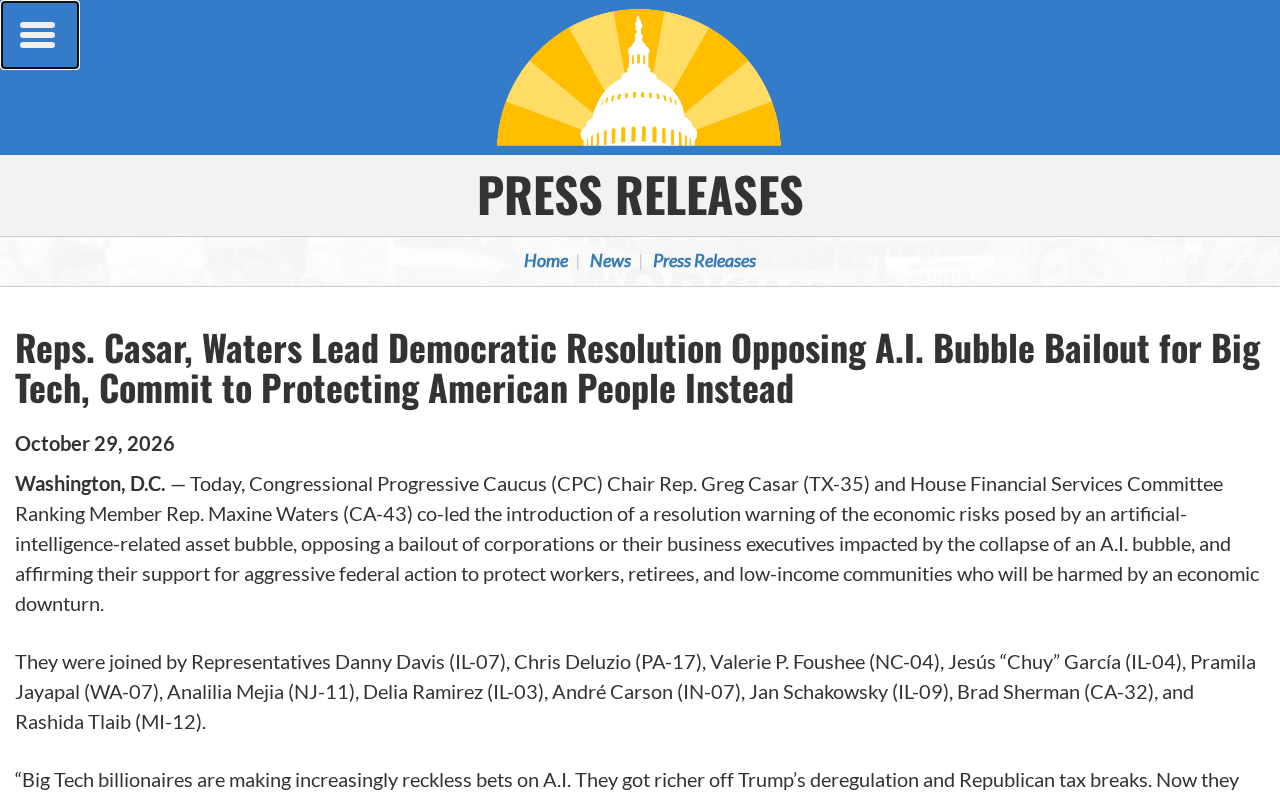
A Hacker News post titled "US Reps Lead Democratic Resolution Opposing A.I. Bubble Bailout for Big Tech" has sparked discussion. The post itself contains limited information, but it points to a policy signal that is beginning to surface: some US lawmakers are trying to draw a line in advance—if the artificial intelligence boom ultimately turns into a bursting bubble, the federal government should not use public funds to backstop large technology companies.
A "Preemptive" Political Statement
From the title, this is a resolution led by Democratic lawmakers. A resolution itself is usually non-binding; it is more about expressing a position and setting an agenda. Its value is not whether it can immediately change policy, but that it puts the two phrases "AI bubble" and "bailout" into the same sentence.
Over the past few years, AI infrastructure investment has expanded dramatically, with data centers, computing chips, and energy contracts layering on top of one another. The market's patience with return cycles is being stretched, and once expectations reverse, the first to be hit will be those large technology companies with the heaviest balance sheets. The lawmakers' concern is direct: these companies have enjoyed the valuation benefits brought by the AI narrative, so they should not shift the risk to taxpayers when the cycle turns down.
Resolution is a legislative tool used by the US Congress to express positions, divided into simple resolutions, concurrent resolutions, and joint resolutions. The first two usually require passage by only one chamber and are not sent to the president for signature, and therefore are non-binding; a joint resolution, if passed by both chambers and signed by the president, has legal effect, but is often used for specific procedural matters. The resolution referred to in this article, judging from the context, belongs to the non-binding type used to express a position, and its political function is to set the agenda, consolidate intra-party consensus, and send signals to the market and the executive branch. Historically, Congress has repeatedly expressed positions on budgets, foreign affairs, and industrial policy through resolutions; although they do not directly change the law, they often become the starting point for subsequent legislation or hearings. Understanding this makes it clear why the details of the resolution text (such as specific wording and number of co-sponsors) are more worthy of attention than whether it passes.
"AI bubble" is not a strict economic definition, but borrows the analytical framework of asset bubbles: when valuation increases in a certain theme are driven mainly by narrative and expectations rather than verifiable cash flow support, there is bubble risk. The particularity of the current AI field is that capital expenditure is highly concentrated in heavy-asset segments such as data centers, advanced-process chips, and power contracts, with payback periods measured in years. Once downstream application revenue falls short of expectations, these rigid investments will quickly translate into depreciation pressure and overcapacity—this is also the real basis for lawmakers discussing "bubble bursting" and "bailout" together.
Why the Word "Bailout" Appears in the AI Context
After the 2008 financial crisis, "too big to fail" became part of public memory. Although large technology companies are not banks, their concentration in computing power, cloud services, and AI models has revived the question of systemic risk. If the AI capital expenditure of a few companies stalls at the same time, the impact could spread to supply chains, energy projects, and broader employment.
The subtext of the resolution is: do not wait until a crisis occurs to discuss the rules. Declaring "no backstop" in advance is itself a declaration of market discipline. It tries to tell capital: the gains from betting on AI belong to you, and so do the losses.
"Too big to fail" refers to certain institutions being large enough and sufficiently deeply connected to the financial system that their failure would trigger systemic chain reactions, forcing the government to rescue them. During the 2008 financial crisis, the United States injected public funds into banks and the auto industry through tools such as the Troubled Asset Relief Program (TARP); afterward, the Dodd-Frank Act introduced stress tests and "living wills" to try to constrain this logic. Applying this concept to large technology companies is controversial: they are not depository institutions and are not protected by federal deposit insurance, but their concentration in cloud computing, computing power supply, and AI model distribution gives them systemic importance similar to infrastructure. Those who support declaring "no backstop" in advance argue that a clear expectation of rescue induces moral hazard—that is, companies take excessive risks because they expect to be saved; opponents point out that when a real crisis arrives, policy often has to compromise after the fact, and preemptive statements may become empty talk.
Where the Divisions Lie
The Hacker News comment section shows a typical polarization. One view holds that the resolution is merely political theater, that whether an AI bubble exists and when it will burst cannot be predicted, and that discussing bailouts now is premature. The other view emphasizes that using public funds to rescue already highly concentrated technology giants is politically unacceptable, and that the resolution at least draws a bottom line.
You may not have noticed that the original article did not disclose the resolution's specific provisions, list of sponsors, or prospects for a vote. Therefore, the facts that can currently be confirmed are limited to this: some members of Congress have led the introduction of a resolution opposing bailouts for large technology companies' AI bubble, and it has sparked discussion in the tech community. Whether it can advance and whether it will affect legislation remain to be seen.
What It Means for the Industry
In the short term, the direct impact of such a resolution on the pace of AI investment is limited. But the signal it sends is worth watching: the political cost of the AI narrative is rising. When the public sector begins discussing "no rescue," it means that market scrutiny of AI capital expenditure will become stricter. For startups and developers, this may mean a divergence in the financing environment—leading companies can still obtain resources, while smaller players relying on a single narrative will feel the pressure earlier.
The real question is not whether the bubble will burst, but who will bear the cost when it does. The resolution puts the answer to this question on the table in advance.
One-line Summary
Democratic lawmakers have introduced a resolution opposing bailouts for large technology companies' AI bubble, sparking discussion in the tech community about the bottom line for public funds.
Paragraph Summary
Some US Democratic lawmakers have led the introduction of a resolution explicitly opposing the use of federal public funds to bail out large technology companies if the artificial intelligence boom turns into a bursting bubble. The resolution is non-binding and is more about expressing a position and setting an agenda; its value lies in declaring in advance the market discipline that "the gains belong to the companies, and so do the losses." The article outlines the background of the resolution: AI infrastructure investment has expanded dramatically, with data centers, computing chips, and energy contracts layering on top of one another, and the market's patience with return cycles is being stretched. Discussion in the Hacker News community is polarized: one side sees it as political theater and says it is too early to discuss bailouts, while the other emphasizes that using public funds to rescue highly concentrated technology giants is politically unacceptable. Because the original article did not disclose the resolution's specific provisions, list of sponsors, or prospects for a vote, the facts that can be confirmed are limited, but its signal is worth noting—the political cost of AI capital expenditure is rising.
Related articles

DeepSeek Open-Sources DeepInfer: What Is an Inference Framework Actually For?
DeepSeek open-sources its inference framework DeepInfer under Apache 2.0, supporting DeepSeek V4.1 Flash offline inference. This article explains its request scheduling, FlashMLA/DeepGEMM compute optimization, DSPark speculative verification acceleration, and what it means for developers and ordinary users.

Open-Source AI Learning Agent: A Full Workflow Experience from Topology Graphs to Exam Generation
Explore an open-source AI learning agent: built on DeepSeek API, it constructs knowledge systems via topology graphs, with automatic document generation, notes, super documents, and exams. Learn about its Agent workflow and design highlights.

DeepSeek Whale Girl Open-Source MV Meme: AI Industry Coded Slang About Pivoting to Closed Source
Bilibili's DeepSeek Whale Girl rap MV uses fictional memes to tease the AI open-source vs. closed-source debate, with lyrics full of industry slang. This article explains the meme culture, the Whale Girl symbol, and the open/closed tension.