Use GPT-5.5 Without a VPN? The Temptation and Hidden Risks of AI Mirror Sites

VPN-free AI mirror sites promise free GPT-5.5 access but hide serious data security and compliance risks.
As overseas AI models like GPT-5.5 and Claude Opus 4 advance rapidly, mirror sites promising Chinese users free VPN-free access have proliferated. This article examines the technical reality behind these sites — reverse proxies, API mirrors, and shared account pools — and exposes three core risks: data security vulnerabilities including potential MITM attacks, unsustainable business models masking hidden monetization, and compliance violations. It recommends safer alternatives including mature domestic models like DeepSeek and Kimi, official subscriptions, and authorized API providers.
The AI Anxiety of Chinese Users: Are Overseas Models Out of Reach?
With OpenAI releasing GPT-5.5, Google launching the Gemini series, and Anthropic updating Claude Opus 4, the ceiling of global AI capabilities keeps being pushed higher. GPT-5.5 is OpenAI's multimodal large model launched in 2025, featuring significant improvements over its predecessors in reasoning depth, contextual understanding, and image generation. Its built-in image generation capability (based on an improved diffusion model architecture) can produce highly realistic and stylistically diverse images, supporting complex scene composition and precise text rendering. Meanwhile, the Claude Opus 4 series excels in long-text comprehension and code generation, the Gemini series has unique advantages in multimodal fusion and real-time information retrieval, and xAI's Grok series stands out with its deep integration with the X platform and real-time data access capabilities. Each of these models has its own strengths, collectively pushing the boundaries of AI capabilities.
However, for users in China, directly accessing these services still involves network and account barriers, which has spawned a flood of tutorials and tools for "free access to overseas AI" going viral on social media.
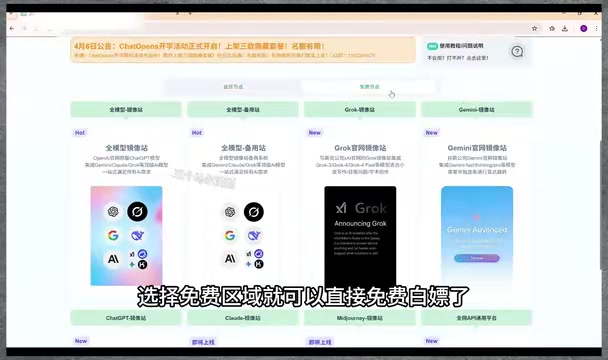
Recently, a category of videos on Bilibili has attracted attention: they claim that through a certain "incredible treasure site," users can directly log into ChatGPT, Grok, Claude, and other top global AI platforms without a VPN — completely free and with unlimited usage. This type of content often uses GPT-5.5's image generation capabilities as a hook, showcasing various stunning AI-generated images to attract eyeballs.
The Technical Truth Behind "VPN-Free Direct Access Sites"
Technical Principles: Proxies and Mirrors
So-called "VPN-free direct access to official sites" is essentially one of the following technical approaches:
- Reverse proxy sites: Requests are relayed through overseas servers. Users are actually accessing a proxy server, which makes requests to OpenAI's official API on their behalf.
- API mirror sites: Third-party frontend interfaces built after purchasing official API access, simulating the official website experience.
- Shared account pools: Maintaining a batch of paid accounts and rotating user access among them.
None of these approaches constitute genuinely "logging into the official website directly" — they all involve forwarding and processing through an intermediary layer.
From a more technical perspective, a reverse proxy is a server architecture pattern where the client doesn't communicate directly with the target server. Instead, requests are sent to an intermediary proxy server, which forwards them on the client's behalf. In legitimate scenarios, reverse proxies like Nginx and Cloudflare are widely used for load balancing and security protection. But in these "VPN-free" sites, reverse proxies are used to bypass geographic access restrictions. All user request data (including prompts entered and files uploaded) passes entirely through the proxy server, and the site operators technically have full access to this data. API mirror sites go even further — they typically purchase API Keys from companies like OpenAI, then build their own frontend interfaces and call the official API through their backend to return results. Under this model, the interface users see may closely resemble the official site, but it's actually a completely independent third-party application.
Features Demonstrated in the Videos
According to the content creators, these sites offer the following capabilities:
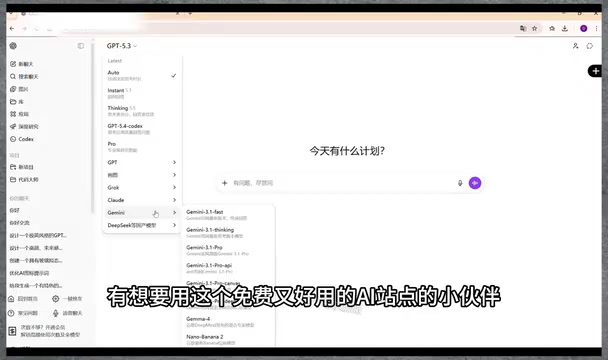
- Full ChatGPT model selection, including GPT-5.5, Syncing mode, and the AMG2 image generation model
- Grok 4.2 series (xAI's model under Elon Musk)
- Claude Opus 4.7
- Full Gemini series
- Even Microsoft Office-related AI features
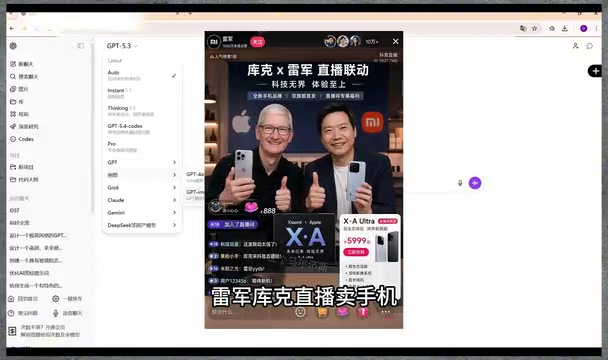
The videos showcase GPT-5.5's image generation capabilities, including fun scenarios like "triangular prism crossover with Genshin Impact," "Tim Cook livestreaming phone sales," and "Elon Musk endorsing Lao Gan Ma chili sauce." These high-quality AI-generated images genuinely demonstrate the enormous progress of the latest models in image generation. GPT-5.5's image generation capability is based on an improved diffusion model architecture that can precisely understand complex scene descriptions, achieving unprecedented levels of quality in facial expressions, lighting effects, and text rendering — which is the core reason these videos quickly attract massive attention.
The Price Behind "Free": Three Core Risks
Data Security Risks
This is the most critical issue. When you use AI services through a third-party proxy site, all your input passes through that site's servers. This means:
- Your conversation content may be logged and stored
- Sensitive information (personal privacy, trade secrets, code, etc.) could be leaked
- Your usage habits and preferences could be analyzed and exploited
In fact, the data security risks of third-party proxy sites go far beyond simply "having conversations recorded." From a technical standpoint, these sites can execute man-in-the-middle attacks (MITM), intercepting all communications between users and the AI. More covert risks include: sites may embed tracking scripts in their frontend pages to collect browser fingerprints, IP addresses, device information, and more; if users register accounts on the site, their email addresses and passwords could be used for credential stuffing attacks; some sites may even use users' conversation data for model fine-tuning or sell it to third-party data brokers. Under China's Personal Information Protection Law and Data Security Law, such non-compliant cross-border data transfers are themselves legally risky, and data generated during usage may fall into a legal gray area.
For casual entertainment use (such as generating fun images), the risk is relatively manageable. But if any sensitive information is involved, using such sites is extremely unwise.
Questionable Sustainability
"Free unlimited usage" is hard to justify from a business logic standpoint. API calls to top-tier models like GPT-5.5 are expensive. If a site truly offers free unlimited service, its operating costs would be extremely high.
Specifically, taking GPT-5.5 as an example, its API charges based on input and output token volume, with advanced models costing tens of dollars per million tokens. A single ordinary conversation might consume thousands of tokens, and image generation costs even more — a single image's API call typically costs between $0.04 and $0.12. If a site has 1,000 daily active users, each averaging 10 conversations and 2 image generations, the API costs alone could reach tens of thousands of dollars per month. This doesn't even include server bandwidth, operations staffing, and other infrastructure costs.
Therefore, common monetization models include:
- Free access initially to attract users, then converting to paid
- Monetizing through ads or data
- Funneling users toward purchasing other paid services
- Using downgraded model versions while claiming full capability (e.g., passing off GPT-4o-mini as GPT-5.5)
Sites claiming to be "completely free with unlimited usage" are either using downgraded models, have other hidden monetization methods, or are running short-term user acquisition campaigns that are difficult to sustain long-term.
Compliance Issues
Unauthorized reselling or proxying of services from OpenAI, Google, and other companies may violate their terms of service. These sites could have their API Keys banned by the official providers at any time, disrupting service. Users' experience and data continuity cannot be guaranteed.
More Reliable Alternative Recommendations
For Chinese users who genuinely need access to overseas AI models, here are some more reliable options:
Domestic Large Models Are Already Very Capable
Current domestic large models have made tremendous progress. The domestic large model ecosystem in 2025 is quite mature: DeepSeek-R1 excels in math and programming tasks with its powerful chain-of-thought reasoning capabilities, and its open-source strategy has driven rapid development in China's AI community; Kimi (Moonshot AI) continues to lead in ultra-long context processing, supporting context windows of over a million tokens; Alibaba's Qwen series keeps iterating on multilingual and multimodal tasks; Baidu's ERNIE Bot has deep expertise in Chinese language understanding and enterprise applications. Additionally, ByteDance's Doubao, Zhipu AI's GLM series, 01.AI's Yi series, and others each have their own distinctive features.
Across multiple international evaluation benchmarks, the overall performance of these models has approached — and in some tasks even surpassed — GPT-4 level capabilities. For most everyday use cases, domestic models can fully meet user needs without any additional barriers, and most offer free basic usage quotas.
Pay Through Official Channels
If you genuinely need to use specific overseas models, paying for subscriptions through official channels is the safest approach. While ChatGPT Plus, Claude Pro, and other subscription services require certain network conditions and payment methods, they guarantee data security and service stability.
Legitimate API Service Providers
Some authorized API service providers offer compliant model access services. While they require payment, they are far superior to dubious free sites in terms of security and stability.
A Rational Perspective on the "Free Access" Culture
In the AI space, "free" often means you're paying with something else — possibly your data, your attention, or potential security risks. The capabilities of new models like GPT-5.5 are genuinely exciting, and the desire to experience them immediately is completely understandable. But while pursuing "free access," maintaining basic security awareness is equally important.
For everyday users, prioritizing domestic large models for daily needs is recommended. For professional users with specific requirements, choosing official or legitimate channels is the sustainable long-term strategy. After all, in the AI era, your data and privacy are your most valuable assets.
Related articles
Alibaba Launches Happy Shrimp: AI-Powered One-Click Complete Song Generation
Alibaba launches Happy Shrimp, an AI music generation tool that creates complete songs with lyrics, melody, arrangement, and vocals from natural language descriptions. In-depth analysis of its core features, differentiation from competitors like Suno, and industry impact.
GPT Sol Ultra vs Grok 4.6: Real-World Task Completion Benchmark in Reasoning Mode
Developer benchmark reveals GPT Sol Ultra completes draw.io scientific diagrams in one iteration while Grok 4.6 fails to converge despite maximum reasoning mode, exposing that reasoning depth ≠ task delivery capability.
OpenAI Authorship Dispute: The Battle Over Academic Boundaries in the AI Era
OpenAI disputes authorship with mathematician Tristan Buckmaster over Navier-Stokes research, raising ethical questions about AI involvement in science.