Using Claude Opus for Brand Films: The Philosophy and Practice of AI-Assisted Creation

A creator used Claude Opus to make a brand film arguing inner vision beats AI tools.
A Bilibili creator used Claude Opus to produce a brand film themed around "The future is here — let's go create it." Rather than showcasing AI's capabilities, the film argues the opposite: in an era of powerful tools and rampant content homogeneity, a creator's inner drive, values, and depth of focus are the truly scarce resources. The film also champions open technology, neural-network-style distributed organizations, niche specialization, and a three-part value framework of innovation, creator freedom, and social balance — insisting AI should empower people, not replace them.
A Brand Film Made with AI
A Bilibili content creator experimented with Claude Opus to help produce a brand promotional film, centered around the rallying cry: "The future is here — let's go create it." More than a showcase of AI's technical capabilities, the short film reads like a creative manifesto. It attempts to answer a fundamental question: as AI tools grow increasingly powerful, where should creators actually focus their energy?
One idea is repeated throughout: a creator's inner world matters more than their tools. This stands in deliberate contrast to the prevailing "tools-first" narrative. As the barrier to AI-generated content continues to drop, this return to the human at the center of creation is a perspective worth taking seriously.

Creation Doesn't Require Deep Pockets — Just Focus and Conviction
One of the film's core beliefs is this: real creative work doesn't depend on massive budgets or ideal conditions. A single device, focus, passion, and determination are enough to produce work that can disrupt an entire industry. In the age of AI, this claim has a new material foundation — tasks that once required full teams, budgets, and equipment (video production, copywriting, music composition) can now be handled by individual creators using large language models and generative tools.
The film openly celebrates "obsessive" and "unconventional" people, framing them as the ones who define new eras and open up new categories. It explicitly rejects homogeneity and assembly-line mediocrity — a pointed stance at a time when AI-generated content is flooding the internet with look-alike work.
The film also offers its own definition of creation: it is never mere entertainment, but self-expression, spiritual redemption, and inner healing. This framing lifts AI-assisted creation out of the "efficiency tool" category and places it back into something more fundamental — the realm of human spiritual need.
Open Technology and the Vision of Distributed Organization

On the philosophical side, the film takes a clear stance: technology exists to solve problems and liberate people — not to create monopolies. From this premise, it advocates for open technology, open thinking, and open collaboration, opposing closed systems built on layers of control.
Even more interesting is its vision for organizational structure. The film proposes building a "neural-network-style distributed organization" — where every decision-maker is an independent node, with no hierarchy of superiors or subordinates. This decentralized model forms a conceptual mirror of neural networks themselves, and reflects a growing skepticism among some creators toward traditional corporate bureaucracy.

The accompanying business philosophy is "small but refined, small but beautiful" — focusing deeply on a niche, going "one millimeter wide and one kilometer deep." This is an explicit differentiation strategy: not breadth of coverage, but extreme depth at a single point. For independent creators and small teams competing against resource-rich players, this is a pragmatic and honest path forward.
The concept of a "neural-network-style distributed organization" borrows from the underlying architecture of deep learning: in artificial neural networks, information isn't routed through a single central node but processed in parallel by billions of independent neurons connected through weighted links. Each node both receives and transmits information, and the whole system produces intelligence that far exceeds any single point. Mapping this to organizational management means distributing decision-making power to every member node, with adaptability and innovation emerging from the edges rather than the center. This shares some DNA with the DAO (Decentralized Autonomous Organization) concept that has gained traction in recent years — though DAOs rely on blockchain smart contracts for governance, while what this film describes is more of a cultural and philosophical decentralization, coordinated through shared values rather than technical protocols. For small creative teams, the practical challenge of this model lies in maintaining decision efficiency and clear accountability without any hierarchy.
Three Core Values: Technology, Freedom, and Social Balance
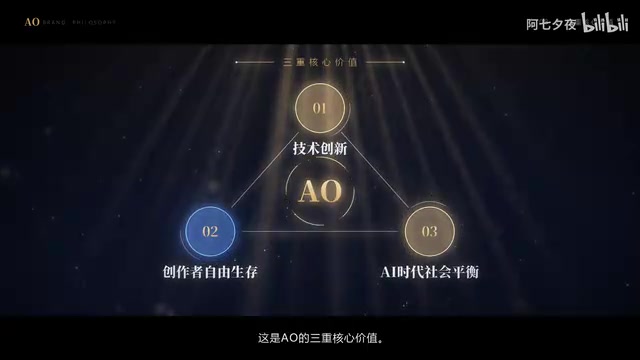
The film distills its philosophy into three core values: technological innovation, creator freedom, and what it calls "social balance in the A2 era." In concrete terms, this translates to three principles: empowering humanity through technology, channeling resources back to people's livelihoods, and healing the era through creation.
The underlying logic running through all of this is simple: technology should serve humanity, not replace it. This is a direct response to the widespread anxiety about AI and job displacement. At a time when most AI discourse fixates on "who AI will replace," this film deliberately plants its flag on the question of "how AI can empower people" — a notably constructive posture.
The film closes on a pragmatic note: "Sincerity and reliability build lasting relationships; professionalism and execution create mutual success" — before returning to its central theme: "The future is here — let's go create it." Overall, this is a genuine attempt to weave AI capability together with humanistic creative values.
The "A2 era" mentioned in the film is a non-standard, non-industry term — likely a coinage by the creator, modeled on the Web2/Web3 naming convention, to describe the current phase in which AI (Artificial Intelligence) is deeply integrated into production and social operations. Self-coined terms like this are common in brand communication, where their primary function is to establish a narrative framework and reinforce identity rather than precisely describe a stage of technological development. Worth noting is the phrase "social balance" — it contains an implicit warning about the unequal distribution of AI's gains. When generative AI dramatically compresses the cost of content production, will the benefits flow primarily to top platforms and capital? Can ordinary creators find sustainable footing in this new ecosystem? These are the structural questions this value statement is really trying to address.
A Brief Observation
Setting aside the promotional nature of the film, this case demonstrates something real: AI generative tools are now capable of supporting individuals in producing brand-level content on their own. But what the film truly wants to emphasize is precisely the opposite of the tool's power — it's the creator's philosophy, conviction, and inner drive that ultimately determine a work's value.
In a landscape flooded with AI-generated, homogenized content, the line "reject assembly-line mediocrity" may be more worth remembering than any benchmark or technical specification. Tools will keep getting easier to access. What remains genuinely scarce is the kind of focus willing to go one kilometer deep.
Related articles

@ai-sdk/vue 3.0.306 Patch Release Syncs with [email protected] Update
@ai-sdk/vue 3.0.306 released, synced with [email protected]. A routine patch release for the Vercel AI SDK ecosystem with no public API changes; the Vue adapter layer stays version-aligned with the core package.

Gemini 4 Argon API Launches: The Era of Million-Token Output Begins
Google launches Gemini 4 Argon with sparse MoE architecture, up to 1M output tokens, and a 68.90% Vals Index score, available across API, AI Studio, and the Gemini app.

DukaanAI: Turning Product Photos into Inventory Lists with Open-Source AI
DukaanAI is an AI inventory tool for small retailers that turns product photos into inventory entries using the open-source Gemma 3 model, with local inference, editable fields, and CSV export.