V7 Cuts Costs 78% with GPT-5.6 Luna: Tool-Call Error Rate Down to Just 0.2%

V7 integrated GPT-5.6 Luna to cut tool-call errors to 0.2% and costs by 78%, with platform architecture as the key.
V7 (v7go) published enterprise AI benchmark data: after integrating GPT-5.6 Luna, its platform's tool-call error rate fell from 2.7% to 0.2%, hallucination rate dropped 38%, and costs were cut 78%. The article argues the model is only half the equation—the other half is platform architecture: a context graph organizing entities and relationships by ontology, paired with grounding and memory systems, supports long-horizon workflows. Document understanding and research speed went from minutes to seconds.
V7 Cuts Costs 78% with GPT-5.6 Luna: Tool-Call Error Rate Down to Just 0.2%
Enterprise AI adoption has long been stuck on the same contradiction: models keep getting more capable, yet handing over complex business processes end-to-end remains difficult. A set of benchmark data recently published by the V7 (v7go) team offers a sample worth unpacking—after integrating GPT-5.6 Luna, its platform's tool-call error rate dropped from 2.7% to 0.2%, hallucination rate fell 38%, and costs were cut by 78%.
The significance of these numbers isn't that some model has topped the leaderboard again, but that they reveal a repeatedly validated yet often overlooked conclusion: the model is only half the equation, and the other half is the platform architecture that carries it.
From "Can't Understand the Process" to "Digesting 100 Pages of Instructions"
The V7 team reviewed the model's evolution over several months. Early models facing complex processes like insurance underwriting or financial transaction screening could barely grasp the full picture of business logic, let alone build workflows autonomously. The latest GPT series models can now digest hundreds of pages of operating instructions and use them to construct end-to-end problem-solving flows.
This leap in capability is what V7 calls "long horizon workflows." Two things underpin it: first, a grounding mechanism that lets every fact in a workflow anchor back to its original source; second, a memory system that continuously retains various types of enterprise background information. Only with both in place can the model avoid drifting off course on long-chain tasks.
Long horizon workflows refer to complex tasks that require a model to complete across extended time spans, spanning multiple steps and tool calls. Unlike single-turn Q&A or simple function calling, the challenge with such workflows is that the model must maintain contextual consistency across dozens or even hundreds of decision points, where any misstep can be amplified by subsequent steps. Grounding and memory systems are two key means of meeting this challenge—grounding lets every intermediate conclusion trace back to the original data source, reducing the risk of "one wrong step leading to all wrong"; the memory system preserves enterprise background, historical interactions, and domain constraints across the long chain, preventing the model from "forgetting" rules set early on. Together they form the infrastructure for reliable execution of long-horizon tasks.
Tool-Call Error Rate Drops from 2.7% to 0.2%
V7 runs its own context graph benchmark against every new model. On GPT-5.6 Luna, the most notable change was the tool-call error rate: down from 2.7% to 0.2%, nearly an order of magnitude reduction.
Tool-call errors are a highly damaging class of problem in enterprise workflows—the model picks the wrong tool or passes the wrong parameters, and the entire process breaks down or produces incorrect results. Pushing the error rate down to 0.2% means that in most business processes, this kind of failure is no longer the main contradiction requiring dedicated fault-tolerance design.
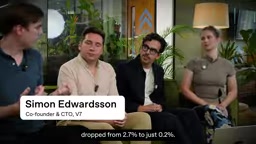
V7's take is direct: model capability is only half of success, and the other half is the platform the model runs on. Its context graph organizes entities, facts, and relationships according to an ontology matched to customer data, giving the model a structured reasoning foundation rather than leaving it to fumble blindly through flat text chunks.
A context graph is a knowledge representation that organizes enterprise data into a network of entities, facts, and relationships—think of it as an ontology-driven knowledge base tailored to a specific business domain. Unlike flat RAG, which chunks documents and performs vector retrieval, a context graph explicitly models "who relates to whom" and "which entity a fact belongs to," enabling the model to retrieve and verify along structured paths during reasoning rather than guessing between text chunks based on semantic similarity. V7's context graph organizes information according to an ontology matched to customer data, meaning the model receives not scattered passages but a structured reasoning substrate with types and relationships—this is the architectural precondition behind the simultaneous improvement in tool-call and hallucination metrics.
Hallucination Rate Down 38%: Sidestepping RAG's Old Problems
Traditional RAG architectures have a much-criticized chronic flaw: when facing unanswerable queries, older models tend to "guess" an answer rather than admit they don't know. V7 notes that after integrating GPT Luna and the context graph, the hallucination rate dropped 38%.

This improvement comes from two sides. The model itself is more accurate at judging its "knowledge boundaries"; and the context graph gates data at the ingestion stage—past model ingestion errors, especially misjudgments about "whether a fact is worth remembering," have been markedly reduced under the new architecture. The memory system remembers what should be remembered, the graph filters out what shouldn't enter, and the soil in which hallucinations grow is thus compressed.
RAG (Retrieval-Augmented Generation) provides grounding for models by retrieving external documents before generation and has been the mainstream enterprise AI architecture of the past few years. Its typical flaws: retrieval results are flat text snippets lacking explicit expression of relationships between entities; and when no relevant content is retrieved, older models often fail to admit "I don't know," instead fabricating answers from parametric memory. Furthermore, RAG's effectiveness depends heavily on data ingestion quality—if ingestion misjudges "which facts are worth remembering," subsequent retrieval and generation are both polluted. The context graph imposes structural constraints at both the ingestion and retrieval ends, thereby compressing the space for hallucinations to arise—this is the technical meaning of "sidestepping RAG's old problems" in the article.
From Minutes to Seconds: Document Understanding and Response Speed Improve Together
Beyond accuracy, efficiency metrics have also changed. V7 mentions that researching information on a company used to take several minutes before producing output for the user; now the process is shortened to seconds, without re-ingesting all data from scratch.

Visual document understanding has also improved notably, and this gain carries through to the workflow level. On output quality, investment research memos generated by older models were "passable but lacking depth and accuracy"; the new model shows substantive improvement on both dimensions.
Where the Real Barrier to Enterprise AI Adoption Lies
V7's data points to a broader judgment: the GPT-5.6 suite makes some application scenarios that were impractical or even impossible a year ago now solvable. But for traditional enterprises known for "slow transformation," simply integrating a stronger model is far from enough—a workflow engine and memory system must work in tandem to translate model capability into deliverable business results.
At the end of the video, V7 mentions it is working with OpenAI to advance this direction. For technical decision-makers evaluating enterprise-grade AI solutions, this benchmark data offers a reference observation dimension: don't just look at model scores—look at what level tool-call error rate and hallucination rate have been pushed to on your own business graph.
Related articles

Meta vs. Publishers: The AI Data Battle Over Terms of Service Changes and the Future of the Internet
Meta changed its business account terms to allow AI training on linked website data, sparking backlash from publishers and creators. Industry groups demanded negotiations, forcing Meta to remove 'training' wording and delay the effective date. The dispute reveals the deeper battle over data authorization and the future of the internet in the AI era.

When Outside Xbox Meets Blood on the Clocktower: A Legion Match in Minecraft
Outside Xbox guests Ellen and Mike play Minecraft Blood on the Clocktower in a Legion game. How can three good players fight an evil majority amid information noise? This article breaks down Legion mechanics, information-role mind games, and the endgame reversal.

Kimi K3.1 Hands-On Test: Open-Source Model Nears Opus, Video Generation Steals the Show
Kimi K3.1 completed motion graphics, 3D rendering, mini-games, and video generation in a live test. Analysis of its 2.8T MoE architecture, gap vs Opus/GPT, and hidden video generation.