Val Town Announces Shutdown: The End of a Developer Tool Platform and Its Lessons
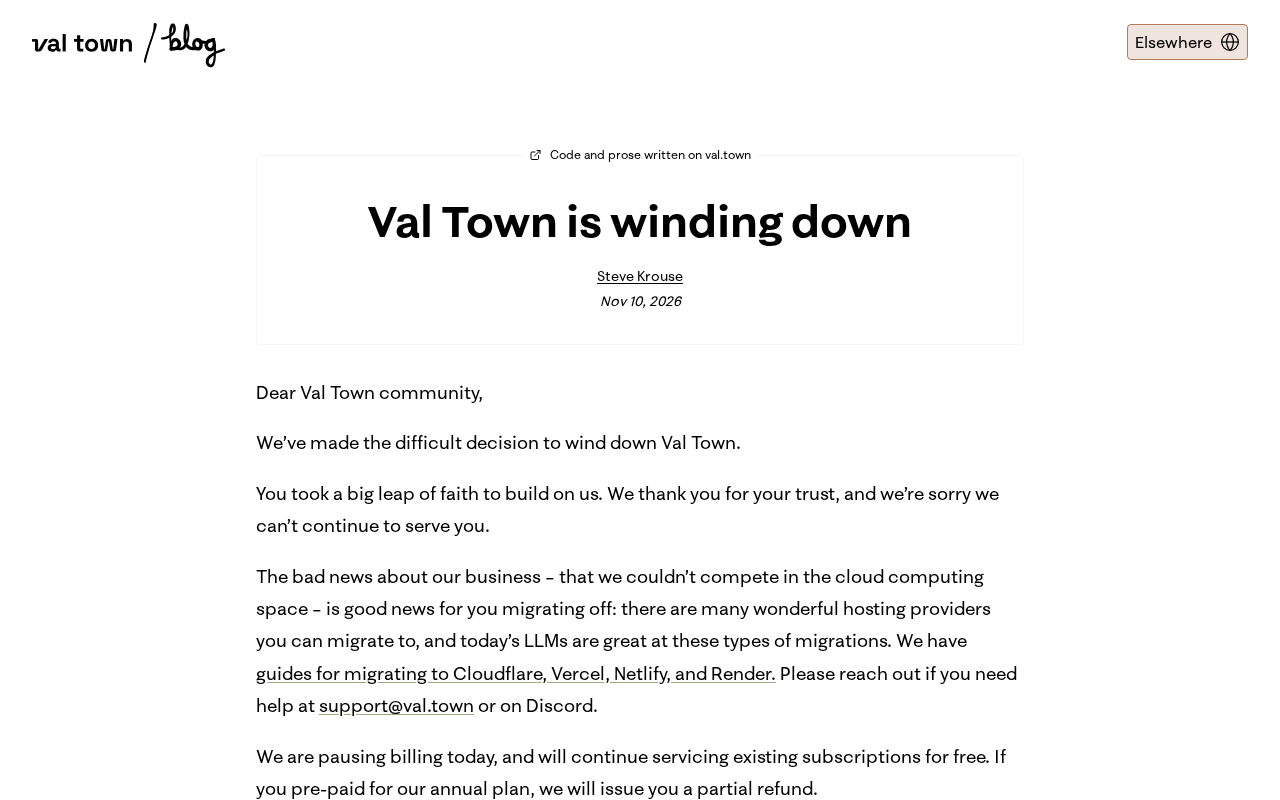
Val Town announces gradual shutdown, prompting developers to reflect on tool sustainability and single-point dependency.
Val Town's official blog announced it will gradually cease operations, drawing 290 points and 75 comments on Hacker News and sparking widespread discussion. The article notes that Val Town positioned itself as an online platform for running and sharing lightweight scripts, lowering deployment barriers, but such developer tools commonly face structural contradictions: difficulty balancing free and paid tiers, low willingness to pay, and persistent operational costs. Community reactions mixed regret with rationality—some praised its value in filling the gap between local scripts and full cloud services, while others stressed the dependency risk of third-party hosting. The event ultimately points to two lessons: developers should avoid single-point dependency and ensure code and data are exportable, while tool developers need to think earlier about business model sustainability.
A Developer Tool Says Goodbye
Val Town, a platform that once offered developers online code execution and sharing services, recently published an announcement on its official blog declaring that it will gradually cease operations. The news quickly sparked discussion on Hacker News, garnering 290 points and 75 comments, a testament to its prominence within the developer community.
For many developers accustomed to hosting small scripts and automation tasks in the cloud, Val Town's shutdown is more than the disappearance of a service—it reflects the broader commercial sustainability challenges facing the developer tools sector.
Val Town's core form was a "cloud script hosting platform": users could write TypeScript/JavaScript functions directly in the browser without configuring servers or handling deployment pipelines, and the platform would handle execution, scheduled triggers, and public sharing. This type of service sat between local scripts and full cloud services (such as AWS Lambda), emphasizing an extremely low barrier to entry and a "code-as-link" sharing experience. Its shutdown drew attention because it represented a lightweight development paradigm—moving one-off scripts, webhook handling, and small automation tasks from local environments to a collaborative cloud—and this niche market holds unique appeal for independent developers and small teams.
Behind the Shutdown: The Survival Challenge of Developer Tools
Val Town's positioning was to "make code as easy to share and run as a document," lowering the barrier to writing and deploying lightweight scripts. However, such tools often face a structural contradiction: their user base is highly concentrated in a niche developer market, where willingness to pay and usage frequency struggle to generate stable revenue.
Judging from the Hacker News comments, many users expressed appreciation for the product philosophy, but others pointed out that similar services find it extremely difficult to strike a balance between free and paid tiers. Developers are accustomed to using basic features for free, while platforms must continuously invest in servers and maintenance costs—once growth falls short of expectations, shutdown becomes the reluctant choice.
The "free tier versus paid tier balance" is a common business model challenge for SaaS and developer tools, often called the freemium paradox. The free tier is used for customer acquisition and word-of-mouth, but the developer demographic generally has strong self-hosting capabilities and price sensitivity, making it easy for them to remain within free limits long-term; meanwhile, platform-side costs (compute resources, storage, operations manpower) rise linearly or even super-linearly with user growth. If the paid conversion rate is insufficient to cover marginal costs, the platform struggles to achieve positive cash flow. Additionally, developer tools exhibit a characteristic of "high usage frequency but low willingness to pay"—users may use them daily yet believe basic features should be free, making pricing strategy and feature tiering design critical variables that determine survival.
Community Reaction: A Mix of Regret and Rationality
In the discussion threads, sentiments were polarized. Some users fondly recalled the convenience Val Town provided, believing it filled a gap "between local scripts and full cloud services"; others coolly noted that the closure of such platforms is not an isolated case, and that developers should remain vigilant about relying on third-party hosting services.
This divergence reflects a reality: the value of developer tools lies not only in technical implementation but also in long-term trust. When a platform announces shutdown, issues such as user migration costs, data export options, and alternative tool selection erupt all at once—problems that are often overlooked in the early stages of platform design.
Lessons for Developers: Avoid Single-Point Dependency
Val Town's shutdown served as a risk education lesson for developers. No matter how elegant a platform is, binding core workflows to a single third-party service always carries hidden risks. For lightweight script hosting, consider self-hosted solutions, open-source alternatives, or at minimum ensure that code and data can be exported at any time.
At the same time, this event reminds tool developers: when building products, they need to think earlier about business model sustainability and how to build deeper stickiness with users. The goodwill and support of the technical community is important but cannot replace a healthy revenue structure.
The "single-point dependency" risk in software engineering typically corresponds to two concepts: vendor lock-in and single point of failure. The former refers to business logic, data formats, or runtime environments being deeply coupled with a specific platform, requiring costly rewrites when migrating; the latter refers to a critical path having only one route, so that if that route fails, the entire workflow is interrupted. For script hosting services, concrete ways to reduce risk include: keeping core logic as portable standard code, regularly exporting data and configurations, using open-source runtimes (such as self-hosted alternatives to Deno Deploy) as backups, and architecting abstraction layers to isolate specific platform interfaces so that switching can happen quickly when services change.
Conclusion
Val Town's curtain call marks the end of a platform, but it is the starting point for the developer community to reflect on the tool ecosystem. In the rapidly iterating wave of technology, how to balance innovation, convenience, and sustainability remains a challenge that all developer tools must face.
Related articles

Gemini 4 Hydrogen Released: A 2.5x Faster Everyday AI Model
Google releases Gemini 4 Hydrogen, claiming 2.5x the speed of Gemini 3.8 Flash, with four-tier thinking control, a million-token context, and Orchestrator multi-model collaboration. API pricing is $1.50 per million input tokens.

Gemini 4 Hydrogen Hands-On: Google's Fastest and Cheapest AI Model
Hands-on with Gemini 4 Hydrogen: the fastest, cheapest model in the Gemini 4 family. We break down the Carbon/Argon/Hydrogen split, API pricing traps, free-tier limits, and the cost trade-offs of four thinking levels—with a real bug-debugging demo.
Gemini 4 Hydrogen vs Sonnet Comparison Test: Uses Only 1% of Weekly Quota, Performance on Par
Hands-on test: Gemini 4 Hydrogen vs Sonnet on the same CRUD task—Hydrogen used only 1% weekly quota with comparable performance and better UI details, while Anthropic's model used 7%. Developer says daily tasks don't require expensive models.