Vantage.ai: Cost Monitoring and Guardrails for Your Coding Agent

Vantage.ai brings cost monitoring, guardrails, and session logs to AI coding agents as open-source infrastructure.
As agent-based coding tools like Cursor and Claude Code grow more autonomous, development teams face a black-box problem: token costs accumulate silently, actions go unrecorded, and behavioral boundaries are impossible to enforce. Open-source tool Vantage.ai targets this gap with three core capabilities: real-time tracking of model call costs and usage, guardrails to constrain out-of-scope agent behavior, and session logs to capture complete decision trails. It essentially transplants mature observability principles — logs, metrics, traces — into agent workflows, addressing the cost, security, and compliance concerns most critical to enterprise AI adoption. Free and open-source, it lowers the barrier to entry, though it remains in early stages and awaits broader community validation.
The Problem of Runaway Coding Agents
As AI coding assistants evolve from code completion to autonomous task execution, a new pain point has emerged for developers: it's hard to know what your coding agent is actually doing, how many resources it's consuming, or whether it's overstepping and performing operations it shouldn't. The open-source tool Vantage.ai, which debuted on Product Hunt, targets exactly this gap. With the tagline "See and control what your coding agent does," it earned 71 upvotes and ranked 16th in the Software Engineering and Developer Tools categories.
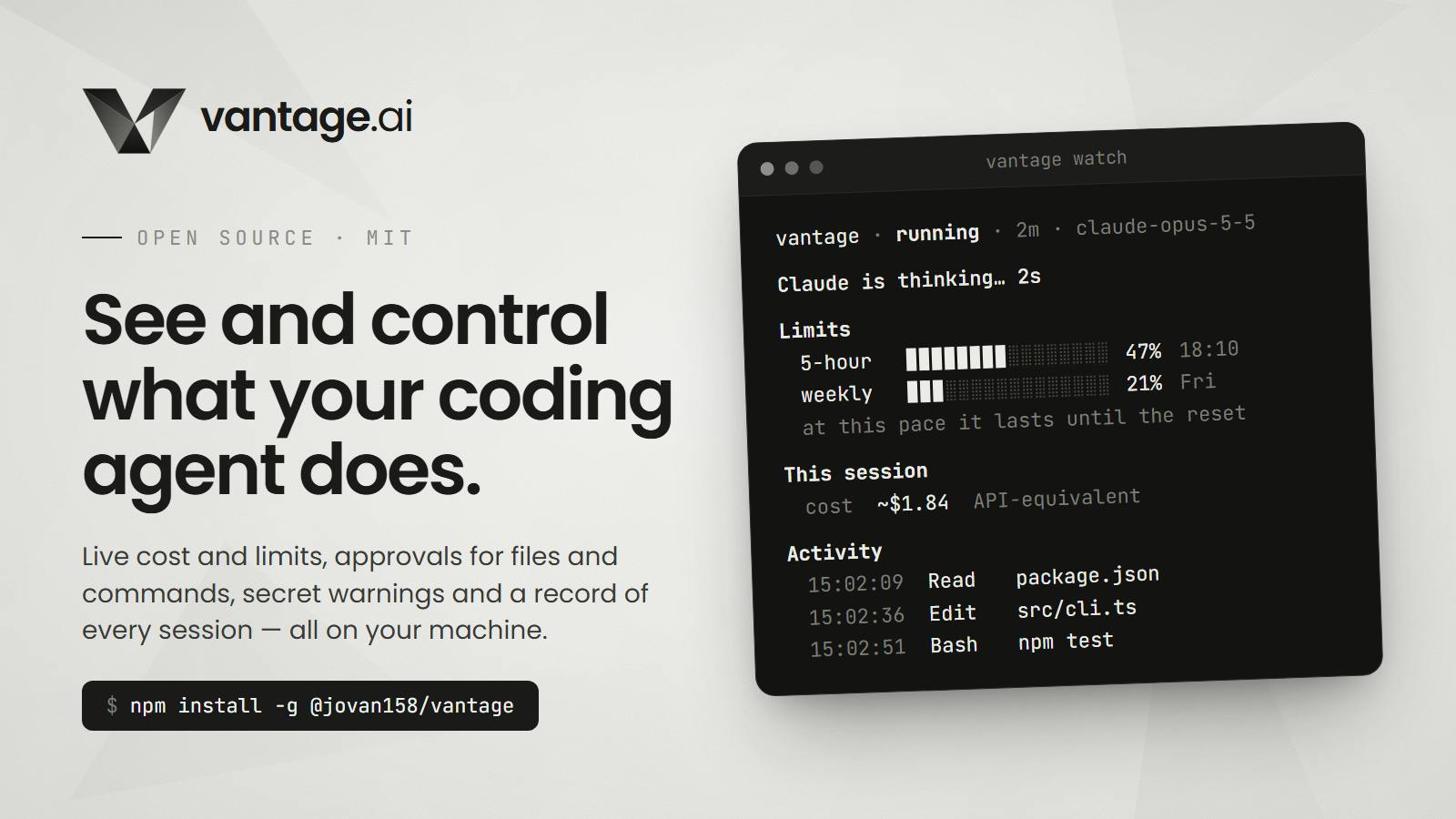
For teams increasingly reliant on agent-based coding tools like Cursor and Claude Code, the value of a monitoring layer like this is easy to understand. When an agent can autonomously read and write files, call APIs, and fire off multiple rounds of model requests, token consumption and costs can silently pile up — and every action the agent takes goes unrecorded. Vantage aims to crack open these black boxes.
What Vantage Offers
According to its official description, Vantage is a free, open-source tool with three core capabilities:
Cost & Usage Monitoring
Vantage tracks the resource consumption of your coding agent. For model services that charge per token or per request, having real-time visibility into usage means you can catch anomalies early — like a task getting stuck in a loop and repeatedly calling the model, or a session unexpectedly triggering a surge of requests. A transparent cost view is the foundation for teams looking to manage their AI development budgets.
Guardrails
Guardrails are what set Vantage apart from purely passive monitoring tools. Rather than just recording what happens, Vantage can actively constrain agent behavior. This typically means setting boundaries on what the agent is allowed to do, preventing it from taking actions outside its intended scope. For scenarios where agents are connected to real codebases or even production environments, guardrails provide a necessary safety net.
In the AI systems world, "guardrails" is an increasingly standardized concept referring to constraint layers applied to a model's or agent's outputs and behaviors. They can operate at different levels of granularity: from simple rule-based filtering (blocking access to specific directories or external domains) to dynamic, semantics-based interception (detecting whether an agent is attempting to run a dangerous shell command). In the LLM application stack, frameworks like Guardrails AI and NeMo Guardrails have already designed guardrail mechanisms for text output. Guardrails for coding agents, however, focus more on the tool-calling layer — agents typically interact with the outside world through function calling or tool use, and guardrails can intercept at this layer to review and selectively block sensitive operations. For agents with permissions to read and write production codebases or execute terminal commands, this layer of protection is no less important than a code review.
Session Logs
Vantage records the agent's session history, creating an auditable log. When an agent produces unexpected results, or when a team needs to review an automated task after the fact, complete session records help developers understand the agent's decision-making path — rather than seeing only the final code changes.
Why Tools Like This Are Becoming Essential
"Vibe coding" — an approach where AI leads the coding and developers guide it through natural language — is explicitly listed by Vantage as one of its target use cases. This development paradigm is highly efficient, but it also introduces new observability gaps. Traditional logging and monitoring tools are designed for human-written code; they don't inherently understand an agent's multi-step reasoning, tool calls, or cost structure.
What Vantage is fundamentally doing is transplanting mature observability principles into agent workflows. The three things it focuses on — how much was spent, whether behavior stayed within bounds, and whether the process is traceable — map directly onto the cost, security, and compliance concerns that matter most to enterprises adopting AI agents. As more teams incorporate coding agents into their daily workflows, tools like this could easily shift from "nice to have" to "core infrastructure."
Its open-source, free positioning also lowers the barrier to entry. Developers can plug it into their own agent environments to evaluate it firsthand, without having to commit to a commercial tool purchase upfront — a clear advantage for early adoption.
Observability originates from control theory and has been widely adopted in software engineering, typically built on three pillars: Logs, Metrics, and Traces. In traditional microservice architectures, these three data types collectively help engineers understand a system's internal state. Migrating this framework to AI agent workflows presents new challenges: the agent's "execution unit" is no longer a function call stack, but a multi-step reasoning chain driven by an LLM; and the inputs and outputs at each step are natural language or semi-structured content, not deterministic numerical metrics. This means traditional APM (Application Performance Monitoring) tools can't be applied directly. The industry has already seen the emergence of observability platforms specifically designed for LLM applications — LangSmith, Langfuse, Arize Phoenix, and others. Vantage takes this thinking a step further, narrowing its focus to the specific context of coding agents: cost, behavioral boundaries, and session traceability — a tighter fit with developers' real pain points.
Current Observations and Limitations
To be objective: based on currently available information, Vantage is still in its early stages. With only 1 comment and 71 upvotes on Product Hunt, it hasn't yet gone through large-scale community validation. Technical details — such as the specific agent types it supports, how integrations work, and the granularity of its guardrail rules — all need to be confirmed through actual use.
That said, the problem direction Vantage is addressing is real and promising. As coding agents become increasingly autonomous, the ability to "see what's happening, keep it under control, and trace it back" will become a prerequisite for teams to trust and comfortably deploy them. For teams actively exploring agent-based development, open-source monitoring and guardrail tools like Vantage are well worth adding to your watchlist.
Related articles

CSS Anchor Positioning: A New UI Positioning Approach Without JavaScript
A deep dive into CSS Anchor Positioning: from anchor-name and position-anchor to the anchor() function, position-area shorthand, position-try-fallbacks, anchor-size, and upcoming anchor queries.

New AI Chart Interaction: Continuous Follow-up Questions and Visualization in Conversation
Explore a new AI interaction method for continuously generating charts in conversation. Use the /visualize command to ask follow-up questions and visualize answers in the same chat window, improving data analysis efficiency.

Cursor Merges Into X Subscription: Paid Plans Share Unified Usage Pool, Grok Model Coding Usage Doubled
Cursor joins The X Subscription with a unified usage pool and doubled Grok coding quota. Third-party models shift to API pricing. Existing users can keep or migrate plans.