Velozity: An All-in-One Workspace for Teams and AI Agents to Work Together

Velozity unifies team collaboration and AI agents in one shared-context workspace, topping Product Hunt's daily chart.
Velozity is a collaboration tool that topped Product Hunt's daily chart by integrating team chat, audio/video meetings, task management, and leading AI agents like Claude and Codex into a single workspace. Its key differentiator is a shared context mechanism — all AI agents operate with the same working background, eliminating the "context tax" of repeatedly re-explaining information across tools. It's free to start and lets users reuse existing AI subscriptions, with "no second AI bill" as its core pitch. Velozity's rise reflects a broader industry shift from single-point AI tools toward collaborative orchestration layers, though its stability and real-world performance in complex scenarios still await long-term validation.
One Workspace to Solve AI Tool Fragmentation
Modern teams are caught in an awkward trap: one app for chat, another tool for meetings, and every AI operating in its own silo. Team members constantly context-switch between platforms, and worse — every time they bring in a new AI assistant, they have to re-explain the entire background from scratch. This fragmentation doesn't just slow teams down; it quietly devours productivity.
Velozity, a new product that hit #1 on Product Hunt's daily chart, targets exactly this pain point. Its core proposition is straightforward: bring team collaboration and AI agents into the same workspace, so work can flow between people and AI without redundant communication. With 250 upvotes, 47 comments, and a #1 ranking, it's clearly struck a chord with many teams' real needs.
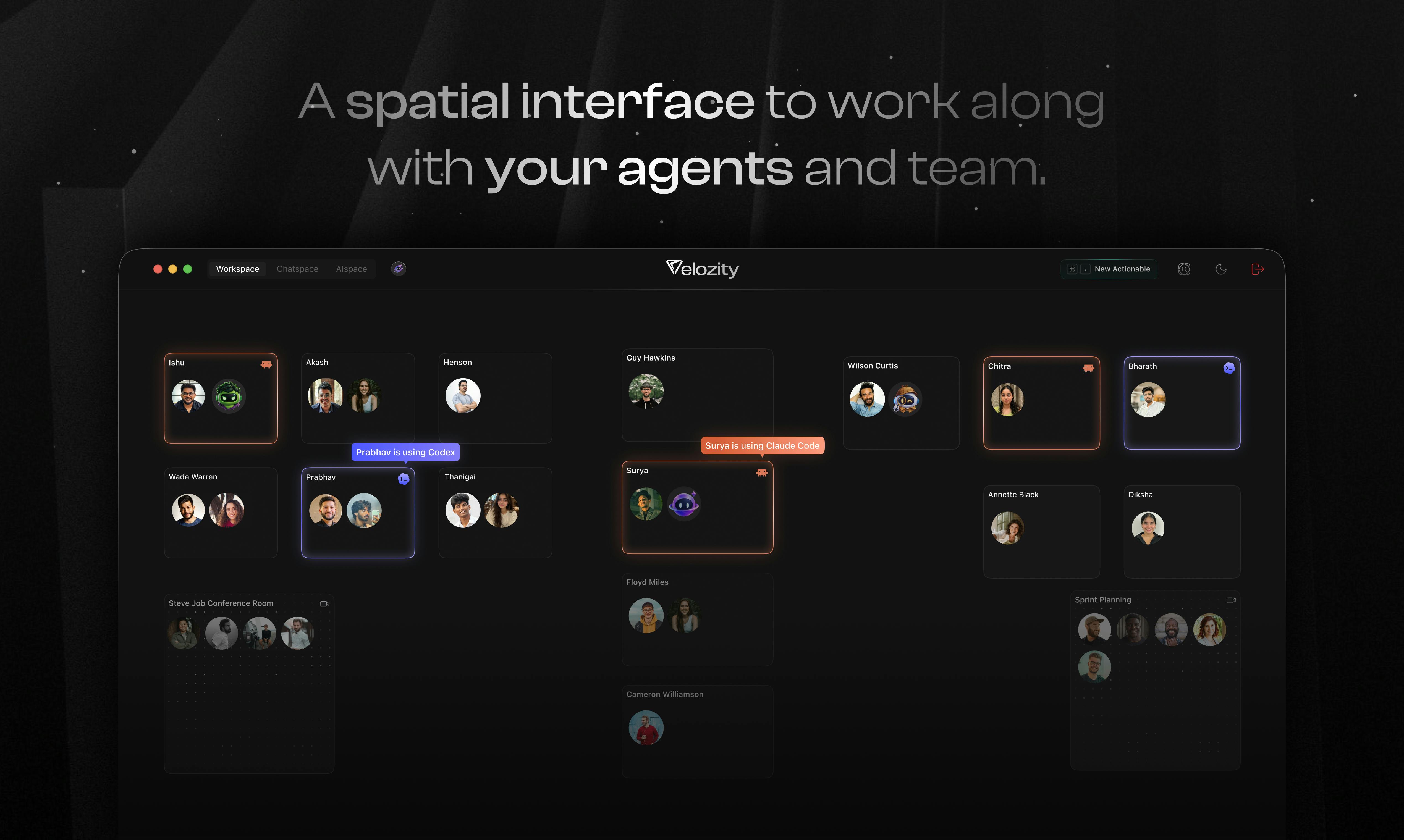
Packing Chat, Meetings, Tasks, and AI Into One Box
Velozity covers a wide range of functionality. It integrates text chat, audio/video calls with transcription, task management, a calendar, and file management — features that teams use daily but typically scatter across multiple tools.
The real differentiation lies in the AI layer. Velozity supports connecting to leading AI agents like Claude and Codex, and uses your existing paid subscriptions rather than billing you for a separate AI plan. This is a compelling proposition at a time when AI subscription costs keep climbing. For users juggling multiple AI subscriptions and constantly switching between them, a unified entry point is itself a form of value.
Shared Context: The Core Competitive Edge
One concept repeatedly emphasized in the product description is "shared context." In Velozity, every AI agent shares the same working context. This means that as work moves between team members and AI, there's no need to repeatedly paste background information or re-explain requirements the way you would with standalone AI tools.
This points to a deeper shift in collaboration paradigms: AI is no longer an isolated Q&A window, but a participant embedded in the team's workflow with continuous awareness of the full project picture. For development, product, sales, and operations teams — where work requires heavy contextual continuity — this design could theoretically reduce communication overhead significantly.
From a technical standpoint, "shared context" is essentially a persistent information state layer that's visible to all participants (both human team members and AI agents). Traditional AI chat windows (like using ChatGPT or Claude independently) operate in a "stateless session" mode — every new conversation starts from zero, with the AI knowing nothing about your project, team terminology, or past decisions. Users must manually paste background material on every invocation, a cost the industry has started calling the "context tax."
Workspace-level shared context attempts to build a "stateful environment" instead: AI can perceive channel history, task status, file contents, and team structure. This aligns closely with the rising trends of RAG (Retrieval-Augmented Generation) and long-context window technology — the former lets AI retrieve relevant information from within the workspace, while the latter lets models process more background material in a single call. In team collaboration scenarios, the value of shared context goes beyond eliminating repetitive copy-pasting; it also reduces AI output inconsistencies caused by information asymmetry.
Target Users and Pricing Strategy
Velozity targets a few key groups: early-stage startups in development mode, functional teams in engineering, product, sales, and operations, and individual users who constantly juggle multiple AI tools.
On pricing, it takes a "Free to start" approach and leads with the tagline "No second AI bill." It's a smart entry point — rather than competing with your existing AI subscriptions, it positions itself as a unified orchestration layer on top of them, lowering the barrier to try and reducing psychological friction.
What Trends Does This Reflect?
Velozity's rise to the top isn't coincidental. It reflects several clear directions in the AI collaboration tools space.
From point AI solutions to collaborative orchestration. Over the past year, many products focused on improving individual AI capabilities. Velozity represents the rise of the "orchestration layer" — how to get multiple AIs and multiple people to collaborate efficiently in the same environment is becoming the new competitive battleground.
Context as the new moat. As AI model capabilities converge, whoever can better maintain and share context will deliver a smoother experience. Velozity places shared context front and center as its core differentiator, landing squarely on this trend.
The business wisdom of subscription reuse. The strategy of "use what you've already paid for" sidesteps direct competition with foundation model providers while precisely addressing users' anxiety about stacking AI costs — a pragmatic product positioning.
That said, a clear-eyed view is also warranted: as a newly launched product, Velozity's real-world stability, depth of AI integration, and actual performance of shared context in complex scenarios all remain to be validated through extended use. The #1 ranking confirms that the need is real — but whether the product can deliver on its promises still requires time to prove.
Summary
Velozity represents a clear direction for the convergence of collaboration tools and AI: instead of forcing teams to juggle multiple apps and isolated AI tools, it threads everything together in one unified space with shared context. For teams and individuals frustrated by tool fragmentation and mounting AI subscription bills, it offers a new option worth watching. Built by Ishu Darshan and Akash Mandal, it's currently available to try for free.
Background: The Orchestration Layer Explained
The "Orchestration Layer" is one of the central concepts in today's AI application architecture landscape. It refers to a class of products or frameworks whose role is not to directly provide AI capabilities, but to coordinate and manage the interaction flow between multiple AI agents, tools, and data sources. Representative technical frameworks include LangChain, LlamaIndex, and Microsoft's AutoGen, while Velozity represents an attempt to bring this capability to life in a productized form accessible to everyday team users.
A key challenge in orchestration layer products is "task routing" — the system needs to determine which type of work should go to which AI (for example, routing code questions to Codex and copywriting tasks to Claude), while ensuring that outputs from different agents connect seamlessly. For users, this means being freed from the cognitive burden of "which AI should I use for this" and focusing instead on the task itself. Competition in this space is intensifying rapidly, with products like Notion AI, Linear, and Slack's AI features all exploring similar directions within their respective workflow contexts.
Related articles

Meta vs. Publishers: The AI Data Battle Over Terms of Service Changes and the Future of the Internet
Meta changed its business account terms to allow AI training on linked website data, sparking backlash from publishers and creators. Industry groups demanded negotiations, forcing Meta to remove 'training' wording and delay the effective date. The dispute reveals the deeper battle over data authorization and the future of the internet in the AI era.

When Outside Xbox Meets Blood on the Clocktower: A Legion Match in Minecraft
Outside Xbox guests Ellen and Mike play Minecraft Blood on the Clocktower in a Legion game. How can three good players fight an evil majority amid information noise? This article breaks down Legion mechanics, information-role mind games, and the endgame reversal.

Kimi K3.1 Hands-On Test: Open-Source Model Nears Opus, Video Generation Steals the Show
Kimi K3.1 completed motion graphics, 3D rendering, mini-games, and video generation in a live test. Analysis of its 2.8T MoE architecture, gap vs Opus/GPT, and hidden video generation.