Veltrix AI: A New Tool That Uses AI to Diagnose Profit Leaks in E-commerce Businesses

Veltrix AI helps small e-commerce businesses find hidden profit opportunities through a free AI-powered business health check.
Veltrix AI is an AI-driven decision analytics tool for e-commerce businesses that ranked second on Product Hunt on launch day with 156 upvotes. Its core value proposition is integrating sales, cost, customer, and marketing data to proactively identify profit blind spots and deliver actionable recommendations — going beyond data visualization. It offers a free, no-credit-card Business Health Check as a low-friction entry point. The article notes that the real competitive moat lies in data integration breadth and recommendation credibility, and cautions users to review data privacy terms before uploading core business data.
E-commerce operators often face a frustrating challenge: business data is scattered across sales, cost, customer, and marketing systems — yet it's nearly impossible to pinpoint exactly what's dragging down profits. Veltrix AI, which ranked second on Product Hunt on its launch day (156 upvotes, 31 comments), aims to solve this problem — using AI at its core to help e-commerce businesses uncover overlooked profit opportunities.
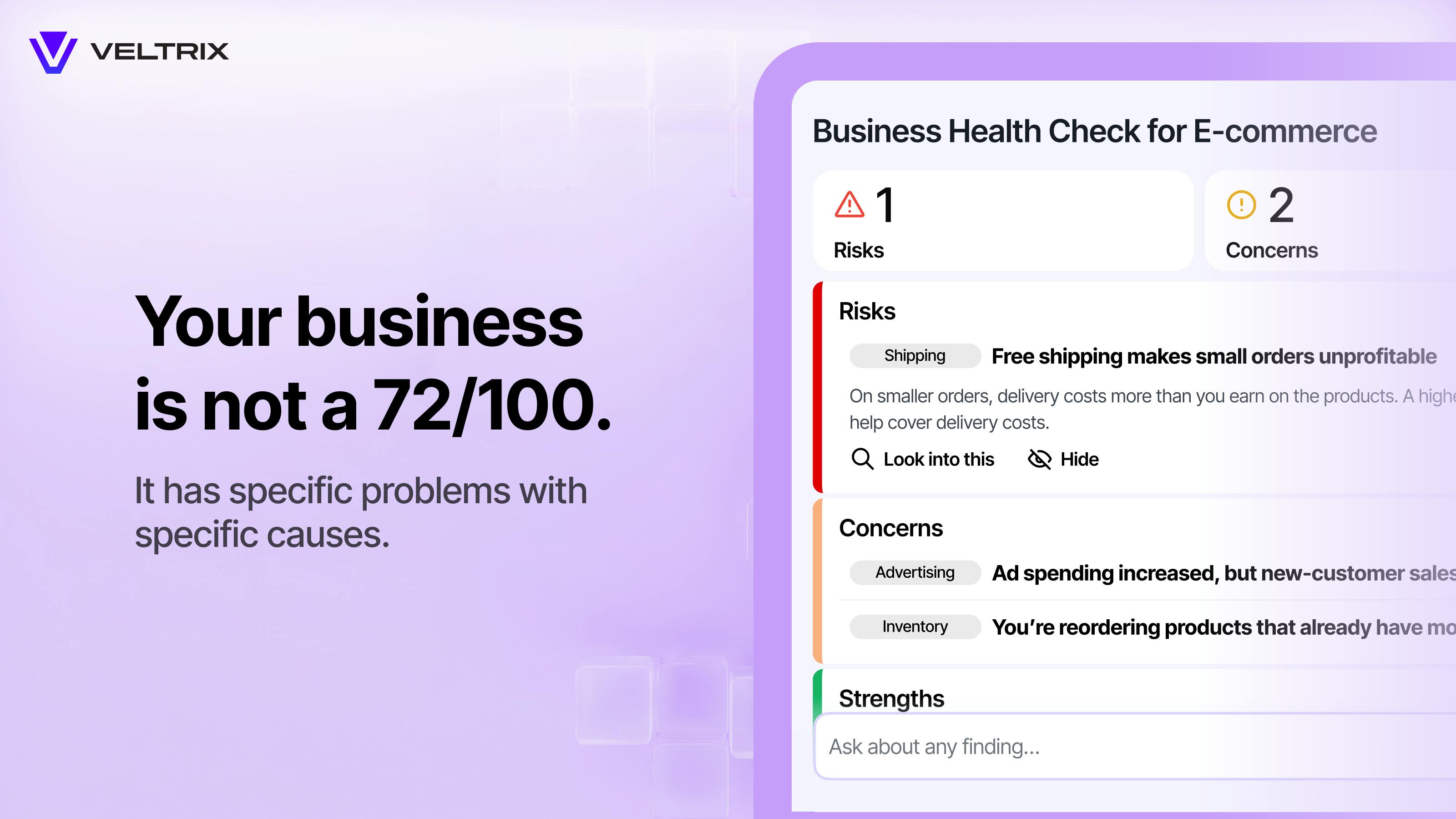
What Problem Does Veltrix Solve?
Veltrix has a clear positioning: help e-commerce businesses become more profitable. It uses AI to analyze a merchant's sales, cost, customer, and marketing data, then delivers actionable recommendations — which products to prioritize, where to cut costs, and what issues are holding back growth.
For small and mid-sized e-commerce teams, this kind of analysis typically relies on experienced operators or external consultants. Veltrix aims to productize that capability, replacing the tedious process of manually combing through reports with automated analysis. Based on its official description, it's not just a data dashboard — it emphasizes "helping you make decisions," which is the key distinction from traditional BI tools.
Core Features: From Health Check to Ongoing Optimization
Veltrix's user journey is designed to be straightforward. Merchants can either connect their existing business tools or upload files directly to give the system access to their data. From there, the product recommends starting with a Business Health Check — a step designed to surface improvement opportunities merchants may have never noticed.
After the initial diagnosis, users can continue using Veltrix to dive deeper into specific areas for optimization. This "check-up first, then treat" workflow lowers the barrier to entry for new users: you don't need to know what you want to analyze — the tool proactively flags potential problems.
One aspect worth noting is its go-to-market strategy: the first health check is free, with no credit card required. This low-friction trial experience is particularly appealing to e-commerce practitioners accustomed to being blocked by SaaS subscription paywalls — and it may be one reason the product earned such strong upvotes on Product Hunt.
The Competitive Logic of AI-Powered E-commerce Analytics
Veltrix is categorized under Artificial Intelligence, E-Commerce, and Business — a positioning that reflects the intersection it occupies. As large language model capabilities mature, more and more tools are packaging "data analysis + decision recommendations" into an AI assistant format.
The real moat for this category of product isn't the analysis itself — it comes down to two things: first, the breadth and accuracy of data integration (can it seamlessly connect to major e-commerce platforms, ad accounts, and financial systems?); and second, the credibility of its recommendations (are the AI's suggestions to "cut costs" or "prioritize promotion" grounded in actual business logic, or just generic advice?). The information Veltrix has made public so far isn't sufficient to judge its depth on either front — that requires hands-on testing.
Traditional BI tools like Tableau and Power BI are built around the logic of "presenting data" — they visualize data for users, leaving humans to interpret and make decisions. The differentiation of next-generation AI analytics tools lies in bridging the gap from "insight" to "action": rather than simply telling you "return rates rose 15%," the system outputs specific directives like "recommend delisting SKU-2031 — its return rate is 3x the category average and its gross margin is negative." This evolution from descriptive analytics to prescriptive analytics only became viable for SMB-level products after the emergence of large language models — previously, this kind of capability was confined to custom data teams at large enterprises. Veltrix operates in a space that also includes competitors like Glassfy and Intelligems, each focused on specific niches such as pricing optimization and A/B testing. No dominant player has emerged in the overall category yet.
Who Is It For, and Is It Worth Trying?
Based on the product's description, Veltrix is best suited for small to mid-sized e-commerce operators — those who have accumulated meaningful data but lack dedicated analytics capabilities, and have a clear need for profitability optimization. The free initial health check carries almost no cost to try, making it a low-risk way to validate whether the tool can surface blind spots in your business.
That said, users should review the specific data privacy and security terms before importing sales, cost, and customer data. Handing core operational data to a third-party AI tool requires a clear understanding of how that data is handled.
Overall, Veltrix represents a typical direction for AI deployment in vertical business contexts: rather than building a general-purpose assistant, it focuses on the specific problem of e-commerce profitability analysis. Whether it can truly deliver on the promise of "helping you make more money" ultimately depends on the depth of its analysis and the real-world impact of its recommendations — a test that every AI decision-making tool must ultimately face.
Data privacy is a compliance challenge that SaaS tools broadly face, and it's especially sensitive in e-commerce contexts. E-commerce operational data typically includes customer personal information (names, addresses, purchase histories), which is subject to GDPR in the EU, China's Personal Information Protection Law (PIPL), and various other regional regulations. When uploading such data to a third-party AI platform, users should confirm: whether data is used for model training, where it is stored and how it is encrypted, what data deletion rights are available, and whether the platform holds security certifications such as SOC 2. For established e-commerce businesses with significant monthly revenue, these terms are worth reviewing carefully before subscribing — rather than importing full operational data simply because a free trial is available.
Related articles
uGAP: An AI Platform Unifying 100+ African Geospatial Datasets
uGAP is an African geospatial AI platform by a University of Cape Town team, unifying 120+ African datasets with a Python SDK for discovery, processing, and model training, already used in cyclone flood mapping.

Cursor Can Now Control Your Computer: AI Agents Can Drive Desktop Apps for Testing
Cursor adds desktop control: AI agents can drive desktop apps like the iOS Simulator to test their own features. We analyze the impact on dev workflows, possible technical approaches, and reliability concerns.

Vibecoding a Custom Inference Engine: High Hopes, Harsh Reality
A Reddit developer shares the real experience of vibecoding a custom inference engine: running GGUF Q4 models in the browser with WebGL2 and GLSL, only to fall into tokenizer debugging hell. This article analyzes the engineering challenges of browser-side LLM inference and why cloning llama.cpp is the more rational choice.