Vercel Achieves ISO/IEC 42001:2023 Certification, Bringing AI Governance into Standardization

Vercel achieves ISO/IEC 42001 certification, setting an AI governance benchmark for developer platforms.
Vercel announced it has achieved ISO/IEC 42001:2023 certification, an international standard for AI management systems covering model risk, data bias, accountability, and supply chain transparency. The certification covers Vercel's governance structure, risk assessment, and responsibility framework, with certificates and audit documents disclosed via its Trust Center for enterprise customer validation. The article stresses that certification applies to the management system, not specific model security, so developers must still assess risks themselves. The move may push other PaaS and Serverless vendors to follow, making AI governance certification a platform competition entry requirement.
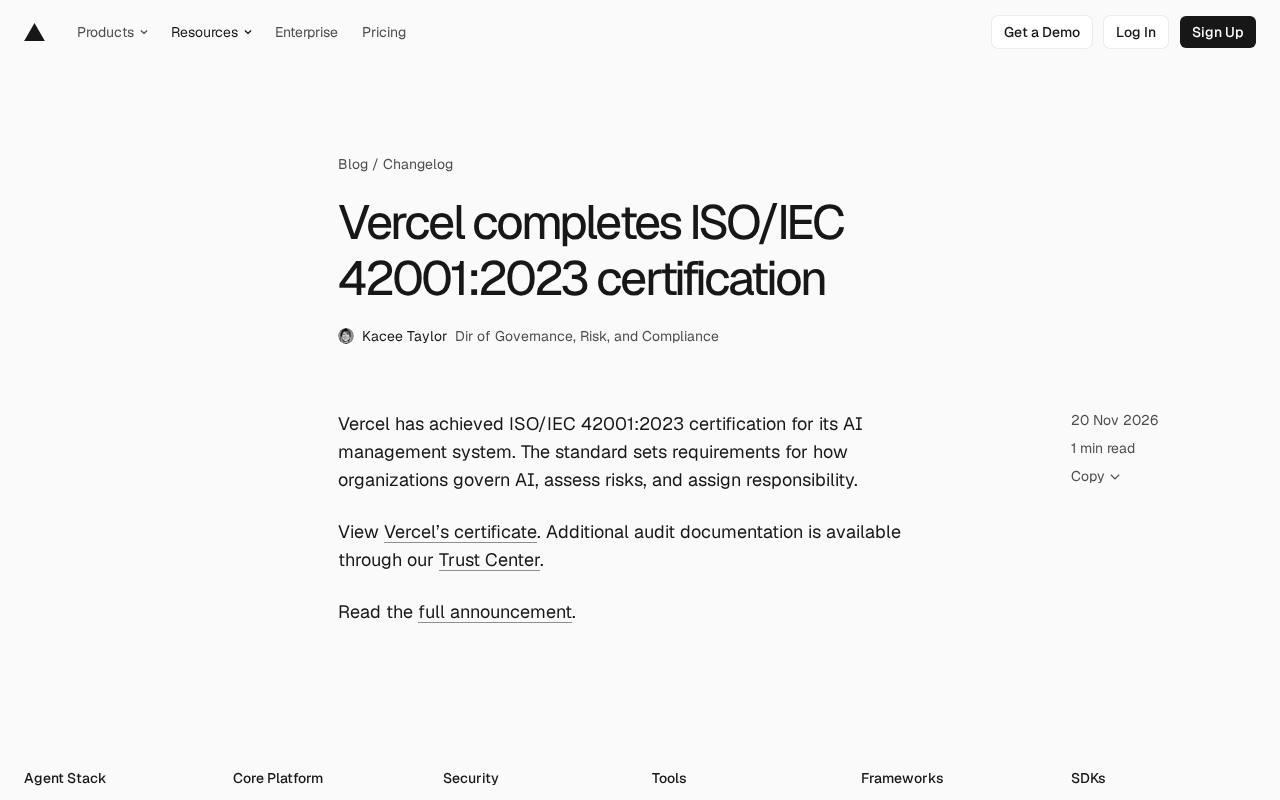
Vercel recently announced that it has achieved ISO/IEC 42001:2023 certification, a standard that sets clear requirements for AI management systems: how organizations govern AI, how they assess risk, and how they allocate responsibility. For a company whose core business is a developer platform, this certification is not only a compliance milestone but also signals its long-term commitment to the trustworthiness of its AI products.
What the Standard Behind the Certification Means
ISO/IEC 42001:2023 is a dedicated standard published by the International Organization for Standardization for AI management systems (AIMS). Unlike general information security management systems, it focuses on governance challenges specific to AI—model risk, data bias, accountability, and supply chain transparency. Organizations need to establish auditable processes that demonstrate controllability over the full lifecycle of AI systems.
In its announcement, Vercel emphasized that the certification covers the governance structure, risk assessment mechanisms, and responsibility allocation framework of its AI management system. This means that from internal R&D to externally offered AI features, Vercel must maintain traceable management records in accordance with the standard's requirements. For developers, this indirectly enhances the credibility of the platform's AI capabilities—when you deploy AI applications on Vercel, the underlying governance processes have already been reviewed by a third party.
Key differences between AIMS and ISO 27001: ISO/IEC 42001 is often compared with ISO/IEC 27001 (information security management systems), but the two have different focuses. ISO 27001 builds controls around the confidentiality, integrity, and availability of information, whereas ISO/IEC 42001 addresses risks specific to the full lifecycle of AI systems, such as the legitimacy of training data sources, model drift, output bias, the explainability of automated decisions, and potential impacts on individual rights. The standard adopts the same "High Level Structure" (HLS) as other ISO management system standards, making it easy for organizations to integrate it with existing quality and information security systems and to share risk registers, internal audits, and management review processes. Certification means the organization has established policies, roles and responsibilities, risk treatment plans, and continuous improvement mechanisms, and has completed a Stage 1 documentation review and a Stage 2 on-site audit by an accredited certification body.
Why Developer Platforms Need AI Governance Certification
Vercel's core users are frontend and full-stack developers, and its product line has been accelerating its integration of AI capabilities in recent years. From the AI SDK to model calls in edge functions, the AI workloads the platform carries are becoming increasingly complex. When enterprise customers evaluate whether to deploy critical business on Vercel, the maturity of AI governance is becoming an implicit indicator.
ISO/IEC 42001 certification provides a form of external validation: the platform doesn't just "claim" to value AI security—it has established an auditable management system in accordance with international standards. Vercel has also opened access to its certificates and audit documentation (Trust Center), and this transparency is itself part of the certification system. For development teams that need to demonstrate AI compliance to customers or regulators, choosing a certified platform can reduce their own compliance burden.
The significance of the Trust Center and third-party audits: The Trust Center is a portal where companies centrally disclose compliance credentials, security controls, and data processing practices, typically including certification certificates, audit reports (such as SOC 2 Type II), subprocessor lists, and vulnerability disclosure policies. For buyers, these materials are the starting point for vendor due diligence and can replace a large amount of back-and-forth questionnaires. It is worth noting that an ISO certificate only indicates that the management system meets the standard's requirements; it is not equivalent to a security endorsement of any specific feature. Audit reports, meanwhile, have clearly defined coverage periods and scope boundaries. When evaluating a platform, development teams should make comprehensive judgments based on the certificate's scope statement, any exceptions noted in the reports, and the types of data involved in their own business, rather than making decisions solely on the basis of a certification mark.
The Practical Impact and Limits of the Certification
It should be clear that ISO/IEC 42001 certification applies to the "management system," not to the security of specific models or products. It proves that Vercel has established governance processes that meet the standard, but it does not mean its AI features are risk-free. In actual use, developers still need to assess for themselves how model outputs, data privacy, and business scenarios fit together.
From an industry trend perspective, AI governance standardization is spreading from large model vendors to the infrastructure layer. As a representative of developer platforms, Vercel's early completion of certification may trigger a chain reaction—other PaaS and Serverless vendors may follow suit, and certification of AI management systems may gradually become an entry requirement for platform competition. For teams focused on deploying AI applications, this change is worth incorporating into their technology selection considerations.
Vercel did not disclose the specific audit scope and timeline of the certification in its announcement; more details can be found through its Trust Center and the full announcement.
One-line Summary
Vercel achieves ISO/IEC 42001 certification, setting an AI governance benchmark for developer platforms.
Paragraph Summary
Vercel announced that it has achieved ISO/IEC 42001:2023 certification, an international standard for AI management systems that focuses on governance challenges such as model risk, data bias, accountability, and supply chain transparency. The article notes that the certification covers Vercel's governance structure, risk assessment, and responsibility allocation framework, and that Vercel discloses certificates and audit documentation through its Trust Center, providing external validation for enterprise customers evaluating developer platforms. It also emphasizes that the certification applies to the management system rather than the security of specific models, so developers still need to assess risks themselves. The move may prompt other PaaS and Serverless vendors to follow suit, making AI governance certification an entry requirement for platform competition.
Related articles

Prompt Engineering for Beginners: From Writing Prompts to Engineering Thinking
Starting from the essence and four functions of prompts, this article systematically explains the six-step process, four success criteria, learning value, and practical limitations of prompt engineering to help you build a complete understanding.

Anthropic Launches Nasdaq IPO: AI Giant's Listing and Risk Disclosures
Anthropic officially launches its Nasdaq IPO under ticker ANT, with market valuation expected to potentially exceed SpaceX's record. The prospectus devotes nearly 100 pages to AI risks, while first-half revenue grew over 14x but net losses widened sharply, reigniting the AI bubble debate.

Rust cURL Clone Uses 4,832 unsafe Blocks—Is the Memory Safety Myth Broken?
A Rust cURL clone uses 4,832 unsafe keywords, challenging Rust's memory safety narrative. We analyze what unsafe really means, compare Fil-C, and examine rewrite motives.