Vercel Agent Integrates with Slack: Conversational AI for Managing Production Environments
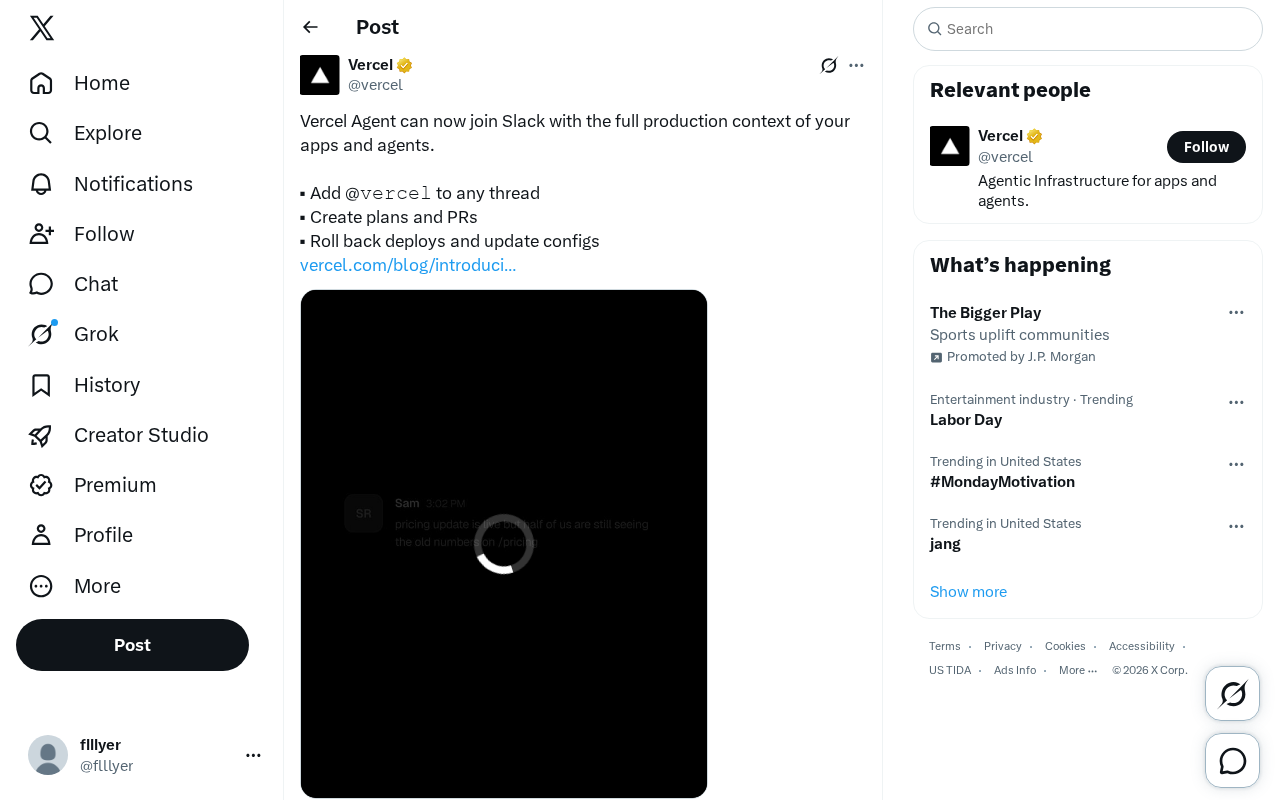
Vercel AI Agent integrates with Slack, enabling conversational management of production deployments and DevOps workflows.
Vercel's AI Agent now integrates with Slack, allowing development teams to manage production deployments, roll back releases, create Pull Requests, and update configurations through natural language conversations. This deep integration transforms the AI into a virtual team member, bridging the gap between collaboration tools and DevOps workflows. The article examines core features, technical architecture, security considerations, and the broader industry trend toward AI-native development tools.
Overview
Vercel recently announced that its AI Agent now officially supports Slack integration, allowing development teams to invoke an AI assistant directly within Slack conversations to manage production applications and AI Agents. This feature deeply integrates development and operations workflows with team collaboration tools, opening up entirely new possibilities for DevOps practices.
An AI Agent (intelligent agent) differs from a simple chatbot — it's an AI system capable of autonomously perceiving its environment, making decisions, and executing actions, with capabilities including tool invocation, multi-step reasoning, and task orchestration. As one of the world's most widely adopted enterprise collaboration platforms, Slack's open API and Bot framework — including event subscriptions, interactive message components, and OAuth permission management — provides a mature infrastructure for deep third-party integrations. By embedding an AI Agent into Slack, Vercel essentially listens for @mention events via Slack's Events API, processes intent recognition and task dispatch through a backend large language model, and ultimately executes specific operations through the Vercel platform API. This architectural design enables the Agent to both understand conversational context and precisely invoke platform capabilities.
Core Feature Breakdown
Seamless Conversational Operations
Simply @vercel in any Slack thread to summon an AI assistant with full production context. This interaction model breaks down the barriers between traditional development tools and collaboration platforms, allowing technical decisions and execution to happen within the same conversation flow.
The underlying logic behind this design is clear: when teams discuss issues in Slack, they often need to switch to other tools to perform actual operations. The Vercel Agent's involvement makes the entire process seamless — whether it's an urgent incident discussion or a feature planning meeting, the AI assistant can respond instantly and execute the corresponding actions.
Intelligent Development Workflows
The Vercel Agent can do more than just create technical plans — it can directly generate Pull Requests. This demonstrates that it has moved beyond being a mere execution tool, possessing end-to-end capabilities from understanding requirements to planning solutions. From discussion to code submission, the AI can understand team intent and produce structured implementation plans, dramatically compressing the cycle from idea to delivery.
From a technical implementation perspective, an AI Agent automatically generating Pull Requests involves multiple stages: first, it needs to understand requirements or issues described in natural language; then, through codebase context understanding (typically leveraging RAG — Retrieval-Augmented Generation — to retrieve relevant code snippets), it locates the files that need modification; next, the large language model generates code changes; and finally, it creates a branch and submits a PR via the GitHub/GitLab API. This workflow aligns with the philosophy of tools like GitHub Copilot Workspace and Cursor, but what makes the Vercel Agent unique is that it moves the trigger point forward into team collaboration scenarios, enabling non-developer roles to initiate technical change requests and further bridging the communication gap between product and engineering.
This capability is especially practical for small iterations and bug fix scenarios. When a product manager or customer reports an issue in Slack, developers can have the Agent analyze it and generate a fix proposal, which can be quickly merged and deployed after human review.
Instant Control Over Production Environments
Even more noteworthy is the Agent's direct control over production environments — rolling back deployments and updating configurations. When a production issue occurs, the team doesn't need to log into an admin dashboard; they can have the AI execute a rollback directly within a Slack discussion, dramatically improving incident response speed.
It's worth noting that in Vercel's Serverless architecture, each deployment generates an Immutable Deployment snapshot. A rollback is essentially redirecting traffic to a historical version's snapshot, which is far safer than traditional server deployment rollbacks — there's no intermediate "half-rolled-back" state. Configuration updates involve changes to environment variables, domain routing, Edge Config, and other settings. This Immutable Deployment architectural feature significantly reduces the risk of executing rollbacks via an AI Agent, since every historical version is a complete, independently functional snapshot.
Of course, this level of access also places higher demands on the Agent's reliability and security. Vercel needs to ensure the Agent accurately understands command intent to avoid misoperations that could cause even greater damage. Exposing these critical operations to an AI Agent typically requires a strict RBAC (Role-Based Access Control) model for granular permission management, along with operation audit logs to ensure every action is traceable and reviewable. Robust permission management and operational auditing mechanisms are equally indispensable.
Technical Significance and Industry Trends
The Evolution of AI-Native Development Tools
Vercel Agent's Slack integration represents a key direction in the AI transformation of development tools: rather than using AI to assist existing tools, it makes the AI itself a virtual member of the team. This "AI colleague" model is reshaping how software development teams collaborate.
Compared to traditional CI/CD tools that require writing complex configurations, AI Agents can execute complex operations through natural language, dramatically lowering the automation barrier. Traditional CI/CD (Continuous Integration/Continuous Deployment) tools like Jenkins, GitHub Actions, and GitLab CI rely on declarative YAML configuration files to define build, test, and deployment pipelines. The learning curve is steep and maintenance costs are high — a moderately sized project's CI/CD configuration files can easily run to hundreds of lines, and debugging and optimization often require dedicated personnel. The AI Agent model replaces configuration writing with natural language interaction, elevating the abstraction level of DevOps operations by an entire dimension. However, the two are not simply substitutes — AI Agents still rely on CI/CD infrastructure under the hood to execute specific tasks. It's more like adding an intelligent orchestration layer on top of existing pipelines, reducing the complexity of human-machine interaction. This is especially friendly for small teams — achieving enterprise-grade DevOps capabilities with less infrastructure investment.
The Potential and Challenges of Conversational Interfaces
Placing critical operations within a conversational interface also introduces new design challenges: How do you maintain conversational fluency while implementing sufficient confirmation mechanisms for dangerous operations? How does the AI accurately understand complex context and implicit intent? The solutions to these questions will directly influence the design paradigms of future AI tools.
When Conversational UI handles dangerous operations, the industry has already developed several mature design patterns: multi-step confirmation mechanisms require users to explicitly input confirmation commands before executing irreversible operations; operation previews display a summary of upcoming changes before execution, keeping operators fully informed; time window restrictions prevent accidentally triggered commands from executing immediately, providing a buffer period. Additionally, Slack's interactive message components (such as buttons and dropdown menus) can transform the ambiguity of natural language into structured, explicit choices, effectively reducing the risk of the AI misinterpreting commands. For example, when a user says "roll back to yesterday's version," the Agent can present a list of recent deployments for the user to click and select, rather than guessing the specific version on its own. Designing these mechanisms requires finding a delicate balance between operational efficiency and safety.
Vercel's approach may prompt more development tool platforms to follow suit. It's likely only a matter of time before GitHub, GitLab, and similar platforms launch comparable conversational AI Agents, bringing the entire software development lifecycle into an intelligent collaboration ecosystem.
Practical Recommendations
For teams considering adopting the Vercel Agent, it's advisable to start with low-risk scenarios — such as having the Agent generate technical documentation or create PRs for non-critical features. Once the team has built up trust and established best practices, gradually expand to production environment operations.
At the same time, establish clear operational guidelines that define which operations must go through human review. No matter how intelligent the AI becomes, human final judgment remains irreplaceable when it comes to critical decisions involving production environments.
Key Takeaways
Related articles

Internet Archive Fundraising Crisis: Server Operations Challenge Behind 800 Billion Archived Web Pages
The Internet Archive faces server operations funding pressure with 800 billion archived pages. Analysis of Wayback Machine cost challenges, nonprofit digital preservation survival crisis, and sustainable development paths.
Bentley Torcal EV: The Luxury Brand Transformation Challenge Behind Simulated V8 Sound
Bentley's Torcal EV features simulated V8 sound, balancing electric silence with mechanical emotion. An analysis of luxury brand identity challenges in the EV transition.
Can't Keep Up with AI Model Releases? Practical Strategies for Practitioners to Handle Information Overload
AI model releases are overwhelming. Learn how practitioners can overcome FOMO, establish evaluation criteria, filter information sources, and maintain focus amid the AI model explosion.