Vercel AI SDK Introduces TypeSafe Evaluation Provider, Reshaping How We Evaluate LLMs
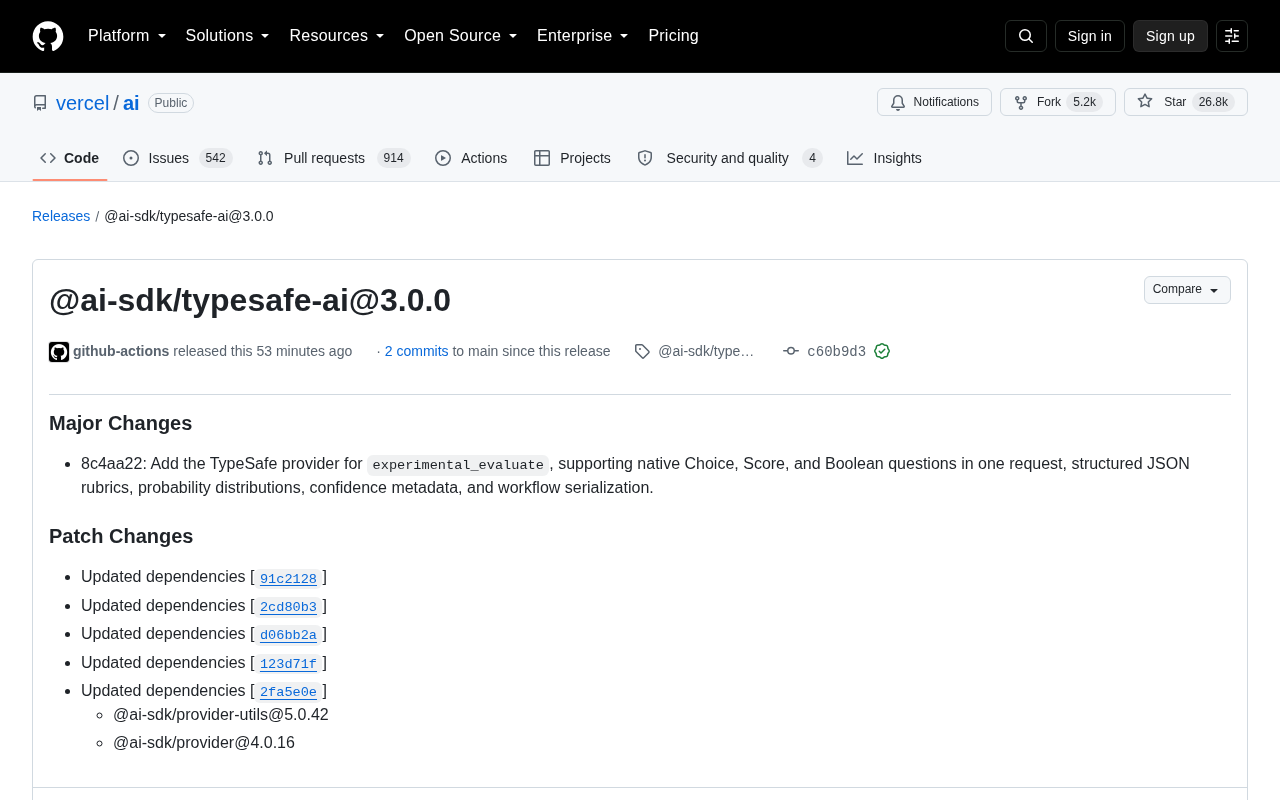
Vercel AI SDK's new TypeSafe provider standardizes LLM evaluation into a structured, type-safe engineering solution.
`@ai-sdk/typesafe-ai@3.0.0` introduces a TypeSafe provider focused on LLM evaluation, centered on the `experimental_evaluate` interface. It lets developers handle Choice, Score, and Boolean evaluations in a single request, using structured JSON rubrics with probability distributions and confidence metadata — elevating results from plain strings to quantifiable structured data. Workflow serialization enables reproducible evaluation configs, while TypeScript type safety catches errors at compile time. This release marks a meaningful step in Vercel's push to make LLM evaluation a proper engineering practice.
Vercel's AI SDK recently released @ai-sdk/typesafe-ai@3.0.0, introducing a new provider dedicated to LLM evaluation. This update centers around the experimental_evaluate interface, aiming to consolidate fragmented model evaluation workflows into a standardized, type-safe, and structured approach.
Multiple Evaluation Types in a Single Request
The most significant change in this release is the introduction of the TypeSafe provider to support experimental_evaluate. Its design goal is clear: enable developers to handle three native evaluation types — Choice, Score, and Boolean — all within a single request.
Previously, if you wanted to evaluate model output across multiple dimensions — for example, checking whether content is compliant (Boolean), rating its quality (Score), and selecting among candidate answers (Choice) — you typically had to make multiple separate calls and manually stitch the results together. The TypeSafe provider consolidates these capabilities into a single interface, reducing round-trip overhead and lowering the complexity of evaluation logic.
Structured JSON Rubrics and Probability Distributions
Beyond merging multiple evaluation types, this update introduces several features critical to reliability:
- Structured JSON rubrics: Developers can define scoring criteria using structured JSON rather than embedding judgment rules in a lengthy natural language prompt. This makes evaluation standards more consistent and reusable.
- Probability distributions: Instead of returning a single isolated answer, the model can now return probability distributions across options, helping assess how confident the model is in its conclusions.
- Confidence metadata: Further supplements each evaluation with confidence information, providing more context for downstream decision-making.
Together, these capabilities elevate evaluation results from "a string" to "structured data with statistical meaning." For teams running quality monitoring, A/B testing, or automated gating, this quantifiable output format is far easier to integrate into existing data pipelines.
Rubric is a concept borrowed from educational measurement in the LLM evaluation space. It refers to multi-dimensional, fine-grained scoring criteria for assessing output quality. The traditional approach embeds scoring rules directly into natural language prompt descriptions, but this has two clear drawbacks: subtle wording differences across calls can cause the model to misinterpret the rules, and the scoring logic cannot be directly parsed or reused programmatically. Structuring rubrics as JSON means each evaluation dimension (e.g., "logical coherence," "content accuracy") becomes a named field with explicitly configurable weights and thresholds. This not only makes it easier to align evaluation standards across teams, but also provides a machine-readable input format for statistical analysis and automated pipelines. Probability Distribution comes from the model's own token prediction mechanism — for multiple-choice questions, the model's logits over candidate option tokens, normalized via softmax, yield a probability distribution. A highly concentrated distribution indicates the model is confident in its answer, while a flat distribution signals uncertainty and warrants human review.
The Value of Workflow Serialization
This release also introduces support for workflow serialization. Evaluation is rarely a single-point operation — it's typically a multi-step process. The ability to serialize workflows means evaluation configurations can be saved, transmitted, and reproduced, making version control and team collaboration more tractable.
This aspect is often overlooked in real-world engineering, yet it directly determines whether an evaluation system can be maintained long-term. An irreproducible evaluation process fundamentally undermines the credibility of its results. The TypeSafe provider's serialization mechanism lays the groundwork for "evaluation as code" practices.
Workflow Serialization in software engineering typically refers to converting a set of operational steps and their configurations into a persistable data format (such as JSON or YAML) for storage, transmission, and replay. In LLM evaluation scenarios, a complete evaluation workflow may include: data preprocessing, multi-round evaluation calls, result aggregation, threshold judgments, and more — each stage depending on specific parameter configurations. If these steps exist only in runtime memory, maintaining consistency across environments (local development, CI/CD, production monitoring) becomes difficult. Serialized workflows can be checked into version control, making changes to evaluation standards traceable; they can also serve as part of test cases, ensuring that pre- and post-model-upgrade comparisons are conducted under identical evaluation conditions. This mechanism aligns with the philosophy of Infrastructure as Code and is a key step in evolving AI evaluation from ad-hoc scripts into a governable engineering practice.
Developer Experience Through Type Safety
The provider's name alone signals one of its key selling points: TypeSafe. In the TypeScript ecosystem, type safety directly impacts developer efficiency and error rates. When evaluation inputs and outputs have well-defined type constraints, developers can catch field mismatches and structural inconsistencies at compile time rather than waiting for runtime failures.
For teams integrating LLM evaluation into production systems, this compile-time guarantee significantly reduces debugging costs and brings evaluation code closer to the maintainability standards of regular business logic.
Other Updates and Summary
Beyond the major changes above, this release also includes several patch-level updates, primarily dependency upgrades involving underlying packages such as @ai-sdk/provider-utils@5.0.42 and @ai-sdk/provider@4.0.16.
Overall, @ai-sdk/typesafe-ai@3.0.0 reflects a broader trend: as large model applications increasingly enter production environments, "how to systematically evaluate model output" is becoming just as important as "how to call the model." By standardizing, structuring, and type-checking evaluation capabilities, Vercel is pushing LLM evaluation from a manual craft toward an engineering discipline. For developers building AI applications who struggle with a lack of reliable evaluation tools, this provider is worth paying attention to.
Note: Since this release is marked as
experimental_evaluate, the related interfaces are still in an experimental stage. Thorough stability validation is recommended before using them in production.
Related articles
Automattic Executives Signed Reciprocal Severance Agreements During Mullenweg's Brief Ouster
Automattic's CFO and General Counsel signed reciprocal severance agreements during Matt Mullenweg's brief ouster, covering one year's salary and accelerated equity vesting, raising corporate governance concerns.
H3 Singularity Optimization: 40% Speed Boost With Better Image Quality
A Reddit user's Minimax Singularity workflow tip: insert an RTX upsampler before H3 Latent for 40%+ speed gains and better quality. Covers parameters, 12-bit output, and more.
Glyph: A Multi-Strategy Agent System for Automated Enterprise Data Catalog Annotation
Glyph is a multi-strategy LLM agent system for enterprise data catalogs that automates column description generation and sensitivity ontology tagging, grounding outputs in pipeline source code to improve accuracy.