Vercel AI SDK Releases @ai-sdk/vue 2.0.260 Patch Update
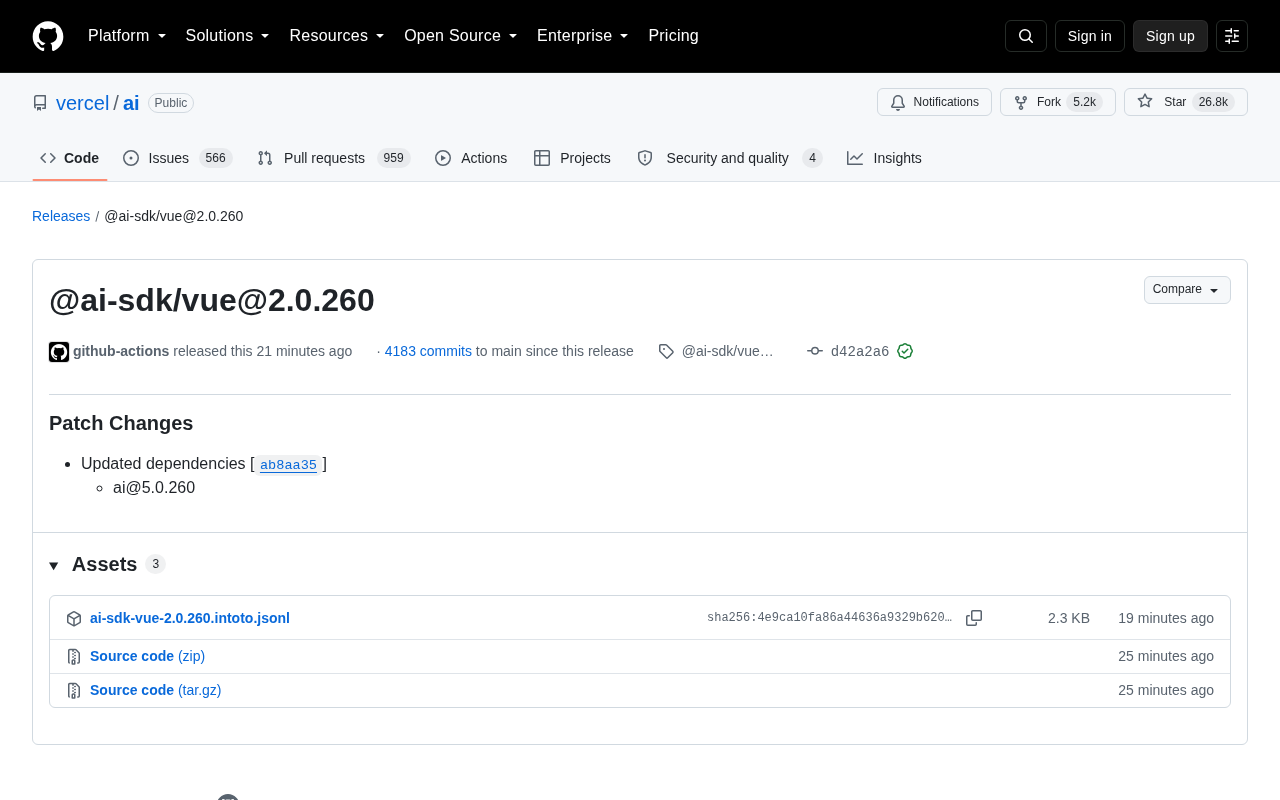
@ai-sdk/vue@2.0.260 is a pure dependency-sync patch that upgrades the core ai package to 5.0.260 with no new features.
Vercel AI SDK has released `@ai-sdk/vue@2.0.260`, a typical patch-level dependency sync update. The Vue adapter itself has no functional changes — it simply bumps the underlying core dependency `ai` to `5.0.260`. This coordinated release stems from the project's monorepo architecture, where a core package update triggers version increments across all framework bindings. The release was published via GitHub Actions with a verified trusted signature. Upgrading is generally safe, but basic regression testing is recommended.
Vercel's AI SDK project has recently released @ai-sdk/vue@2.0.260. This is a patch-level update, published in sync with the upgrade of the core dependency ai@5.0.260. For developers building AI applications in the Vue ecosystem, this update is small but represents a routine step in maintaining a stable toolchain.
What's in This Update
According to the GitHub Release page, @ai-sdk/vue@2.0.260 falls under Patch Changes, with a concise changelog: the dependency has been updated, bumping the underlying core package ai to 5.0.260.
In other words, this version introduces no functional changes to the Vue adapter layer itself. Instead, it follows the main package version to ensure that the Vue bindings stay in sync with the AI SDK's core logic. This kind of "dependency-driven release" is quite common in monorepo-managed projects — once the core package is updated, all framework adapter packages (React, Vue, Svelte, etc.) increment their version numbers in lockstep to maintain compatibility.
This version was published on September 18 via an automated GitHub Actions workflow and carries a verified trusted signature from GitHub, with a commit hash of d42a2a6. Automated signed releases are a sound practice for open-source projects to safeguard supply chain security.
What is a Monorepo? A monorepo (monolithic repository) is a project organization approach where multiple interrelated packages are managed together in a single Git repository. Vercel AI SDK uses this architecture, housing
ai(core logic),@ai-sdk/react,@ai-sdk/vue,@ai-sdk/svelte, and various model provider adapters (e.g.,@ai-sdk/openai) all in one repo, with unified builds and releases managed by tools like pnpm workspace or Turborepo. The key advantage is that type definitions and interface changes in the core package can be synchronized to all framework binding packages within a single PR, preventing version drift. The downside is that any core change triggers a version bump across all sub-packages — even if the framework adapter itself has no changes. That's exactly why@ai-sdk/vue@2.0.260was published.
What Is Vercel AI SDK
Vercel AI SDK is one of the more popular AI application development libraries in the frontend and full-stack space, having accumulated over 26.8k stars and 5.2k forks on GitHub with an active community. It provides developers with a unified interface for integrating various large language models, and simplifies common patterns like streaming responses, tool calling, and structured output.
@ai-sdk/vue is the SDK's official binding package for the Vue framework. It exposes the SDK's core capabilities — such as the useChat and useCompletion composables — in a Vue-idiomatic way, giving Vue developers the same convenient experience as React developers when building conversational AI interfaces.
What are
useChatanduseCompletion? These are two of the most central composables in Vercel AI SDK.useChatis designed for multi-turn conversation scenarios, with built-in message history management, streaming output rendering, and loading state tracking — no need to manually maintain conversation context.useCompletionis better suited for single-turn text completion tasks, such as auto-continuation or summarization. In the Vue version, both functions are provided as Composition API composables: the reactive refs they return can be bound directly to templates, used withv-forto render message lists andv-modelto bind input fields, making the overall experience highly consistent with native Vue development. The React versions of these hooks work on the same semantic principles but use a different underlying reactivity mechanism. This "same semantics, multi-framework adaptation" design is precisely the value of the SDK's monorepo multi-package architecture.
What a Patch Update Means for Developers
Looking at the version number 2.0.260, it's clear that the AI SDK iterates at a very rapid pace, with the patch number already in the hundreds. This high-frequency, small-step update cadence implies two things:
On one hand, the project is actively maintained, with timely bug fixes and dependency syncs. On the other hand, it's a reminder that in production environments, developers should pin to a specific version number or use a compatibility range (e.g., ^) to avoid unexpected behavior from frequent updates.
For projects already using @ai-sdk/vue, upgrading to 2.0.260 is generally safe — patch updates follow semantic versioning and should not contain breaking changes. However, since this update pulls in the core package ai@5.0.260, it's recommended to run basic regression tests after upgrading to confirm that critical paths like chat streams and model calls are functioning correctly.
Summary
@ai-sdk/vue@2.0.260 is a typical dependency-sync patch release with no new features — the focus is entirely on keeping version alignment with the core package ai@5.0.260. For AI developers in the Vue ecosystem, this kind of update may seem unremarkable, but it reflects the continuous healthy evolution of the entire toolchain. Developers interested in following along can watch the Vercel AI SDK GitHub repository to stay up to date on core package changes as they land.
Related articles
Three Stages of AI LLM Testing: A Practical Guide from Core Concepts to API Calls
A learning path for testers covering LLM fundamentals, prompt engineering, OpenAI SDK calls, API Key vs Token differences, streaming output, RAG, and Agent systems.
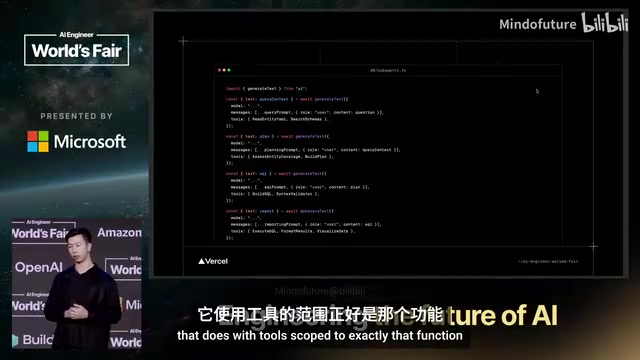
Vercel's Chief of Software Looks Back: The Evolution of Agent Building — From Multi-Agent Chains to File System Agents
Vercel's Chief of Software Andrew recaps the agent-building journey at AI Engineer: from giant prompts to multi-agent chains, monolithic memory, file system agents, and the open-source EVE framework.
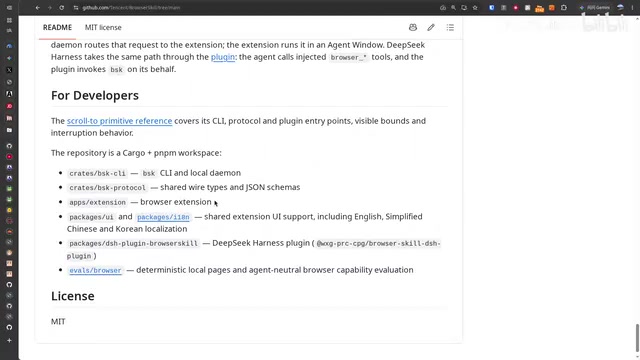
Tencent's Open-Source BSK in Action: Letting AI Take Over Your Already-Logged-In Browser
Tencent's open-source BSK (Browser Skill Kit) lets AI take over your real, logged-in Chrome via WebSocket. We break down the architecture, setup, and three key pitfalls from real-world testing.