Vercel AI SDK Releases @ai-sdk/xai 5.0.0: Chat Completions API Removed
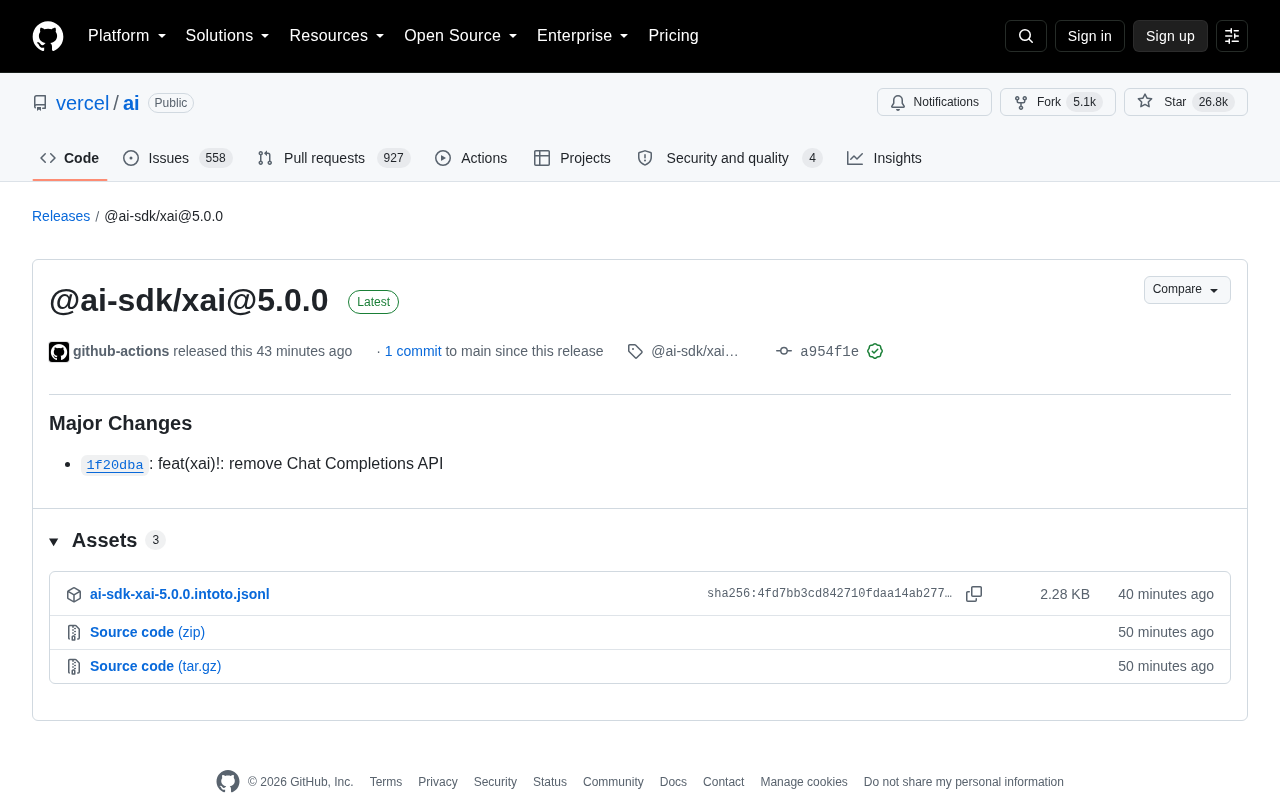
@ai-sdk/xai 5.0.0 removes the Chat Completions API — developers must migrate to unified higher-level interfaces.
Vercel AI SDK's xAI provider package `@ai-sdk/xai` has released major version 5.0.0, with the core breaking change being the removal of the Chat Completions API. Following Conventional Commits conventions, the breaking change is explicitly marked in the commit message. Projects that directly depend on this interface may fail to compile or encounter runtime errors after upgrading. Developers are advised to audit existing call paths and migrate to AI SDK's standardized higher-level APIs such as `generateText` and `streamText`. This aligns with Vercel's long-term design direction of unifying interfaces and abstracting away vendor-level differences.
Vercel's AI SDK has released @ai-sdk/xai version 5.0.0, a major version bump for the xAI provider package. According to the GitHub Release notes, this update introduces a breaking change: the removal of the Chat Completions API. For developers currently integrating xAI (Grok) models via this SDK, upgrading will require corresponding code-level adjustments.
Core Changes in This Release
The key commit (1f20dba) in the 5.0.0 release is labeled feat(xai)!: remove Chat Completions API. The exclamation mark (!) follows the Conventional Commits specification, explicitly signaling that this is a feature update containing a breaking change.
In plain terms, @ai-sdk/xai no longer supports the legacy Chat Completions interface. This type of change typically signals that the SDK's model interaction pattern is converging toward a more unified, modern API paradigm. Across the AI SDK ecosystem, Vercel has consistently pushed for higher-level abstractions like generateText and streamText to normalize differences between model providers, rather than directly exposing each vendor's specific interface format.
This release was coordinated via GitHub Actions and signed with GitHub's verified signature (GPG key ID: B5690EEEBB952194), ensuring the integrity and trustworthiness of the published artifact.
What is Conventional Commits? Conventional Commits is a lightweight Git commit message convention that conveys change semantics through structured prefixes. Common types include
feat(new feature),fix(bug fix), anddocs(documentation changes). When a change is breaking, the spec requires appending an exclamation mark after the type (e.g.,feat!) or adding aBREAKING CHANGE:footer in the commit body. Toolchains can use this to automatically determine how to increment semantic version numbers — breaking changes bump the major version, new features bump the minor version, and bug fixes bump the patch version. This convention works hand-in-hand with Semantic Versioning (SemVer) and is a mainstream practice for managing API compatibility promises in the modern open-source ecosystem.
What This Means for Developers
The major version jump from 4.x to 5.0.0 is itself a signal: read the migration notes before upgrading. Removing the Chat Completions API is a classic breaking change — projects that directly depend on this interface may fail to compile or throw runtime errors after upgrading.
For teams using xAI Grok models, here are the key areas to focus on when upgrading:
- Audit existing call paths: Identify any code that directly depends on the removed Chat Completions methods or types.
- Migrate to the unified API: Prioritize using AI SDK's standardized text generation and streaming interfaces to reduce coupling with vendor-specific API formats.
- Pin your version strategically: In production environments, consider staying pinned on
4.xuntil migration testing is complete before switching to5.0.0.
While breaking upgrades like this introduce short-term migration costs, they ultimately reduce maintenance burden and decouple business logic from specific model providers.
Context: The AI SDK Ecosystem
Vercel's AI SDK is one of the more popular AI application development libraries in the TypeScript/JavaScript ecosystem, with approximately 26,800 stars and 5,100 forks on GitHub and an active community. The SDK uses a modular design, providing separate provider packages for different model providers (such as OpenAI, Anthropic, Google, xAI, etc.). @ai-sdk/xai is the adapter layer specifically targeting xAI's Grok model series.
This split release cadence allows each provider to iterate independently, keeping pace with its corresponding vendor's API changes. The xAI provider advancing independently to 5.0.0 reflects the reality that model interfaces across providers are still evolving rapidly, and the SDK must continuously realign with upstream changes.
For developers focused on AI application engineering, actively tracking version updates across these provider packages is essential work for maintaining project stability and accessing the latest model capabilities.
About xAI xAI is an artificial intelligence company founded by Elon Musk. Its flagship language model series is called Grok, originally notable for its access to real-time data from X (formerly Twitter). xAI provides an OpenAI-compatible API interface, which was the foundation that allowed early versions of
@ai-sdk/xaito integrate via the Chat Completions endpoint. As xAI has introduced its own native API format and continued to iterate, the SDK has proactively chosen to drop direct support for the legacy Chat Completions interface and consolidate around AI SDK's own abstraction layer — keeping pace with upstream API evolution while reducing the long-term maintenance complexity that comes with maintaining compatibility shims.
Summary
@ai-sdk/xai 5.0.0 is a clear breaking release, with the core change being the removal of the Chat Completions API. Before upgrading, be sure to consult the official migration documentation and assess the compatibility of your existing code. Overall, this aligns with the AI SDK's longstanding direction of driving interface unification and abstraction — the short-term migration cost is a trade-off for a cleaner, more maintainable integration architecture.
Related articles

LynnReal-Omni: 32B Unified Video Diffusion Model Goes Open Source with Multi-Task Coverage in Four Steps
LynnReal-Omni is a 32B unified video diffusion model on MiniMax H3, covering text-to-video, pose guidance, style transfer, restoration in 4 steps. Flash version generates 540p video in 377ms on one H100.

Anthropic Co-Founder: AI 'Kill Switch' May Need to Be Mandatory by Law
Anthropic's co-founder tells the BBC that AI 'kill switches' may need to be legally mandated. We analyze the industry logic, technical challenges, and the tension between regulation and innovation.

The AI Data Center Boom Is Colliding With Cities Scarred by Heavy Industry
The AI data center boom is clashing with post-industrial communities. Philadelphia's case reveals structural conflicts between AI growth, energy use, water, and environmental justice.