Vercel AI SDK Releases @ai-sdk/xai 5.0.5: Adds Support for Grok 4.7 Model ID
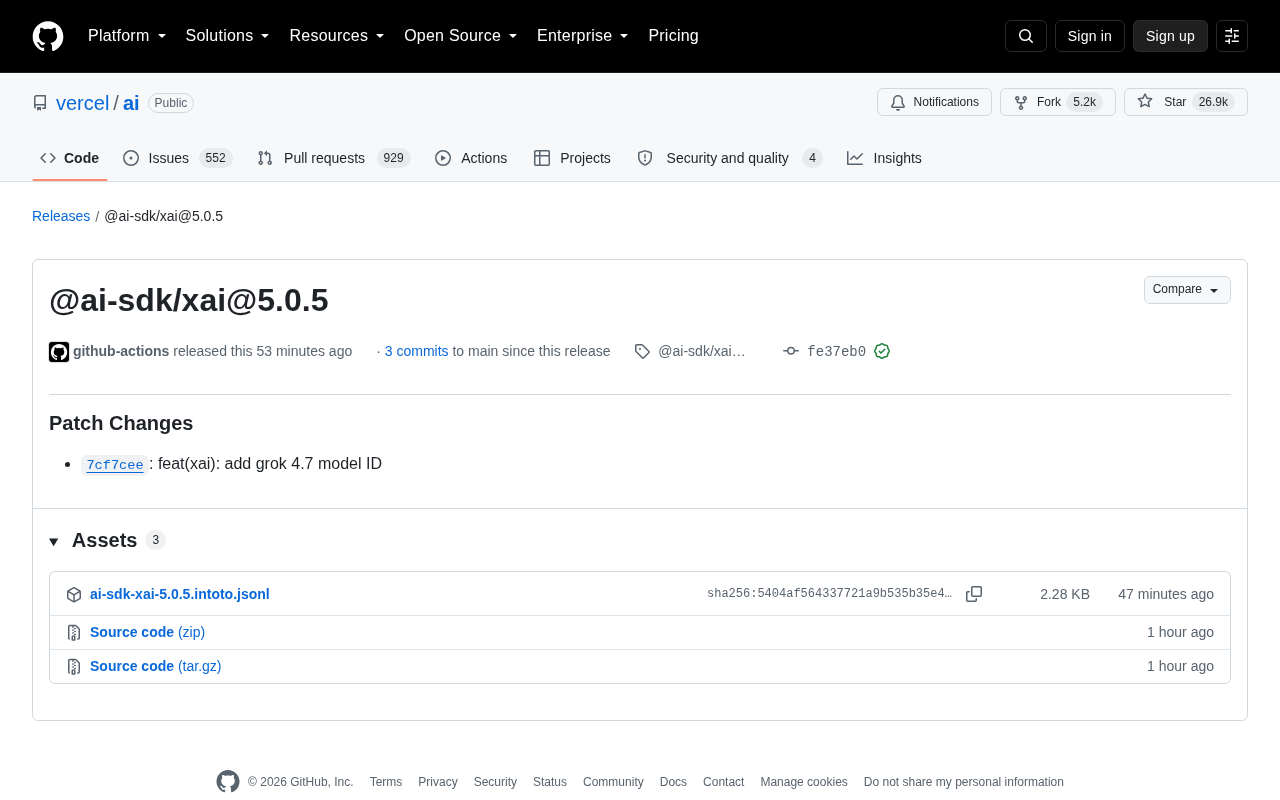
Vercel AI SDK patches xAI provider to add Grok 4.7 model ID support with zero breaking changes.
The Vercel AI SDK's xAI provider package `@ai-sdk/xai` has released version 5.0.5, with a single core change: support for the Grok 4.7 model ID. Thanks to the SDK's modular provider architecture, developers don't need to modify existing code — just upgrade the package to access Grok 4.7 via the unified API alongside GPT, Claude, and Gemini. As a SemVer Patch release, it carries no breaking changes and is safe to apply immediately. Note that the release notes don't include details on Grok 4.7's capabilities, context length, or pricing — refer to xAI's official announcements for those.
Vercel's AI SDK ecosystem recently released @ai-sdk/xai@5.0.5, a patch update. While the version bump is minor, it's a noteworthy signal for developers building with xAI's (Elon Musk's AI company) Grok model family.
What's in This Update
According to the official release notes in Vercel's ai repository, @ai-sdk/xai@5.0.5 was automatically published by github-actions as a Patch Changes release.
There's exactly one core change:
feat(xai): add grok 4.7 model ID
In short, this update adds support for the Grok 4.7 model ID in the xAI provider. This means developers using the Vercel AI SDK to call xAI models can now select Grok 4.7 directly through the standardized interface, without having to handle model identifier compatibility on their own.
Worth noting: Vercel's ai repository has garnered approximately 26,900 stars and 5.2k forks on GitHub, making it one of the most widely adopted libraries for building AI applications in the JavaScript/TypeScript ecosystem.
What Is the xAI Provider in Vercel AI SDK
Vercel AI SDK uses a modular provider architecture, packaging the capabilities of different AI vendors (OpenAI, Anthropic, Google, xAI, etc.) into separate npm packages. @ai-sdk/xai is the official adapter layer for xAI's Grok model family.
The benefit of this design: developers only need to learn one unified API (such as generateText, streamText, generateObject, etc.) to freely switch between different model providers, without writing glue code for each vendor's API differences. When xAI releases a new model, users typically just need to upgrade the corresponding provider package to get immediate access.
This 5.0.5 release is a perfect example — upgrading the provider package is all it takes to gain Grok 4.7 model ID support, with virtually no migration overhead.
Semantic Versioning (SemVer) is the widely adopted version management standard in the npm ecosystem, formatted as MAJOR.MINOR.PATCH. Patch-level upgrades are specifically for backward-compatible bug fixes or minor feature additions (like adding a new model ID), and should theoretically not break existing code. Minor upgrades add new features while maintaining backward compatibility; Major upgrades may contain breaking changes requiring active developer adaptation. Understanding this convention helps developers quickly assess upgrade risk — for Patch versions, you can generally let your CI/CD pipeline apply updates automatically without worrying about compatibility issues.
What Does Grok 4.7 Represent
From a version evolution perspective, Grok 4.7 is an iterative update within the xAI Grok 4 family. The provider layer promptly tracking new model IDs typically indicates that the model is already available or soon to be released on xAI's side.
For teams building chat assistants, agents, or content generation applications, being able to specify Grok 4.7 directly in the Vercel AI SDK means you can quickly benchmark it against GPT, Claude, Gemini, and other models in your specific business scenarios, enabling more informed model selection decisions.
It's worth noting that the release notes themselves don't disclose specific capability parameters, context length, or pricing information for Grok 4.7 — those details should be sourced from xAI's official announcements.
xAI is the AI company founded by Elon Musk in 2023. Its flagship model family, Grok, is known for integrating real-time X (formerly Twitter) data and strong reasoning capabilities. The Grok series follows an incrementing version naming convention, where decimal numbers (e.g., 4.5, 4.7) typically represent capability enhancements within the same architectural generation, as opposed to whole-number versions which indicate entirely new architectures. In the competitive AI model landscape, xAI — backed by its data synergy with the X platform and Musk's resources — has established itself as a major model provider alongside OpenAI, Anthropic, and Google. The Grok 4 series has demonstrated competitiveness across multiple benchmarks. Developers evaluating model options often include the Grok family as an alternative or complementary choice to GPT or Claude.
Practical Impact for Developers
If you're already using @ai-sdk/xai in your project, upgrading to 5.0.5 is a low-risk operation:
- This is a Patch version, following Semantic Versioning — no breaking changes expected;
- After upgrading, you can reference the Grok 4.7 model ID directly in your code;
- No changes to existing call logic required — simply switch to the new model when needed.
The upgrade itself is straightforward via your package manager:
npm install @ai-sdk/xai@5.0.5
# or
pnpm add @ai-sdk/xai@latest
Summary
@ai-sdk/xai@5.0.5 is a lightweight patch, but it reflects the Vercel AI SDK ecosystem's commitment to keeping pace with cutting-edge model releases. For developers relying on xAI Grok models, upgrading the provider package lets you access Grok 4.7 at minimal cost — which is exactly the core value proposition of a modular AI SDK architecture.
For more details, keep an eye on the official Releases page of Vercel's ai repository, as well as xAI's official announcements regarding Grok 4.7.
Related articles

iPhone Duo Review Controversy: Why Apple's First Foldable Is Said to 'Should Be Called an iPad'
The Vergecast debates the iPhone Duo review controversy: is a 7 fair? Why are apps struggling? Why critics say it 'should be called an iPad'? We unpack Apple's first foldable's positioning mismatch and first-gen compromises, plus AI security flaws and agentic shopping.

Meta vs. Publishers: The AI Data Battle Over Terms of Service Changes and the Future of the Internet
Meta changed its business account terms to allow AI training on linked website data, sparking backlash from publishers and creators. Industry groups demanded negotiations, forcing Meta to remove 'training' wording and delay the effective date. The dispute reveals the deeper battle over data authorization and the future of the internet in the AI era.

When Outside Xbox Meets Blood on the Clocktower: A Legion Match in Minecraft
Outside Xbox guests Ellen and Mike play Minecraft Blood on the Clocktower in a Legion game. How can three good players fight an evil majority amid information noise? This article breaks down Legion mechanics, information-role mind games, and the endgame reversal.